Blog · Archive
Virtual CSR 101: Comparing Options for Home Service Businesses
Is a virtual CSR more affordable than hiring in house for home service businesses seeking flexible 24/7 support?

Is a Virtual CSR More Affordable Than Hiring In House? (Quick Answer)
Is a virtual CSR more affordable than hiring in house? Yes — for most home service businesses, a virtual CSR costs significantly less than a fully loaded in-house hire, especially when you factor in taxes, benefits, equipment, office space, and the real cost of coverage gaps.
Here's a quick side-by-side to give you the bottom line:
| Factor | In-House CSR | Virtual CSR |
|---|---|---|
| Annual base cost | ~$37,000-$52,000 salary | Subscription or fractional pricing |
| Taxes + benefits added cost | +30-40% on top of salary | Not applicable |
| Weekly coverage | ~40 hours (24% of the week) | Up to 168 hours (100% of the week) |
| Sick days / PTO gaps | You absorb the cost | Covered by the service team |
| Equipment + office overhead | Your expense | Included |
| Scalability during peak season | Hire, train, and hope | Scale up or down as needed |
| Turnover risk | ~45% annual CS turnover rate | Managed by the provider |
For most HVAC, plumbing, and electrical contractors with low-to-moderate call volume, the math heavily favors virtual support — often by tens of thousands of dollars per year.
Running a home service business means your phone is your lifeline. Every missed call during a summer heat wave, a burst pipe at midnight, or a post-storm roofing emergency is a job that walks straight to a competitor. Yet the solution most owners reach for first — hiring a full-time in-house CSR or receptionist — comes with a cost that rarely shows up clearly on a job offer letter.
The salary is just the beginning. By the time you add payroll taxes, health insurance, paid time off, onboarding time, equipment, and the very real risk that your new hire quits within 90 days, that role costs far more than most contractors expect. And it still only covers 40 hours a week.
That's why so many home service business owners are taking a closer look at virtual CSR options. Whether you're considering a fractional model, a full-time virtual receptionist, or a hybrid of AI and human support, the question is the same: is a virtual CSR more affordable than hiring in house — and is it actually the right move for your business?
This guide breaks it all down clearly, so you can make a decision based on real numbers, not assumptions.
What “affordable” really means for a home service business
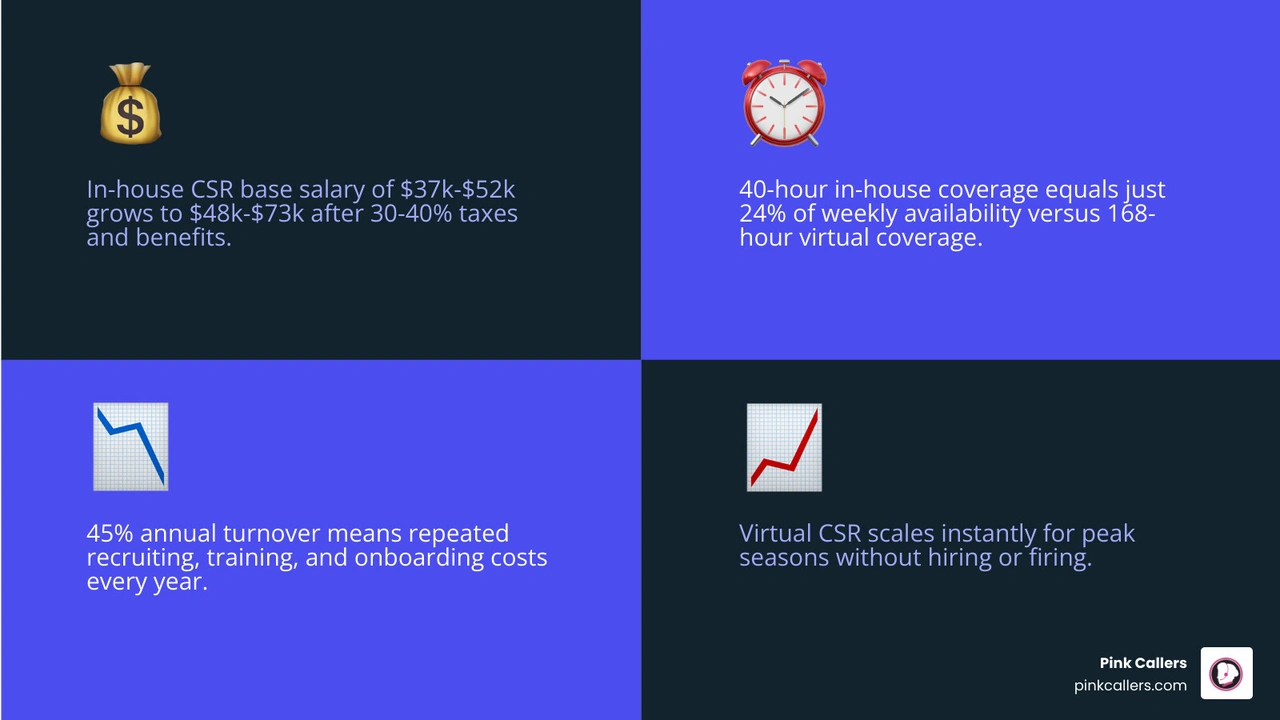
When we talk about whether a virtual CSR is more affordable than hiring in house, we have to look past the base hourly wage. For an in-house employee, the "fully loaded" cost is the real number that hits your bank account. This includes the salary burden plus an additional 30% to 40% for employer-paid payroll taxes (FICA, FUTA, SUTA), workers' compensation insurance, and health benefits.
Beyond the paycheck, you are also paying for "infrastructure." Every in-house hire needs a desk, a high-quality headset, a reliable computer, and a seat in your CRM software—like ServiceTitan or Housecall Pro. Then there is the "recruiting tax." On average, it costs thousands of dollars just to find, interview, and onboard a new employee. If that person leaves within the first few months—a common occurrence in customer service where turnover rates hover around 45%—you have to pay that recruiting tax all over again.
Is a virtual csr more affordable than hiring in house for low-to-moderate call volume?
For small to mid-sized contractors, one of the biggest drains on profit is "idle time." If you hire a full-time person but only have enough calls to keep them busy for four hours a day, you are still paying for all eight. You’re essentially paying someone to wait for the phone to ring.
A virtual CSR model solves this through a shared team or fractional approach. Instead of paying for 40 hours of "presence," you pay for the actual volume or the specific level of support you need. This is especially helpful during "shoulder seasons"—those mild spring and fall months when HVAC calls drop off. With a virtual partner, you aren't stuck with a massive fixed payroll when the weather is nice. You can find more details on how this works in our guide on How Much Does a Virtual Receptionist Cost for Contractors?.
Is a virtual csr more affordable than hiring in house when you need nights and weekends?
This is where the math becomes undeniable. A standard employee works 40 hours a week. However, there are 168 hours in a week. To cover your phones 24/7 in-house, you would need to hire at least 4.2 full-time employees to account for night shifts, weekends, holidays, and sick leave.
The cost of a 24/7 in-house team is astronomical for a local plumbing or electrical business. A virtual CSR service provides 100% coverage for a fraction of that cost. This ensures that when a homeowner calls at 2:00 AM with a localized flood, they talk to a real person who can dispatch an emergency tech, rather than hitting a voicemail that they’ll likely ignore. For a deeper look at these tiers, check out our Answering Service Pricing Guide.
The True Cost of an In-House CSR or Receptionist

Most business owners see the "tip of the iceberg"—the salary. But the "management tax" is the part that often sinks the ship. When you hire in-house, you aren't just a contractor anymore; you’re an HR manager. You have to spend time on 1-on-1 meetings, quality assurance, performance reviews, and managing interpersonal office drama.
Direct and indirect costs business owners often miss
Indirect costs can quietly eat your margins. Think about "ramp time." A new hire typically takes 6 to 8 weeks to reach full productivity. During that time, you are paying a full salary for half-speed work. There is also the cost of absenteeism. If your lone receptionist calls in sick, who answers the phones? Usually, it’s you or your top technician, which means you’re losing high-value production time to handle low-value admin tasks.
We’ve detailed these "invisible" drains in our article on the Hidden Costs of Hiring In-House vs. Virtual Support. From office coffee and electricity to the professional liability insurance required for on-site staff, the list is longer than most realize.
The continuity risks of relying on one person
Relying on a single in-house person creates a "single point of failure." If they quit, they take all their institutional knowledge with them—how you like to handle certain zip codes, which tech is best for water heaters, and the specific way you talk to "frequent flier" customers. This "context loss" is a major risk.
Virtual models provide built-in redundancy. Because you are supported by a team that follows documented Standard Operating Procedures (SOPs), the service doesn't stop if one person is out. Your "lead leakage"—the leads lost because no one was available to pick up the phone—drops to nearly zero.
Where Virtual CSR Models Win on Flexibility and Scale
In the trades, demand isn't a flat line; it’s a series of spikes. A heat wave in July can triple your call volume overnight. An in-house CSR will quickly become overwhelmed, leading to long hold times and frustrated customers.
Matching support levels to real call demand
Virtual CSRs offer the ability to scale. During a peak season, you have a "bench" of professionals ready to handle the surge. When things quiet down in the winter, you aren't stuck with the overhead of a large staff. This "on-demand" staffing is a game-changer for growth-minded contractors. You can learn more about this flexibility in our post on How Fractional CSR Services Work for Small Contractors.
Fractional CSR vs full-time virtual receptionist
It’s important to distinguish between a basic answering service and a true CSR. A virtual receptionist might just take a message. A Fractional CSR, however, has "task depth." They understand your dispatch rules, can qualify a lead based on your specific high-margin services, and enter data directly into your CRM. They aren't just "answering phones"; they are booking jobs. To see which fits your current stage of business, read our Fractional CSR vs. Full-Time Virtual Receptionist Comparison.
Why scalability matters more in HVAC, plumbing, and electrical
Homeowners in distress have zero patience. Research shows that 85% of people who don't reach a live person on the first try will not call back—they simply move to the next listing on Google. In industries like HVAC and plumbing, where the average ticket can be hundreds or thousands of dollars, a single missed call is a massive loss. Virtual models ensure that even during your busiest hour, every caller feels like your only priority. Discover how specialized support can transform your operations on our Fractional CSR Services page.
Risk, Accountability, and Data Security: Virtual vs In-House
A common concern with virtual support is: "How do I know they are doing a good job if I can't see them?" In reality, virtual models often provide more accountability than in-house staff.
Security and compliance questions to ask before choosing either model
When you work with a professional virtual CSR partner, data security is a priority. You can control permissions in your CRM, ensuring the remote team only sees what they need to. Professional services also carry their own insurance and follow strict protocols for call documentation, creating a clear audit trail that is often more organized than an in-house "paper and sticky note" system.
Accountability and performance in a remote support model
With a virtual team, you get access to data you might not be tracking in-house:
- Average Speed to Answer: How many seconds until a human picks up?
- Booking Rate: What percentage of qualified leads turned into appointments?
- Script Adherence: Is your brand voice being maintained?
Because virtual providers live and die by their performance metrics (SLAs), they often have stricter quality assurance (QA) processes than a small business owner has time to implement for one office employee.
When in-house still makes more sense
Despite the cost benefits, a virtual CSR is not always the answer. In-house hires are still superior if:
- You have high walk-in traffic at a physical showroom.
- You have a large amount of physical paperwork that must be filed manually.
- Your workflow requires the person to physically handle equipment or parts.
- You are in a highly regulated industry requiring on-site supervision for legal reasons.
ROI, Break-Even Thinking, and the Best Hybrid Approach
To decide if a virtual CSR is more affordable than hiring in house, you have to look at your Return on Investment (ROI).
How to estimate return without relying on guesswork
Calculate your "Missed Call Value." If your average job is $500 and your close rate is 25%, every missed call costs you $125 in potential revenue. If you miss just five calls a week because your in-house CSR was on lunch or the phone was busy, that's $2,500 a month in lost "found money." A virtual service that captures those calls often pays for itself within the first few days of the month.
Hybrid models that balance cost and performance
The most successful modern contractors use a Hybrid Model. They might keep one highly experienced office manager in-house to handle complex high-context relationships and strategy, while using a virtual CSR team for:
- After-hours and weekend emergencies.
- Overflow during the busy morning rush.
- Managing "live chat" and SMS leads.
- Seasonal scaling.
This approach gives you the "culture fit" of an in-house leader with the "cost efficiency" of a virtual team. For more on how to start this transition, see Why Hire a Virtual Assistant?.
A practical decision checklist for home service owners
Before you post that job ad on Indeed, ask yourself:
- Call Volume: Do I have 40 hours of actual work, or am I paying for "just in case" time?
- Booking Complexity: Can my bookings be handled by a trained professional following a script and CRM? (Usually, the answer is yes).
- Growth Forecast: Am I planning to add more trucks? If so, can my current office setup scale with them?
- Software Stack: Am I using ServiceTitan or Jobber? If so, a virtual CSR can likely plug in tomorrow.
Frequently Asked Questions About Virtual CSR Costs and Hiring
How does a virtual CSR compare to one in-house employee for 24/7 availability?
One in-house employee covers 40 hours. A virtual CSR service covers 168. To get the same 24/7 coverage in-house, you would need to hire 4 to 5 people, making the virtual option roughly 80-90% more affordable for around-the-clock peace of mind.
Can a virtual CSR handle more than just answering phones?
Yes. Modern virtual CSRs are trained in specific industries. They can manage your ServiceTitan schedule, follow up on "unbooked" leads, confirm appointments for the next day, and even handle basic dispatching rules to ensure the right tech goes to the right job.
Which industries benefit most from virtual CSR support?
HVAC, plumbing, electrical, and roofing businesses see the highest ROI. These industries are "event-driven"—people call when there is a crisis—and the ability to respond 24/7 is the difference between a thriving business and a struggling one.
Conclusion
Deciding whether a virtual CSR is more affordable than hiring in house ultimately comes down to your goals for growth. If you want to move away from being the "everything person" in your business and start operating like a scalable company, the virtual model offers a level of flexibility and cost-control that traditional hiring simply cannot match.
By eliminating the overhead of taxes, benefits, and idle time, you can reinvest those thousands of dollars back into your marketing or into hiring more revenue-generating technicians. Ready to see how the numbers look for your specific volume? Check out Pink Callers Pricing to find a plan that fits your business perfectly.
Keep reading
More from the blog
How We Handle Multi-Trade Dispatching for HVAC and Plumbing Combos
Misrouting an ambiguous 'no hot water' call wastes highly skilled technicians' time. We break down the exact intake triage rules that successfully separate plumbing from HVAC tickets.
Read → September 14, 2026Outsourced Customer Service vs Hiring a Local Temp Agency
Losing a dispatcher right before the fall heating rush can overwhelm any contractor. Compare the operational impact of a specialized call center versus a local temp worker to protect your revenue.
Read → September 11, 2026Transitioning Phone Scripts for Northeast Fall Boiler Prep
The first freeze brings a sudden wave of urgent no-heat calls that can easily overwhelm untrained CSRs. Prepare your dispatch board by strategically updating your front-office triage process.
Read →