Blog · Archive
Which Virtual Support Model is Right for Your Business Size?
Compare fractional csr vs full time virtual receptionist comparison. Find the best scalable support for home services growth, 24/7 coverage & ServiceTitan integration.

Why the Fractional CSR vs Full Time Virtual Receptionist Comparison Matters for Home Service Businesses
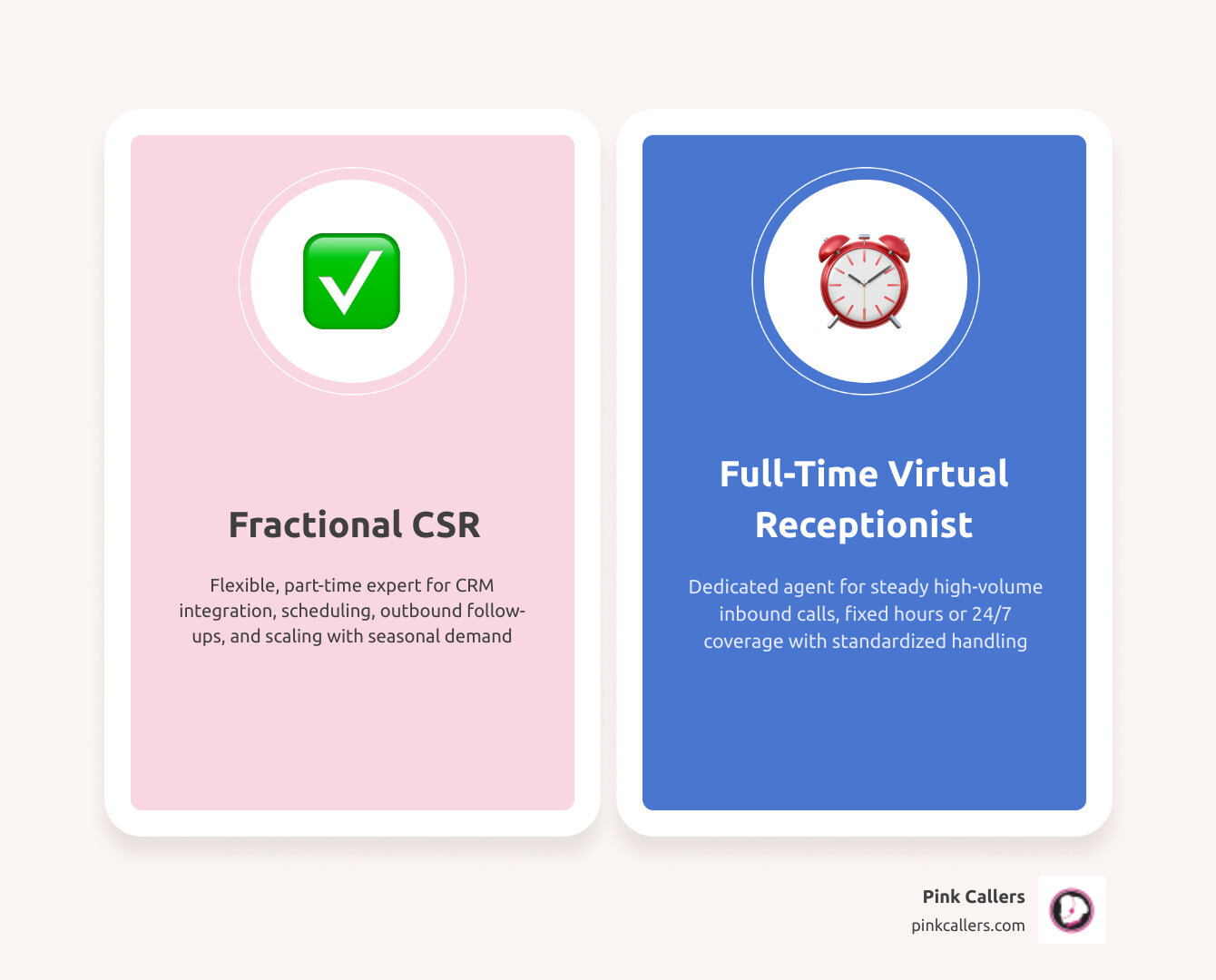
The fractional csr vs full time virtual receptionist comparison comes down to one core question: does your business need flexible, on-demand customer service expertise — or a dedicated agent handling calls around the clock?
Here's a quick breakdown:
| Factor | Fractional CSR | Full-Time Virtual Receptionist |
|---|---|---|
| Engagement model | Part-time, on-demand, scalable | Dedicated, fixed hours or 24/7 |
| Best for | Growing or seasonal businesses | Steady, high-volume call needs |
| Cost structure | Pay only for hours used | Fixed monthly rate or salary equivalent |
| Task depth | CRM updates, scheduling, outbound follow-ups, multi-channel | Primarily inbound call handling |
| Flexibility | High — scales up or down | Lower — fixed capacity |
| Integration | Deep CRM integration (e.g., ServiceTitan) | Varies by provider |
| Brand alignment | Custom scripting, industry-specific training | Standardized scripts, less customization |
You're on a job site. Your phone rings. You can't answer. That caller — a homeowner with a broken HVAC unit in July — just moved on to the next result on Google. Research consistently shows that 85% of people who don't reach a business on their first attempt won't call back. For HVAC, plumbing, and electrical contractors, that's not a minor inconvenience — it's a direct hit to revenue.
The two most common solutions business owners explore are fractional CSRs and full-time virtual receptionists. Both handle customer calls remotely. Both free you from the phone. But they work very differently, and choosing the wrong model for your business size or growth stage can leave money on the table — or have you paying for capacity you don't need.
Home service businesses face a unique challenge: call volume isn't predictable. A summer heat wave or a hard freeze can triple your inbound calls overnight. A traditional full-time hire — virtual or in-office — can't flex with that kind of demand. A fractional model can. On the other hand, businesses with consistent, high call volumes may benefit from the reliability and depth of a dedicated full-time virtual receptionist.
This guide breaks down both models clearly, so you can make the right call for your business.
Defining the fractional csr vs full time virtual receptionist comparison
In the modern landscape of April 2026, the way we manage customer interactions has evolved far beyond the traditional front-desk role. When we look at the fractional csr vs full time virtual receptionist comparison, we are essentially looking at a choice between specialized partnership and generalist support.
A Fractional CSR (Customer Service Representative) is a professional who functions as a seamless extension of your internal team but on a part-time or project-specific basis. Unlike a traditional employee, you aren't paying for "down time" when the phones aren't ringing. Instead, you are securing a slice of a highly trained expert's time. They don't just answer the phone; they live in your CRM, understand your specific trade jargon, and manage the customer journey from the first "hello" to the final follow-up.
A Full-Time Virtual Receptionist, by contrast, is often a more traditional remote role focused on high-volume call handling. While they offer the benefit of constant presence, they may lack the deep industry specialization found in the fractional model. For many service businesses, the "full-time" aspect can actually be a drawback if call volumes fluctuate wildly between seasons.
To learn more about how these specialized roles function, you can explore our Fractional CSR page.
Key Responsibilities in a fractional csr vs full time virtual receptionist comparison
When we dive into the day-to-day tasks, the differences become even clearer. A virtual receptionist is typically your "Director of First Impressions." They excel at answering basic inquiries, taking messages, and routing calls. However, a Fractional CSR takes things several steps further.
At Pink Callers, our fractional experts handle:
- Lead Qualification: Not every call is a "good" lead. Our team filters out the noise so your technicians only head to high-value jobs.
- Complex Appointment Scheduling: We don't just pick a time; we understand travel zones, technician skill sets, and job priority.
- CRM Management: Whether you use ServiceTitan or Housecall Pro, a Fractional CSR ensures every data point is captured accurately.
- Multi-Channel Monitoring: We watch your social media messages and website chats, ensuring a customer never feels ignored.
For a deeper look at these specialized functions, check out our Virtual CSR Services.
Flexibility and Scalability in the fractional csr vs full time virtual receptionist comparison
Scalability is the secret sauce for 7-figure home service companies. If you hire a full-time in-house receptionist, you are locked into a fixed cost. If you have a slow week in the shoulder season, you’re still paying that salary. If you have a massive spike in January due to a freeze, that one person will be overwhelmed, leading to long hold times—which 60% of customers cite as the most frustrating part of a service experience.
The fractional model allows you to scale up or down based on your actual needs. This resource optimization is vital for HVAC Virtual Receptionist services, where weather dictates the workflow. By choosing a fractional model, you ensure that your overhead remains lean while your capacity for growth remains unlimited.
Strategic Advantages of the Fractional Model for Home Services
For those of us in the trades, the "fractional" approach isn't just about saving money; it's about gaining an edge. When a technician is out on a job site, they shouldn't be worried about who is answering the office line or if the next job is booked correctly in the tablet.
The strategic advantages of the fractional model include:
- Access to Specialized Talent: You get CSRs who already know the difference between a heat pump and an AC condenser.
- Administrative Relief: We take over the "busy work" of CRM appending and lead tracking.
- Proactive Outbound Follow-ups: We don't just wait for the phone to ring; we call back old leads and chase down unpaid invoices.
- Reduced Overhead: No office space, no equipment costs, and no payroll taxes for a full-time hire.
Our Plumbing Virtual Receptionist services are a prime example of how this model helps contractors focus on what they do best: fixing pipes and serving customers.
Customization and Brand Alignment
One of the biggest fears business owners have when outsourcing is losing their "voice." They worry that a remote agent will sound robotic or won't understand the local culture in cities like Nashville or Fort Worth.
The fractional model prioritizes brand alignment. Because these CSRs work with fewer clients and have deeper integrations, they can master your specific brand voice. Whether you want a "neighborly and warm" tone or a "strictly professional and efficient" approach, a Fractional CSR uses custom scripting to ensure your brand identity is never compromised. This is especially critical for Roofing Virtual Receptionist services where building trust during a high-stakes emergency is paramount.
Integration with ServiceTitan and Industry CRMs
In 2026, data is king. If your answering service isn't talking to your CRM in real-time, you're creating a mountain of manual data entry for yourself later. Pink Callers is a ServiceTitan Certified Call Center, meaning our fractional team works directly inside your software.
When a call comes in, we aren't just taking a message on a sticky note. We are:
- Opening the customer's profile.
- Checking their service history.
- Booking the job directly into the dispatch board.
- Updating tags and notes for the technician.
This level of integration is a hallmark of the fractional model. If you are looking for a Fractional CSR in Dallas, you need a partner who understands that speed and data accuracy are the keys to winning the market.
Choosing the Right Model Based on Business Needs
How do you decide which side of the fractional csr vs full time virtual receptionist comparison fits your current situation? It starts with a honest needs assessment of your current metrics.
Ask yourself:
- What is my missed call rate? If you're missing more than three calls a week, you're losing revenue.
- How complex are my bookings? If you require specific technical questions to be answered before a dispatch, you need a CSR, not just a receptionist.
- Is my volume seasonal? If you're based in a place like Phoenix or Austin, your summer volume likely dwarfs your winter volume.
Suitability for Small vs. Mid-Sized Enterprises
Solopreneurs often start with basic virtual receptionists to "keep the lights on." However, as you scale toward being a mid-sized enterprise with multiple trucks, the limitations of a generalist receptionist become a bottleneck.
For businesses in growing hubs like Denver, the fractional model provides the operational efficiency needed to compete with larger national franchises without the massive payroll burden. It allows you to "punch above your weight class" by providing a level of customer service that usually requires a massive in-house team.
Response Times and Customer Satisfaction Metrics
In the service industry, speed is everything. 80% of callers who don't reach a live person won't leave a voicemail; they simply call the next person on the list.
Both models aim to reduce wait times, but the fractional model often results in higher first-call resolution. Because the CSR has access to your CRM and understands your business, they can often solve the customer's problem or book the appointment on the first interaction, rather than just "taking a message" for you to call back later. In competitive markets like Nashville, that first-call resolution is what separates the market leaders from the rest.
Frequently Asked Questions about Virtual Support
What is the main difference between a fractional CSR and a virtual receptionist?
While both work remotely, a virtual receptionist is a generalist who handles basic call answering and message taking. A Fractional CSR is a specialist who integrates deeply into your business processes, manages your CRM (like ServiceTitan), qualifies leads, and handles complex scheduling. The CSR acts as a part-time member of your actual office staff, whereas a receptionist is more of an external answering service.
How does virtual support handle after-hours emergencies?
Pink Callers provides 24/7/365 coverage. We use a hybrid model that combines our advanced AI assistant, pAIge, with human expertise. When an emergency call comes in at 2 AM—like a burst pipe or a failed furnace—we follow your specific emergency protocols to alert your on-call technician immediately, ensuring no high-value emergency lead is ever missed.
Can these models scale during peak seasons like summer or winter?
Absolutely. This is the primary advantage of the fractional model. During the "shoulder seasons," you can scale back your hours to save on costs. When the peak summer heat hits, we can ramp up our involvement to handle the surge in calls, ensuring your team stays busy without being overwhelmed by administrative tasks.
Conclusion
Choosing between a fractional CSR and a full-time virtual receptionist is a pivotal decision for your growth strategy in 2026. While a full-time receptionist offers a dedicated presence, the fractional model provides the agility, expertise, and cost-efficiency that modern home service contractors need to thrive.
At Pink Callers, we’ve perfected the hybrid model. By combining our ServiceTitan-certified human CSRs with "pAIge," our proprietary AI voice assistant, we provide a level of 24/7 coverage and CRM integration that traditional models simply can't match. We don't just answer your phones; we help you build a more profitable, scalable business.
Ready to see how the right support model can transform your operations? Explore Fractional CSR Solutions today and stop letting those valuable leads go to voicemail.
Keep reading
More from the blog
How We Handle Multi-Trade Dispatching for HVAC and Plumbing Combos
Misrouting an ambiguous 'no hot water' call wastes highly skilled technicians' time. We break down the exact intake triage rules that successfully separate plumbing from HVAC tickets.
Read → September 14, 2026Outsourced Customer Service vs Hiring a Local Temp Agency
Losing a dispatcher right before the fall heating rush can overwhelm any contractor. Compare the operational impact of a specialized call center versus a local temp worker to protect your revenue.
Read → September 11, 2026Transitioning Phone Scripts for Northeast Fall Boiler Prep
The first freeze brings a sudden wave of urgent no-heat calls that can easily overwhelm untrained CSRs. Prepare your dispatch board by strategically updating your front-office triage process.
Read →