Blog · Archive
Everything You Need to Know About How Virtual Support Helps Contractors Scale Sustainably
Discover how virtual support helps contractors scale sustainably with efficient operations, better lead conversion, and seamless growth.

Why Virtual Support Is the Scaling Secret Most Contractors Are Missing
Understanding how virtual support helps contractors scale sustainably starts with one uncomfortable truth: most contractors are losing money not because their work is poor, but because their back office can't keep up with their growth.
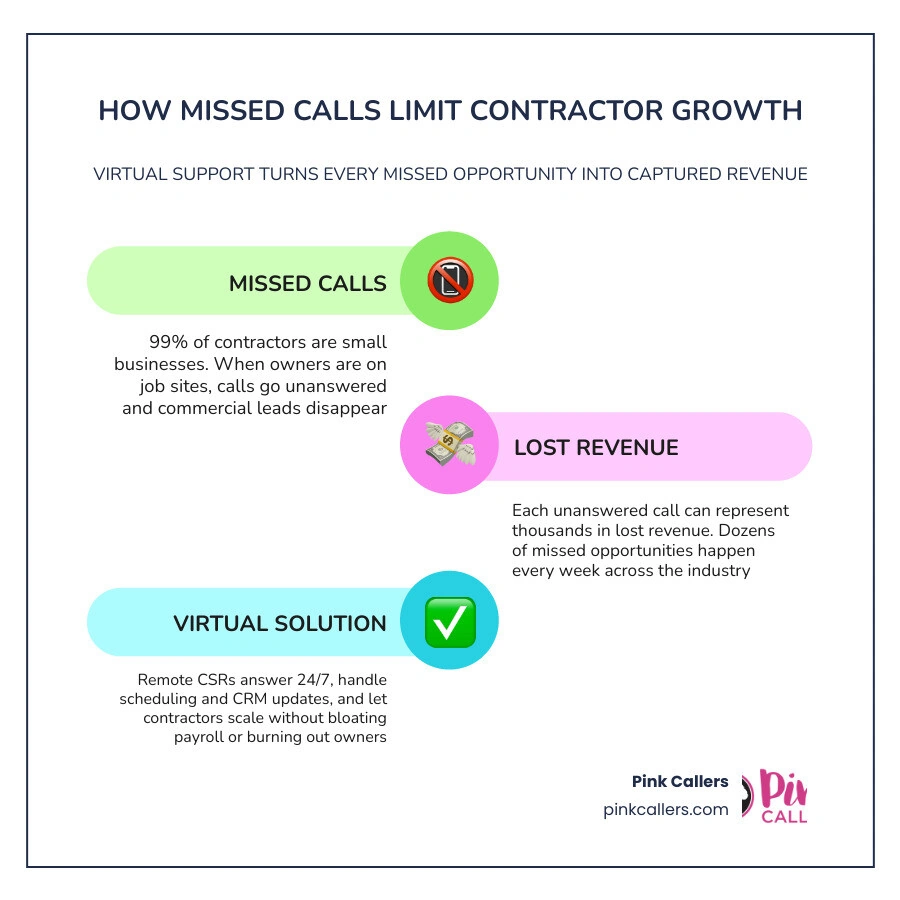
Think about it. You're on a job site at 6 PM. A potential commercial client calls. Nobody answers. They move on. That single missed call could represent thousands of dollars in lost revenue — and it happens dozens of times a week across the country.
The numbers tell the story clearly. Approximately 99% of construction businesses in the United States are small businesses. Most of them are run by owners who are simultaneously managing crews, quoting jobs, handling complaints, and trying to grow — all while answering their own phones.
That's not a growth strategy. That's a ceiling.
Virtual support changes the equation. Instead of hiring full-time office staff at significant overhead cost, contractors can tap into trained, remote customer service and administrative professionals — or a hybrid of AI and human support — to handle scheduling, lead intake, CRM updates, and client communication. The result is a leaner operation that can take on more work without burning out the owner or bloating payroll.
This guide breaks down exactly how that works, what roles virtual support covers, how it integrates with tools like ServiceTitan, and what metrics show it's actually paying off.
Quick Answer: How Virtual Support Helps Contractors Scale Sustainably
Virtual support helps contractors scale sustainably by:
- Capturing more leads — Trained virtual CSRs answer calls, texts, and messages 24/7 so no opportunity slips through
- Reducing overhead — Remote support eliminates the fixed costs of full-time in-house admin staff
- Freeing up owner time — Scheduling, dispatch coordination, and CRM updates are handled without pulling the owner off the tools
- Maintaining service quality during growth — Consistent, professional customer communication scales with job volume without requiring new hires
- Integrating with existing software — Virtual teams work directly inside platforms like ServiceTitan, Jobber, and Housecall Pro
- Supporting sustainable operations — Paperless workflows and digital processes reduce waste and improve efficiency across the business
Defining Virtual Support vs. Traditional In-House Models
To truly understand how virtual support transforms a trade business, we have to look at the math of traditional staffing. When you hire an in-house, full-time office administrator, you are purchasing block chunks of time—usually 40 hours a week. However, actual administrative demand in a contracting business rarely matches a neat 40-hour window.
In fact, across the service industry, companies that rely entirely on in-house staff often suffer from low capacity utilization. On average, capacity utilization for in-house office staff hovers around 50%. This means business owners are effectively paying for idle time when the phones aren't ringing or when technicians are fully booked. Conversely, during peak seasons, that single in-house employee is overwhelmed, leading to missed calls, dropped leads, and scheduling bottlenecks.
Ideally, a customer service representative (CSR) or scheduler should operate at 80% to 90% capacity utilization. Achieving 100% is unrealistic due to natural scheduling gaps, last-minute cancellations, and administrative transitions. Virtual support solves this structural imbalance through fractional and hybrid models.
By utilizing virtual support, you only pay for the productive capacity you actually use. Whether you need support during seasonal rushes, after-hours coverage, or a dedicated partner to handle dispatching during business hours, the virtual model scales dynamically.
To see if this path makes sense for your business, it helps to read up on whether Is a Virtual CSR More Affordable Than Hiring In-House. For many growing trade businesses, comparing a Fractional vs Full-Time CSR for Home Service Businesses reveals that paying for dedicated, on-demand support yields far better margins than taking on the fixed overhead of a local hire.
| Operational Feature | Traditional In-House Admin | Virtual Support Model (Pink Callers) |
|---|---|---|
| Capacity Utilization | Often sits around 50% (paying for idle time) | Optimized to 80–90% capacity |
| Overhead & Benefits | High (payroll taxes, benefits, office space, hardware) | Zero added overhead; fully remote |
| Availability | Strictly standard business hours (9 AM - 5 PM) | 24/7/365 coverage options |
| Scalability | Hard to scale up or down seasonally | Instantly scales with your call and job volume |
| CRM & Tool Expertise | Requires extensive, paid on-the-job training | Pre-trained and ServiceTitan certified |
How Virtual Support Helps Contractors Scale Sustainably
Sustainable scaling is about growing your top-line revenue without allowing your operational overhead to swallow your profit margins. In the contracting world, many businesses hit an "invisible ceiling." They have plenty of demand and plenty of skilled technicians in the field, but their administrative systems collapse under the weight of more jobs.
As a business grows, the customer experience often suffers. Phones ring out, follow-ups on estimates are delayed, and technicians arrive at jobs with incomplete info. This is why understanding How Contractors Can Scale Without Losing Customer Service Quality is so critical. If you don't build a scalable administrative foundation, you risk damaging the reputation you worked so hard to build.
When you look at Why Customer Service Breaks Down as Contractors Grow, the root cause is almost always resource fragmentation. Owners try to wear too many hats, and in-house staff get pulled in a dozen directions at once. Virtual support provides the dedicated focus needed to keep customer service seamless, allowing you to grow your footprint sustainably.
The Core Mechanics of How Virtual Support Helps Contractors Scale Sustainably
At its core, how virtual support helps contractors scale sustainably comes down to operational efficiency and lead conversion. When a homeowner or commercial property manager needs an HVAC technician, a plumber, or an electrician, they rarely leave a voicemail and wait. Research shows that 90% of customers rate an immediate response as important or very important when they have a service question. If you don't answer, they click the next contractor on their search page.
This is why Why Contractors Who Answer Their Own Phones Lose Leads is such a painful reality for growing businesses. If your hands are full of tools, or you are driving between jobs, you cannot provide that immediate response.
By delegating call handling and lead intake to a virtual support team, every single call is answered by a professional who knows your industry. This dramatically improves your lead-to-job conversion rate. When you calculate The Real Cost of a Missed Phone Call for Service Businesses, you realize that capturing just one or two additional high-value jobs a week easily covers the cost of your virtual support system.

Why Modern Trade Businesses Rely on How Virtual Support Helps Contractors Scale Sustainably
In 2026, the construction and trade industries are undergoing a massive digital transformation. Modern businesses are moving away from paper schedules, whiteboard dispatching, and physical invoices. Going paperless isn't just about saving trees—though with Americans throwing away paper equivalent to an estimated 1 billion trees every year, the environmental benefits of digital workflows are substantial.
For contractors, going digital is a massive productivity multiplier. For example, trade businesses that transition to paperless, digital workflows frequently see a 25% reduction in the time spent on payroll management, saving tens of thousands of dollars annually. Furthermore, digitizing accounts payable tasks can make those processes up to 99% paperless, eliminating manual data entry errors and keeping cash flow predictable.
Virtual support teams act as the champions of these digital workflows. Because they operate entirely online, they rely on cloud-based tools, real-time communication, and automated scheduling platforms. To learn more about how this shift frees up your leadership team, explore How Outsourcing Office Tasks Helps Contractors Grow. If you are looking for trade-specific growth strategies, checking out our Ultimate Virtual CSRs Guide HVAC Growth provides a clear roadmap for modernizing your operations.
Key Operational Roles Handled by Virtual Support Teams
A common misconception is that virtual support is "just an answering service." In reality, a modern virtual support team acts as the remote nerve center of your contracting business. They handle complex, multi-step workflows that keep your field technicians busy and your clients happy.
Here are the key operational roles that virtual support teams manage:
- Scheduling & Dispatch Coordination: Booking jobs, optimizing technician routes, and managing calendar changes in real-time.
- Lead Intake & Nurturing: Following up on web forms, answering live chats, and qualifying inbound leads before they go to your estimators.
- Customer Service & Reviews: Handling client inquiries, resolving minor complaints, and proactively asking satisfied customers for online reviews.
- Back-Office Administration: Processing invoices, updating job documentation, and tracking compliance requirements.
These roles are highly specialized. For example, a virtual assistant supporting a plumbing business must understand the difference between an emergency drain cleaning request and a routine water heater consultation. To see how this works in practice, read about How Virtual CSRs Help Plumbing Companies Grow. Similarly, roofing businesses have unique workflows, such as coordinating with insurance adjusters and tracking weather-dependent schedules. You can explore these nuances in our guide on How Virtual CSRs Help Roofing Companies Grow.
Overcoming Barriers to Adopting Virtual Support Systems
Despite the clear benefits, some contractors hesitate to adopt virtual support. The most common obstacle is technology resistance. Around 60% of construction and trade experts believe that resistance to new technologies is a major barrier to organizational growth. Change can feel risky when you are already busy.
Another common concern is data quality. Between 30% and 40% of construction projects and service workflows suffer from data quality problems. If a remote assistant enters the wrong address, misinterprets a trade term, or fails to update the CRM correctly, it can disrupt your entire day.
Furthermore, data security is a top priority for modern business owners; roughly 80% of construction professionals express concerns about the potential misuse of sensitive company or customer data.
To overcome these barriers, we recommend a structured approach to onboarding:
- Standardize Your SOPs: Before handing off tasks, document your core workflows. Standardizing your operating procedures ensures your virtual team knows exactly how you want your phones answered, how jobs should be scheduled, and how escalations should be handled.
- Use Secure Access Controls: You do not need to share your master passwords. Use encrypted password managers and set up role-based access controls in your CRM, allowing your virtual team to do their jobs without exposing sensitive financial details.
- Start with a Focused Scope: Begin by handing off low-risk, high-frequency tasks, such as inbound call handling or estimate follow-ups. Once your virtual support team demonstrates consistent quality, you can expand their responsibilities to dispatching and CRM management.
Integrating Virtual Support with Construction Software and Workflows
The true magic of virtual support happens when remote teams integrate seamlessly with your existing field service software. Modern contractors rely on powerful platforms like ServiceTitan, Jobber, and Housecall Pro to run their businesses. A virtual support team should not require you to learn a new system; instead, they should work directly inside the tools you already use.
At Pink Callers, our team is ServiceTitan certified. This means our virtual CSRs can log in to your account, view your live dispatch board, schedule jobs according to your routing rules, and update customer profiles in real-time.
This level of integration supports advanced operational strategies like "productization" and digital-led workflows. In the construction and trade industries, implementing digital accuracy and standardized workflows can yield incredible results:
- Productivity Gains: Digital workflows can lead to a 30% increase in overall business productivity.
- Time Savings: Engineering and scheduling time is slashed by up to 50%, while on-site installation time is reduced by up to 20% due to better coordination.
- Waste Reduction: Digital accuracy in material procurement and scheduling reduces physical waste by 5% to 20%.
- Quality Control: Standardized digital workflows can result in an 80% enhancement in overall quality by eliminating human scheduling and communication defects.
When your virtual support team handles the data entry, scheduling, and client communication directly inside your CRM, your field technicians can focus entirely on what they do best: delivering exceptional craftsmanship on-site.
Frequently Asked Questions About Virtual Contractor Support
How does virtual support improve project timelines and client satisfaction?
Virtual support acts as the communication bridge between your clients and your field crews. When a customer has a question, they get an immediate answer instead of waiting for a busy field technician to return their call.
By managing the schedule proactively, virtual assistants ensure that technicians are dispatched efficiently, reducing drive times and minimizing delays. Better route planning and immediate scheduling updates can reduce project delays and on-site installation times by up to 20%, keeping your projects on track and your customers happy.
Is my company and client data secure with a virtual support team?
Yes, provided you partner with a professional service that prioritizes data security. At Pink Callers, we use strict data protection protocols, including multi-factor authentication (MFA) and role-based access control (RBAC).
Our team members are trained in data privacy best practices, and we utilize secure password management tools so that actual login credentials are never exposed. Every team member operates under strict non-disclosure agreements to protect your proprietary business data and your customers' private information.
What metrics should I track to measure the ROI of virtual support?
To evaluate the effectiveness of your virtual support team, we recommend tracking these key performance indicators (KPIs):
- Lead Capture Rate: The percentage of inbound calls and web inquiries that are successfully answered and converted into scheduled appointments.
- Capacity Utilization: The percentage of your field technicians' billable hours relative to their total working hours, ensuring your crews are kept busy.
- Response Time: How quickly inbound messages, emails, and calls are handled.
- Customer Satisfaction Score (CSAT): Feedback from post-job follow-up calls or messages managed by your virtual team.
Conclusion
Scaling a contracting business doesn't have to mean taking on massive overhead, working 80-hour weeks, or watching your customer service quality slip. By partnering with Pink Callers, you can build a stable, scalable foundation for your business.
Our unique Human + AI Hybrid model combines our proprietary voice AI assistant ("pAIge") with experienced, empathetic, U.S.-based customer service representatives. We are fully ServiceTitan certified, meaning we can step directly into your existing workflows and start delivering value from day one. With 24/7/365 coverage and a flexible, fractional staffing model, we help you capture every lead, optimize your dispatch board, and scale your business sustainably.
Ready to take your business to the next level without the administrative chaos? More info about virtual CSR services is just a click away. Let us handle the phones so you can focus on building your legacy.
Keep reading
More from the blog
How We Handle Multi-Trade Dispatching for HVAC and Plumbing Combos
Misrouting an ambiguous 'no hot water' call wastes highly skilled technicians' time. We break down the exact intake triage rules that successfully separate plumbing from HVAC tickets.
Read → September 14, 2026Outsourced Customer Service vs Hiring a Local Temp Agency
Losing a dispatcher right before the fall heating rush can overwhelm any contractor. Compare the operational impact of a specialized call center versus a local temp worker to protect your revenue.
Read → September 11, 2026Transitioning Phone Scripts for Northeast Fall Boiler Prep
The first freeze brings a sudden wave of urgent no-heat calls that can easily overwhelm untrained CSRs. Prepare your dispatch board by strategically updating your front-office triage process.
Read →