Blog · Archive
Detailed Guide to BPO vs In-House Hiring for Contractors
Compare BPO vs hiring in house office staff for contractors to cut overhead, boost scalability, and improve customer service.

The Real Choice Behind BPO vs Hiring In-House Office Staff for Contractors
When it comes to BPO vs hiring in-house office staff for contractors, the decision comes down to one core question: do you want to own the overhead, or outsource it?
Here's a quick breakdown to help you decide:
| Factor | BPO | In-House Staff |
|---|---|---|
| Upfront cost | Lower | Higher |
| Setup time | Weeks | Months |
| Scalability | High — scale up or down fast | Low — tied to hiring cycles |
| Control | Managed via SLAs and KPIs | Direct, daily oversight |
| Recruitment burden | Handled by provider | Falls on you |
| Best for | Non-core tasks, call handling, scheduling, admin | Strategic roles needing deep company knowledge |
Running an HVAC, plumbing, or electrical business means your focus needs to stay on the job site — not on hiring, training, and managing office staff. But every missed call is a missed lead. Every scheduling gap costs revenue. And every hour you spend on admin is an hour you're not growing.
The global BPO market exploded from $92.5 billion in 2019 to $232.32 billion in 2020, and it keeps growing — because businesses across every industry are realizing that not every role needs to sit inside their four walls.
For contractors, the stakes are even higher. Seasonal spikes, 24/7 customer expectations, and lean operating budgets make this decision genuinely consequential. Get it right and you free up your team to do what they do best. Get it wrong and you're either overstaffed in the off-season or overwhelmed during peak demand.
This guide walks you through both options honestly — costs, control, scalability, security, and when each model actually makes sense for a service-based business like yours.
Terms related to bpo vs hiring in house office staff for contractors:
- business process outsourcing for home service contractors
- how outsourcing office tasks helps contractors grow
Understanding BPO vs Hiring In-House Office Staff for Contractors

To make an informed decision, it helps to understand what each model actually brings to your day-to-day operations. For a home service business, the office is the engine room. If the phones aren’t answered, the dispatch board stays empty, and the trucks stay parked.
When you evaluate your office operations, you can generally split them into two main categories:
- The Front Office: This is your customer-facing gateway. It includes answering inbound calls, responding to web leads, booking appointments, dispatching technicians, and managing customer follow-ups.
- The Back Office: This covers non-client-facing processes like updating customer relationship management (CRM) software, basic bookkeeping, processing invoices, and tracking job histories.
If you are currently wearing the hats of the dispatcher, bookkeeper, and lead technician all at once, you already know that this model isn't sustainable. To scale, you must delegate. The question is whether you build an internal team or partner with an external provider.
To explore the foundational reasons for stepping away from the "do-it-all-yourself" mindset, read our guide on Why Hire a Virtual Assistant and discover the breadth of administrative support available through modern Virtual Assistant Services.
Defining BPO vs Hiring In-House Office Staff for Contractors
Business Process Outsourcing (BPO) for contractors is the practice of delegating specific business functions to an external, specialized service provider. Instead of hiring a single person to sit in an office and handle everything, you partner with an organization that provides trained professionals, pre-built technology, and established management structures to handle those workflows for you.
In-House Hiring, on the other hand, means expanding your internal headcount. You recruit, interview, hire, and onboard permanent W-2 employees who work directly for your company, typically operating out of a local physical office or as direct remote employees under your immediate daily supervision.
Key Differences in BPO vs Hiring In-House Office Staff for Contractors
The practical differences between these two paths boil down to management, speed, and responsibility:
- Operational Control vs. Management Burden: With in-house staff, you have absolute operational control. You can walk over to their desk, adjust their posture, or hear exactly how they speak to a customer in real time. However, this comes with a massive management burden. You are responsible for their training, performance reviews, payroll management, and handling interpersonal conflicts. With a BPO provider, you manage the outcomes through Service Level Agreements (SLAs) and Key Performance Indicators (KPIs), while the provider handles the daily management, coaching, and HR headaches.
- Recruitment Cycles and Onboarding Timelines: Finding a reliable, customer-centric office employee in competitive markets like San Diego, Fort Worth, or Charlotte can take months. Once hired, you must spend weeks training them on your specific industry terminology, dispatch software, and customer service standards. If they leave, the recruitment cycle starts all over again, leading to costly operational downtime. A professional BPO provider already has a pipeline of pre-screened, trained professionals and can often deploy fully operational support in a fraction of the time.
Financial Trade-Offs: Overhead and Hidden Expenses
Many contractors look only at the hourly wage of a potential in-house employee and compare it directly to a BPO service rate. This is a classic financial trap. The true cost of an in-house employee is their "fully loaded" cost, which includes a mountain of hidden overhead and administrative expenses.
When you hire an in-house office worker, you aren't just paying their base salary. You are also paying for:
- Recruitment and Onboarding: Job board postings, background checks, drug screenings, and the valuable hours you spend interviewing candidates instead of bidding on high-value contracting jobs.
- Employee Benefits and Taxes: Employer-paid FICA taxes, workers' compensation insurance, health insurance contributions, paid time off (PTO), sick leave, and retirement contributions.
- Office Space and Equipment: A physical desk, an ergonomic chair, a reliable computer, dual monitors, a physical phone system, and high-speed internet.
- Software Licenses: Every in-house employee needs their own seat in your dispatch software, CRM, email client, and VoIP phone system. These monthly subscription fees add up rapidly.
- The Cost of Idle Time: You pay an in-house employee for an 8-hour day regardless of whether the phones are ringing. During seasonal dips, you are still paying for idle hours.
Conversely, a BPO provider wraps these costs into a structured, predictable service model. You do not pay for their computers, their health insurance, or their office space.
To dive deeper into the unseen financial drains of building an internal team, read about the Hidden Costs of Hiring In-House vs Virtual Support. Furthermore, the alternative to paying for support—simply letting the phone ring when you're busy—is incredibly expensive. Learn about those financial consequences in The Real Cost of a Missed Phone Call for Service Businesses.
Below is a qualitative comparison of the financial and resource commitments required for each model:
| Cost Category | In-House Hiring Model | BPO / Virtual CSR Model |
|---|---|---|
| Recruitment & Hiring | High (advertising, screening, background checks) | Zero (handled entirely by the provider) |
| Workspace & Hardware | High (desks, computers, phones, office space lease) | Zero (infrastructure is provided by the partner) |
| Software & Licensing | High (individual user licenses for CRM, phone, etc.) | Minimized (often integrated or shared access structures) |
| Benefits & Payroll Taxes | High (health insurance, PTO, FICA, workers' comp) | Zero (responsibility of the BPO employer) |
| Management Overhead | High (requires ongoing supervision, training, HR) | Low (managed by BPO supervisors and QA teams) |
| Capacity Utilization | Low (you pay for 100% of the shift, even during idle hours) | High (scalable models ensure you pay only for active coverage) |
Control, Scalability, and Security for Service Businesses
Beyond the financial math, you must evaluate how each model affects your ability to scale, your operational control, and your data security.
Scalability and Flexibility
In the home services industry, demand is highly volatile. An HVAC contractor in Nashville or Jacksonville might be overwhelmed with emergency calls during a summer heatwave, only to experience a significant drop-off in mid-autumn.
If you rely entirely on in-house staff, you face a painful dilemma: do you hire extra staff to handle the summer rush (knowing you may have to lay them off or pay for idle time in the autumn), or do you keep a skeleton crew and let lucrative leads go to voicemail?
A BPO model provides the ultimate scalability. It allows you to scale your support up or down based on seasonal demands without the emotional and financial strain of hiring and firing.
To understand how this fits your specific stage of growth, check out Is Outsourcing Customer Service Right for My Business Size.
Quality Control and CRM Integration
A common fear among contractors is that an outsourced team won't understand their business or will make a mess of their scheduling system. This is why choosing a generic BPO provider can be risky.
However, a specialized contractor BPO provider operates as a seamless extension of your business. By utilizing industry-specific workflows and integrating directly with leading CRMs like ServiceTitan, specialized virtual CSRs can book jobs, dispatch technicians, and update customer accounts in real-time—exactly like an in-house employee would, but with built-in supervisor oversight to maintain quality control.
To explore how these workflows keep your business moving forward, read How Outsourcing Office Tasks Helps Contractors Grow.
Data Security and Compliance
Whether your office is in Middleburg VA, Fort Worth, or Charlotte, protecting your customers' personal data and payment information is critical.
Some contractors assume that keeping data in-house is inherently safer. However, physical offices often lack strict data security protocols—passwords written on sticky notes, unlocked computers, and unsecured paper files are common.
Established BPO providers utilize secure, enterprise-grade cloud infrastructures, single sign-on (SSO) systems, strict physical access controls, and continuous activity monitoring to ensure customer information remains completely confidential and compliant with modern security standards.
Frequently Asked Questions About Contractor Outsourcing
Choosing between these two models involves answering several practical questions about your daily workflows and long-term business goals.
When is it better to hire in-house office staff instead of using a BPO?
Hiring in-house office staff makes the most sense when you are filling highly strategic, specialized, or hands-on roles that require physical presence and direct, face-to-face daily interaction.
For example, a high-level Operations Manager who physically inspects equipment, manages local fleet logistics, or conducts in-person training for your field technicians needs to be an in-house hire. Similarly, if your business processes involve highly complex, proprietary workflows that cannot be easily documented into Standard Operating Procedures (SOPs), keeping those roles internal provides the close supervision you need.
How do BPO providers handle data security compared to in-house teams?
Professional BPO providers typically maintain far more robust data security protocols than the average small-to-mid-sized contractor's physical office. They operate within secure, restricted-access facilities where personal devices are prohibited in work areas.
Their digital infrastructure includes secure virtual private networks (VPNs), disabled USB ports to prevent data extraction, multi-factor authentication, and continuous activity monitoring software. Because their reputation depends entirely on security, they implement strict compliance frameworks that protect your customer database far more effectively than an unsecured local office computer.
Can contractors combine in-house teams with fractional BPO services?
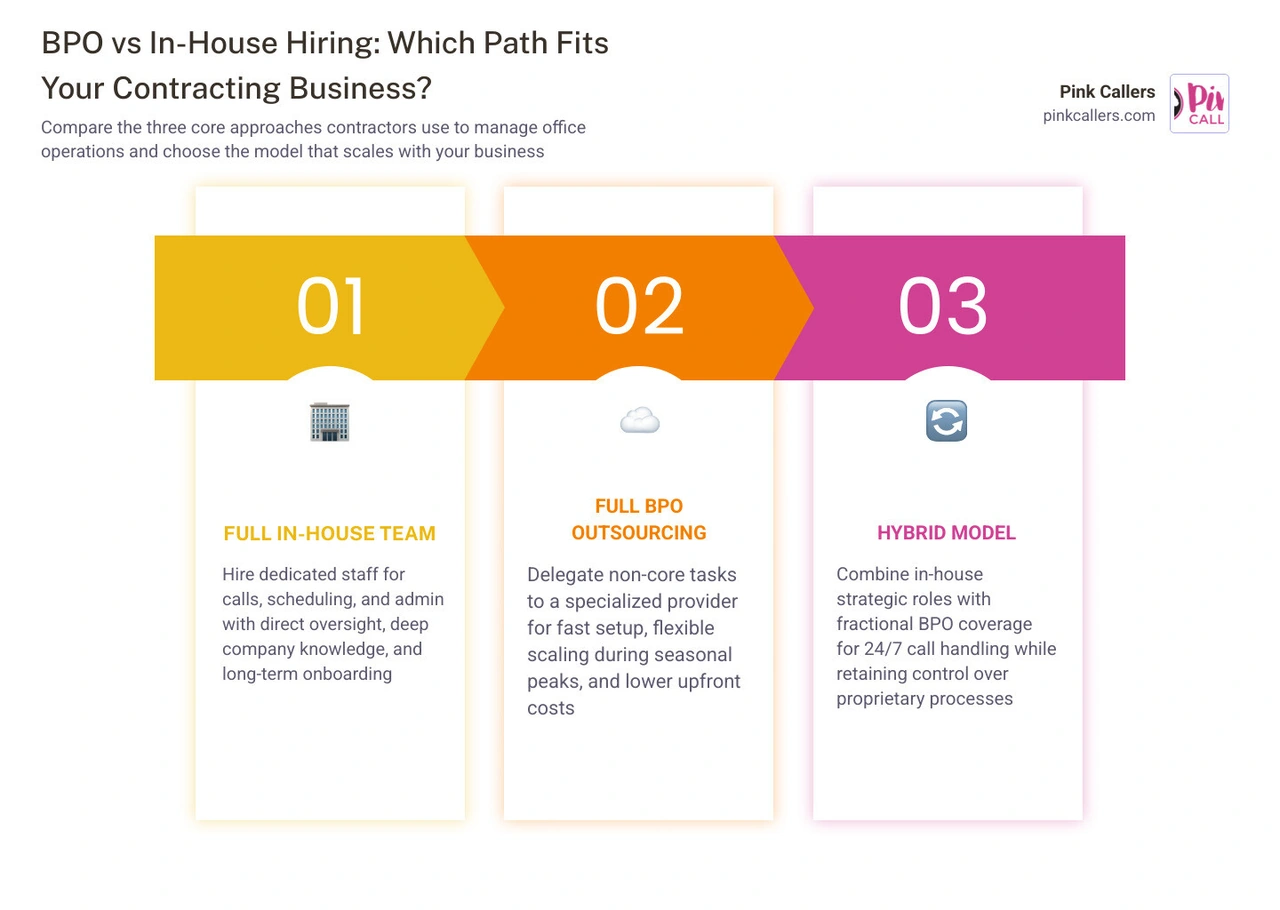
Absolutely. In fact, a hybrid model is often the most efficient and cost-effective strategy for growing service businesses. In this setup, you keep a lean, highly skilled in-house team—such as a single office manager or senior dispatcher—to handle complex customer issues, face-to-face technician relations, and high-level strategy.
You then utilize fractional BPO services to handle the high-volume, repeatable tasks like:
- Answering overflow calls during peak morning hours so your office manager isn't interrupted.
- Providing 24/7/365 coverage for night, weekend, and holiday emergency calls.
- Managing outbound lead follow-ups and appointment confirmations.
To compare these models and see how they can work together, read our detailed breakdowns:
- Fractional vs Full-Time CSR for Home Service Businesses
- Fractional CSR vs Full-Time Virtual Receptionist Comparison
- How Fractional CSR Services Work for Small Contractors
Conclusion
Deciding between bpo vs hiring in house office staff for contractors is not just a tactical choice—it is a long-term strategic decision that shapes the growth trajectory of your business. If your goal is to stay lean, eliminate the headaches of constant recruitment, and ensure your phones are answered 24/7/365 without burning out your team, partnering with a specialized BPO provider is the smartest move you can make.
At Pink Callers, we provide the ultimate middle ground: a unique Human + AI Hybrid model designed specifically for HVAC, plumbing, electrical, and roofing contractors. By pairing our advanced voice AI assistant, "pAIge," with our highly trained, ServiceTitan-certified virtual CSRs, we deliver seamless CRM integration, real-time scheduling, and 24/7/365 coverage.
You get the professional representation and deep industry knowledge of a dedicated in-house team, paired with the cost-efficiency, reliability, and effortless scalability of a world-class BPO partner.
Ready to stop chasing missed calls and start scaling your home service business? Visit Pink Callers today to schedule a consultation and discover how we can help you grow.
Keep reading
More from the blog
How We Handle Multi-Trade Dispatching for HVAC and Plumbing Combos
Misrouting an ambiguous 'no hot water' call wastes highly skilled technicians' time. We break down the exact intake triage rules that successfully separate plumbing from HVAC tickets.
Read → September 14, 2026Outsourced Customer Service vs Hiring a Local Temp Agency
Losing a dispatcher right before the fall heating rush can overwhelm any contractor. Compare the operational impact of a specialized call center versus a local temp worker to protect your revenue.
Read → September 11, 2026Transitioning Phone Scripts for Northeast Fall Boiler Prep
The first freeze brings a sudden wave of urgent no-heat calls that can easily overwhelm untrained CSRs. Prepare your dispatch board by strategically updating your front-office triage process.
Read →