Blog · Archive
How Virtual Receptionists Learn Your Business and Brand Voice
Discover how virtual receptionists learn your business and brand voice during onboarding to deliver consistent, personalized customer experiences.

Why How Virtual Receptionists Learn Your Business and Brand Voice Matters More Than You Think
Understanding how virtual receptionists learn your business and brand voice is critical if you want every caller to feel like they reached your team — not a stranger reading from a generic script.
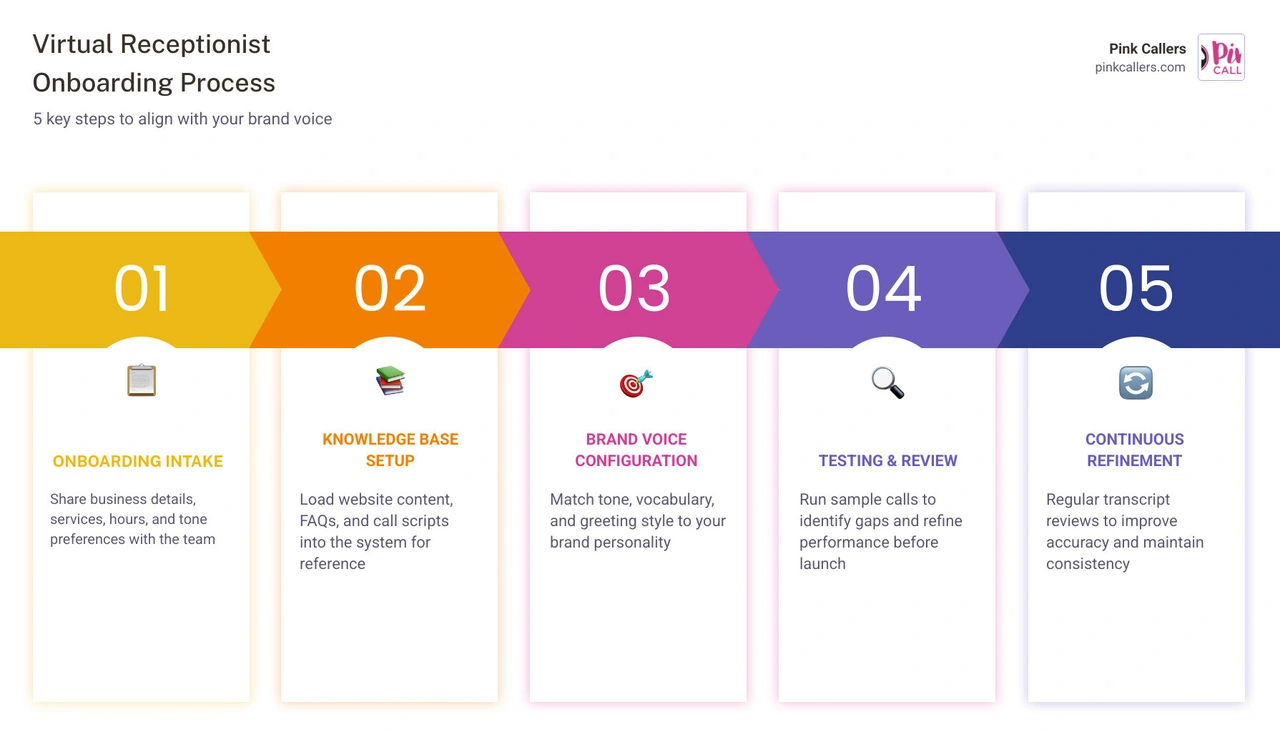
Here's a quick overview of the process:
- Onboarding intake — You share your business details, services, hours, and tone preferences
- Knowledge base setup — Your website, FAQs, and call scripts are loaded into the system
- Brand voice configuration — Tone, vocabulary, and greeting style are matched to your brand personality
- Testing and review — Sample calls are run to catch gaps before going live
- Continuous refinement — Call transcripts are reviewed regularly to improve accuracy over time
For HVAC, plumbing, and electrical contractors, this matters enormously. Missed calls cost real revenue — in fact, 76% of callers will hang up without leaving a voicemail if no one answers. And 28% of callers will abandon a brand entirely after just one bad experience.
Your phone is often the first impression a customer gets of your business. A virtual receptionist who sounds confident, knowledgeable, and on-brand can turn that first call into a booked job. One who sounds robotic or uninformed can send that customer straight to a competitor.
The good news? Modern virtual receptionist services — especially hybrid models that combine AI with trained human CSRs — are built to sound and act like a natural extension of your team. But that doesn't happen by accident. It happens through a deliberate training and onboarding process.
Understanding the Difference: Virtual Receptionist vs. Traditional Answering Service
Before diving into how a virtual team learns your specific voice, we need to clear up a common misconception. Many business owners confuse virtual receptionists with traditional answering services. While both handle phone calls, they operate in completely different leagues.
A traditional answering service is essentially a message-taking utility. Operators sit in massive, generic call centers, answering phones for hundreds of different companies spanning dozens of unrelated industries. They use rigid, bare-bones scripts: "Thank you for calling. What is your name and number? Someone will get back to you." They do not have access to your calendar, they cannot answer technical questions about your plumbing or HVAC services, and they certainly cannot navigate your CRM.
This is a major problem for modern home service businesses. Research shows that 67% of callers will hang up immediately if they reach an automated machine or a highly robotic, unhelpful operator. When a homeowner in Charlotte or Fort Worth has a burst pipe or an air conditioner failure in the dead of summer, they do not want to leave a message. They want a solution, and they want it now.
A virtual receptionist, on the other hand, operates as a seamless, integrated extension of your local office. They are trained, professional Customer Service Representatives (CSRs) who understand your industry's terminology, have direct access to your scheduling software, and know how to guide a customer from an initial inquiry to a booked appointment. Whether you need a full-time presence or prefer a flexible, fractional approach, a virtual receptionist represents your brand with the same care as an in-house employee.
To understand which model fits your business best, you can read our deep-dives on How a Virtual Receptionist Differs from an Answering Service and explore the Fractional CSR vs Full Time Virtual Receptionist Comparison.
Here is a quick breakdown to illustrate how these options compare:
| Feature | Traditional Answering Service | In-House Receptionist | Virtual Receptionist (Pink Callers Hybrid) |
|---|---|---|---|
| Primary Goal | Take basic messages & deliver call logs | Manage local office, dispatch, & answer calls | Book appointments, qualify leads, & sync CRMs |
| Industry Expertise | Generic (none) | High (highly trained) | High (industry-specific training) |
| CRM Integration | None | Direct access | Deep integration (e.g., ServiceTitan, Jobber) |
| Availability | Usually 24/7 (basic message taking) | Standard business hours only | 24/7/365 comprehensive coverage |
| Cost Efficiency | Low cost, but low lead-to-booking ROI | High overhead (salaries, benefits, training) | Highly scalable, fractional, and cost-effective |
| Brand Voice Alignment | Extremely low | Very high | Exceptionally high (structured onboarding) |

How Virtual Receptionists Learn Your Business and Brand Voice
Your brand is more than just a logo on your service trucks in Nashville or San Diego; it is the feeling your customers get when they interact with your team. This is why many contractors ask: Can a Virtual CSR Really Represent My Brand?
The answer is yes — but only if there is a rigorous, structured process to download your business’s DNA into the receptionist's workflow. We don't just put warm bodies on the phone and hope for the best. Instead, we use a systematic onboarding strategy to ensure that whoever answers the call sounds like they are sitting right in your local office.
Step-by-Step: how virtual receptionists learn your business and brand voice during onboarding
The learning process begins the moment you partner with us. We treat this phase as a structured "knowledge transfer" designed to capture every detail of your business operations.
- Step 1: The Brand Voice Intake: We gather your documented brand guidelines, preferred greetings, and general communication style. Do you prefer a warm, southern, conversational greeting in Jacksonville, or a crisp, highly professional, direct approach in Middleburg? We establish these guardrails early.
- Step 2: Digital Asset Scraping & Review: We analyze your existing website, customer reviews, and marketing materials. This helps us capture the exact phrases, service descriptions, and local landmarks you use to describe your service areas.
- Step 3: Vocabulary and Tone Mapping: We define your brand’s personality across a spectrum (e.g., Chatty vs. Formal, Detached vs. Warm). We also identify "words to use" and "words to avoid." For example, if you prefer calling your customers "guests" or your technicians "specialists," we program those exact preferences into our training protocol.
- Step 4: Interactive Simulation: Before taking a single live call, our team conducts mock calls to test scenarios, refine pronunciation, and ensure the conversational pacing matches your expectations.
Aligning with your mission, values, and unique selling proposition
A great virtual receptionist doesn't just read a script; they understand why your company exists and what makes you different from the shop down the street.
During the onboarding phase, we take the time to study your mission statement, core values, and Unique Selling Proposition (USP).
- If your USP is "We guarantee same-day service for all electrical calls in Charlotte," our virtual receptionists are trained to lead with that promise during high-intent calls.
- If your company values prioritize "honesty and upfront pricing," we train our team to handle pricing inquiries with absolute transparency, giving approved price ranges rather than evasive answers that frustrate callers.
By aligning every interaction with your core business values, we build immediate customer trust, which is essential when 93% of consumers say online reviews and initial brand trust influence their purchasing decisions.
Managing call scripts, FAQs, and customer interactions
To maintain absolute brand consistency, we build a robust, dynamic knowledge base that guides every customer interaction. Rather than relying on rigid, robotic scripts that make customers hang up, we use flexible decision trees and comprehensive FAQ databases.
We compile your top 20 to 50 most frequently asked questions, including details like:
- What are your standard hours of operation for non-emergency plumbing in Fort Worth?
- Do you offer financing options (e.g., GreenSky), and how can customers apply?
- What geographic boundaries define your service area, and do you charge a travel fee outside of them?
- What is your policy on booking fees, diagnostics, and dispatch fees?
By having these answers readily accessible, our virtual receptionists can resolve customer questions on the spot, ensuring a seamless, satisfying interaction that protects your brand's reputation.
The Tech and Tools Driving Brand Voice Customization
Behind every successful virtual receptionist is a powerful suite of modern technology. We don't just rely on manual notes; we leverage advanced digital tools, custom integrations, and intelligent automation to make our virtual CSRs perform as a cohesive unit.
Leveraging AI, NLP, and CRM integrations for seamless operations
We utilize advanced Natural Language Processing (NLP) and Artificial Intelligence to streamline call routing, transcribe conversations, and extract key customer details in real time. This ensures that when a caller speaks, the system immediately understands the context of their request.
The real magic, however, happens through deep CRM integrations. For home service businesses, having a virtual receptionist who can navigate your dispatch software is a game-changer. Our team is specifically certified in ServiceTitan, Jobber, and Housecall Pro.
This means we don't just take messages; we work directly inside your system to:
- Verify customer history and account details instantly.
- Check real-time technician availability.
- Book appointments directly onto your dispatch board according to your specific scheduling rules.
- Log detailed, accurate call summaries so your field technicians have all the context they need before they arrive at the job site.
To see how this works in practice, explore How Does AI Call Handling Work for Home Service Businesses, dive into How a Virtual Receptionist Works Inside ServiceTitan, and learn about Choosing the Right CRM Integration for Your Virtual Team.
Maintaining consistency: how virtual receptionists learn your business and brand voice through continuous training
Learning your brand voice is not a "one-and-done" project. It is an ongoing process of optimization and refinement.
To ensure our virtual receptionists remain perfectly aligned with your business as you grow, we implement a continuous learning loop:
- Weekly Transcript Reviews: We regularly analyze recorded calls and transcripts to identify any communication gaps, phrasing issues, or missed booking opportunities.
- Knowledge Base Updates: Whenever you add a new service, change your seasonal hours, or adjust your service areas in Virginia, we update your digital profile instantly so our team has the most current information.
- Quality Assurance Audits: Our dedicated QA managers review calls to ensure our high standards of empathy, clarity, and professionalism are met on every single interaction.
Seamless escalation to human staff without losing brand identity
No matter how advanced technology becomes, there will always be complex, high-stakes situations that require immediate, hands-on human attention. The secret to an exceptional customer experience is knowing exactly when and how to transition a call from automated systems to a live human expert.
This is why we champion a hybrid model. If our AI assistant, "pAIge," handles a routine inquiry but detects a high-priority emergency — such as a customer in Nashville reporting a gas leak or active water flooding — the system executes a seamless, warm live transfer.
The customer is immediately connected to a live, empathetic U.S.-based CSR or your designated on-call technician, without having to repeat their problem. This keeps the customer calm, resolves the emergency rapidly, and preserves your brand's reputation for outstanding service. You can learn more about this approach in our guide on What is a Hybrid AI and Human Customer Service Model.
Frequently Asked Questions About Virtual Receptionist Training
How long does it take for a virtual receptionist to learn my brand voice?
The onboarding and training timeline can vary depending on the complexity of your business, but our structured process is designed for speed and efficiency.
- Initial Setup (30 to 60 minutes): We configure your foundational business details, including your exact company name, hours of operation, service areas, and primary contact details.
- Knowledge Base Building (2 to 3 hours): We import your existing website content, FAQs, and custom call handling preferences into our system.
- Go-Live (Within 24 Hours): In most cases, our hybrid virtual receptionists can begin answering your calls and booking appointments within 24 hours of initiating onboarding, with performance continually optimizing over the first two weeks.
What are the common mistakes businesses make when implementing a virtual receptionist?
While a virtual receptionist is incredibly powerful, its success depends on clear communication and realistic expectations. The most common pitfalls include:
- Providing Vague Instructions: Telling us to "just book appointments" without defining your scheduling rules, buffer times, or dispatch preferences can lead to scheduling conflicts.
- Overcomplicating Initial Scripts: Trying to train the virtual team on highly complex, rare technical scenarios on day one can slow down response times. It is best to start with your top 20 most common FAQs and expand over time.
- Forgetting to Update the Team: If you run a seasonal promotion in San Diego or change your emergency dispatch rates in Charlotte, but forget to update our knowledge base, it can lead to inconsistent information being shared with callers.
How do virtual receptionists help with lead capture and appointment booking?
Every missed call is a missed revenue opportunity. When a homeowner calls a contractor, they rarely leave a voicemail; they simply call the next business on their search results list.
Our virtual receptionists prevent this leakage by providing immediate, 24/7/365 coverage. We actively capture leads, qualify them based on your specific criteria, and book them directly into your CRM. Furthermore, we help reduce appointment no-shows — which can be as high as 20% in some service sectors — by sending automated reminders and confirmation texts.
To see how virtual CSRs can fuel your specific trade's growth, check out our comprehensive industry guides:
- Ultimate Virtual CSRs Guide HVAC Growth
- How Virtual CSRs Help Plumbing Companies Grow
- How Virtual CSRs Help Roofing Companies Grow
Conclusion
Your brand voice is one of your business's most valuable assets. Handing your phones over to an outside service can feel daunting, but with the right partner, it becomes your greatest competitive advantage.
At Pink Callers, we have mastered the art and science of how virtual receptionists learn your business and brand voice. By combining our proprietary voice AI assistant, "pAIge," with our elite, ServiceTitan-certified human CSRs, we deliver a seamless, professional experience to every single caller. We ensure your phones are answered 24/7/365, your schedule stays full, and your brand reputation remains spotless.
Ready to stop missing high-value leads and start scaling your home service business? Discover how our team can integrate directly into your operations by exploring the Pink Callers Virtual CSR Services page today!
Keep reading
More from the blog
How We Handle Multi-Trade Dispatching for HVAC and Plumbing Combos
Misrouting an ambiguous 'no hot water' call wastes highly skilled technicians' time. We break down the exact intake triage rules that successfully separate plumbing from HVAC tickets.
Read → September 14, 2026Outsourced Customer Service vs Hiring a Local Temp Agency
Losing a dispatcher right before the fall heating rush can overwhelm any contractor. Compare the operational impact of a specialized call center versus a local temp worker to protect your revenue.
Read → September 11, 2026Transitioning Phone Scripts for Northeast Fall Boiler Prep
The first freeze brings a sudden wave of urgent no-heat calls that can easily overwhelm untrained CSRs. Prepare your dispatch board by strategically updating your front-office triage process.
Read →