
Blog · Archive
The Complete Guide to Virtual Receptionist vs Hiring In-House Staff
Compare virtual receptionist vs hiring in house staff comparison to cut costs, boost coverage, and streamline home service operations.

Every Missed Call Is a Missed Job: The Case for Rethinking Your Front Desk
When it comes to a virtual receptionist vs hiring in-house staff comparison, the right choice depends on your coverage needs, budget, and how your business operates — but for most home service contractors, virtual receptionist solutions deliver far more value at a fraction of the cost.
Here's a quick side-by-side overview:
| Factor | In-House Receptionist | Virtual Receptionist |
|---|---|---|
| Coverage hours | ~40 hrs/week (24% of weekly hours) | 24/7/365 |
| Annual cost (total) | $52,000–$61,000+ | Significantly lower |
| After-hours calls | Not covered | Fully covered |
| Scalability | Slow (weeks to hire) | Fast (days to deploy) |
| Turnover risk | High | None |
| Benefits & payroll taxes | Yes | No |
| Office space required | Yes | No |
| Sick days / vacation gaps | Yes | No |
You're under a sink. Your phone rings. You can't answer it.
That caller doesn't leave a voicemail. They call the next contractor on the list — and that job is gone.
For HVAC, plumbing, and electrical business owners, this isn't a hypothetical. It happens dozens of times a week. And the instinct is understandable: hire someone to sit at the front desk and answer the phones.
But when you dig into what that hire actually costs — salary, payroll taxes, benefits, training, turnover, office space, and the 76% of the week when they simply aren't there — the math starts to look very different.
This guide breaks down everything you need to know to make a smart, informed decision for your business.
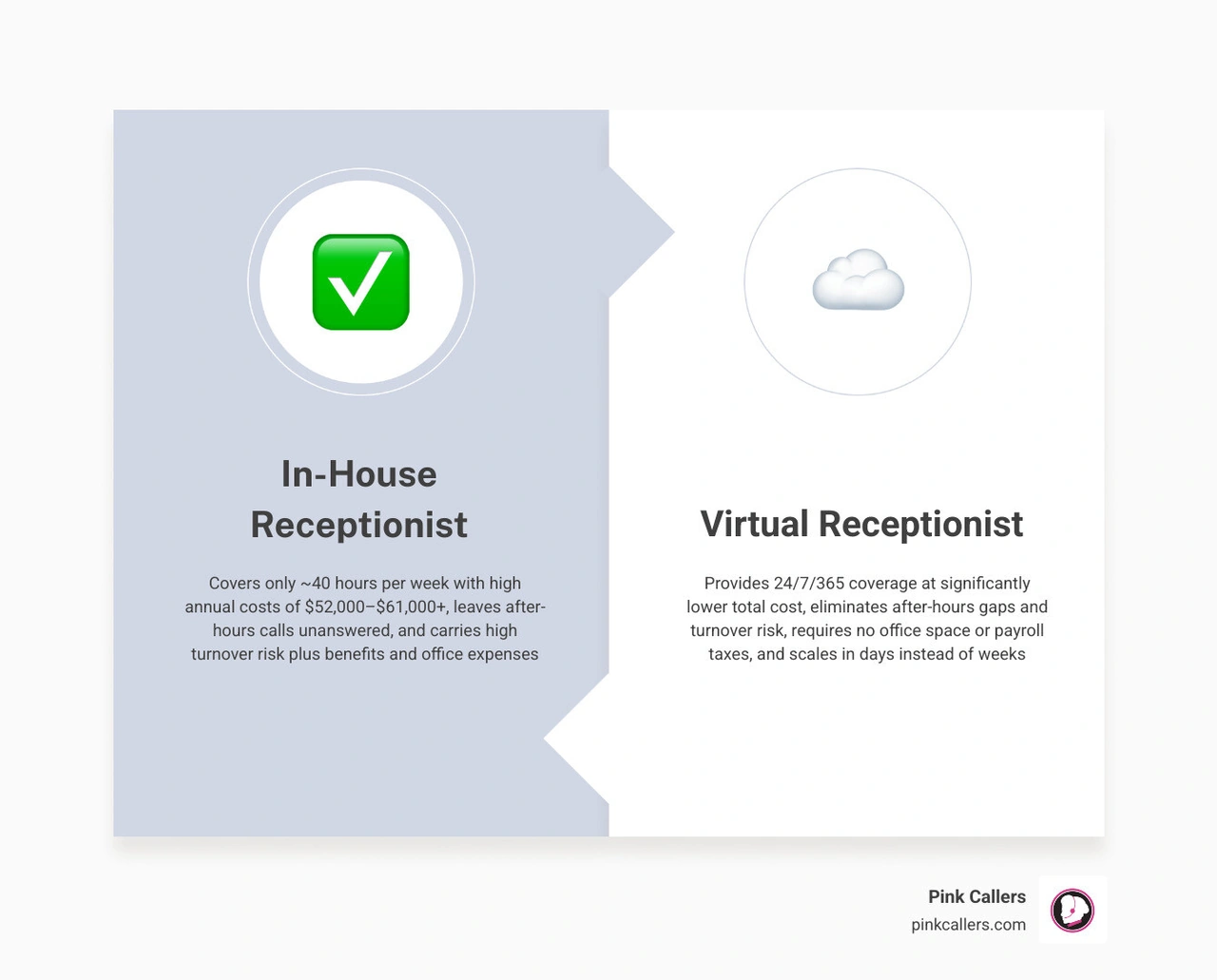
A Detailed Virtual Receptionist vs Hiring In-House Staff Comparison

To truly understand how a virtual receptionist stacks up against a traditional, in-office hire, we have to look past the front desk itself. In-house front-desk operations require a physical workspace, dedicated management, and constant oversight. On the other hand, remote virtual receptionist services shift the burden of communication handling and administrative support to a specialized, external team.
For home service contractors operating in highly competitive markets like Charlotte, Fort Worth, or San Diego, the speed and quality of your first customer interaction can make or break your booking rates.
Let’s look at how these two models compare across the day-to-day realities of running a service business:
| Feature | In-House Staff | Virtual Receptionist |
|---|---|---|
| Primary Focus | Multi-tasking (filing, greeting, phones, coffee) | Dedicated call answering, lead intake, and booking |
| Call Capacity | One call at a time per person | Multiple calls handled simultaneously |
| Availability | Strict 9-to-5, Monday through Friday | Around-the-clock (24/7/365) |
| Management Overhead | High (HR, payroll, reviews, conflicts) | None (managed by the provider) |
| Office Footprint | Desk, chair, computer, phone hardware | $0 infrastructure costs |
| CRM Native Knowledge | Requires extensive on-the-job training | Pre-trained in platforms like ServiceTitan |
Key Operational Differences in a Virtual Receptionist vs Hiring In-House Staff Comparison
The most glaring gap between these two approaches is coverage. A standard in-house employee works 40 hours a week. In a week containing 168 hours, that leaves 128 hours completely uncovered. That means for 76% of the week—including evenings, weekends, and holidays—your business is essentially closed to new leads unless you are forwarding calls to your personal cell phone during dinner.
Furthermore, when your in-house receptionist takes a lunch break, goes on vacation, or calls in sick, your phone lines go cold.
A virtual receptionist, however, provides seamless continuity. Because virtual teams utilize a shared, distributed model, there is always an active professional ready to take your calls. If you want to dive deeper into how these specialized remote professionals differ from bare-bones answering systems, check out our guide on the Virtual Receptionist vs Answering Service Difference.
Evaluating Long-Term Value: Virtual Receptionist vs Hiring In-House Staff Comparison
In the home services sector, demand is rarely flat. A sudden summer heatwave in Jacksonville or a winter freeze in Middleburg, VA, can cause your call volume to quadruple overnight.
If you rely solely on in-house staff, you face a tough operational bottleneck:
- Your single receptionist is overwhelmed, leading to long hold times or dropped calls.
- You have to quickly recruit, hire, and train temporary help, which takes weeks.
- Once the seasonal spike ends, you are left with excess payroll and underutilized staff.
A virtual receptionist model solves this through on-demand scalability. During peak seasons, you can scale your support instantly without the stress of hiring. When things quiet down, your overhead scales back down automatically. For a deeper look at how this flexibility compares to rigid full-time hiring, see our breakdown of the Fractional CSR vs Full-Time Virtual Receptionist Comparison.
Analyzing the Overhead and Hidden Liabilities of In-House Staffing
When business owners calculate the cost of an in-house receptionist, they usually look at the base hourly wage. However, the base salary is just the tip of the iceberg.
The hidden liabilities of traditional employment often add an extra 30% to 40% on top of that base rate. These expenses include:
- Employer Payroll Taxes: Social Security, Medicare, and state unemployment taxes.
- Employee Benefits: Health insurance, retirement contributions, and paid time off (PTO).
- Equipment and Infrastructure: A reliable computer, dual monitors, a dedicated desk, an ergonomic chair, and a software license for your dispatch software.
- Recruitment and Onboarding: Job board postings, hours spent screening resumes, background checks, and the lost productivity of senior staff members who must train the new hire.
Most importantly, you have to account for the risk of turnover. According to industry data, more than a third of new hires leave within their first 90 days. If your receptionist quits after two months, you lose all the capital and time spent training them, and you are forced to start the expensive recruitment cycle all over again. To learn more about these invisible drains on your cash flow, explore the Hidden Costs of Hiring In-House vs Virtual Support.
The Management Burden and Productivity Fluctuations
Beyond the financial spreadsheet, there is a "management tax" that comes with in-house staff. As a business owner, your time is your most valuable asset. Every hour you spend managing payroll, conducting performance reviews, resolving office conflicts, or monitoring productivity is an hour you aren't spending on strategic growth, high-ticket sales, or field operations.
Furthermore, in-house employees experience natural productivity fluctuations. There will be slow afternoons where your receptionist has no calls to answer, yet you are still paying for their time. Conversely, when you partner with a managed virtual assistant service, those administrative burdens disappear. You can read more about why shifting to this hands-off model makes sense in our article on Why Hire a Virtual Assistant.
Understanding Virtual Receptionist Models and Capabilities
Modern virtual receptionist services are a far cry from the robotic, detached answering services of the past. Today, they function as seamless, integrated extensions of your local business.
With advanced cloud-based dashboards and native software integrations, a high-quality virtual receptionist can:
- Answer Calls Live: Greet customers with warmth and professionalism, using your exact business name and custom greeting.
- Qualify Leads: Ask the right questions to separate urgent service requests from low-priority inquiries or spam.
- Book Appointments Directly: Access your live calendar and schedule jobs according to your dispatch rules.
- Integrate with Your CRM: Work directly inside platforms like ServiceTitan, booking jobs in real-time so your technicians see them instantly.
- Provide Bilingual Support: Communicate clearly with Spanish-speaking customers, expanding your market reach in diverse areas like Fort Worth or San Diego.
If you are curious about the technical capabilities that set these modern systems apart from traditional call centers, read our detailed comparison on How Does a Virtual Receptionist Differ from an Answering Service.
Customization and Brand Representation
One of the most common concerns business owners have is: "Will a virtual receptionist sound like they are actually part of my company?"
The answer is a resounding yes. When set up correctly, virtual customer service representatives (CSRs) follow customized scripts, learn your specific service areas, and adopt your brand’s unique tone of voice. Whether you want a highly formal, corporate greeting or a warm, neighborly Virginia-style welcome, the team can adapt to match your culture perfectly.
For a reassuring look at how virtual professionals maintain brand integrity, check out our guide on Can a Virtual CSR Really Represent My Brand.
Onboarding Speed and Scalability
Hiring an in-house receptionist typically takes four to eight weeks from posting the job ad to their first day on the phones. If you need immediate relief because your phones are ringing off the hook, that timeline is simply too slow.
With a managed virtual CSR service, the onboarding process is streamlined. Because the representatives are already trained in general customer service best practices and home service CRMs, they can begin taking your calls in a matter of days. To find out what this setup looks like and how to get started, check out How Quickly Can a Virtual CSR Start Taking My Calls.
Additionally, if you are a contractor looking for a highly flexible, budget-friendly approach to professional call answering, you can explore How Much Does a Virtual Receptionist Cost for Contractors to see how customizable plans fit different business sizes.
Strategic Decision Framework: Which Option Fits Your Business?
How do you decide which path is right for your unique business? It helps to look at your physical office environment and customer habits.
Choose an In-House Receptionist If:
- You Have Heavy Walk-In Traffic: If you run a retail showroom, a busy physical salon, or a medical clinic where customers constantly walk through the door, you need a physical human being present to greet them, accept physical payments, and handle on-site logistics.
- You Need Hands-On Office Coordination: If the role requires physical tasks like sorting paper mail, managing office supply inventory, or organizing physical files, an in-person employee is necessary.
Choose a Virtual Receptionist If:
- You Are a Field-Based Contractor: If your team consists of technicians out in service vans in Nashville or Charlotte, and you don't have customers visiting a physical office, there is no operational need for a physical front desk.
- You Want 24/7 Responsiveness: If you want to capture emergency plumbing or HVAC leads at 9 PM on a Saturday without paying massive overtime wages to an in-house employee.
- You Want to Eliminate Management Overhead: If you want to focus entirely on running your trade, leaving CSR training, monitoring, and scheduling to an agency.
The Hybrid Staffing Model
Many growing home service businesses find that a hybrid model offers the best of both worlds. In this setup, you might keep a part-time or full-time office manager in-house to handle high-level coordination, billing, and local community relations, while utilizing a virtual receptionist service for:
- Overflow Support: Answering incoming calls instantly when your in-house staff is already on the line.
- Lunch Break & Meeting Coverage: Ensuring no calls are missed during daily operational gaps.
- After-Hours & Weekends: Taking over the lines after 5 PM and over the weekend to capture late-night emergency service leads.
To see how this flexible, fractional approach works in practice for growing trade businesses, read our guide on How Fractional CSR Services Work for Small Contractors. If you are ready to explore local agency options to support your business, you can also search for Virtual Assistant Companies Near Me to find a partner that understands your regional market.
Frequently Asked Questions about Virtual Receptionists
Can a virtual receptionist handle emergency dispatching after hours?
Yes! A professional virtual receptionist service can be trained on your specific emergency protocols. When an urgent call comes in—such as a burst pipe at midnight or an AC failure during a summer heatwave—the virtual CSR can identify the emergency, gather the customer's details, and immediately dispatch the on-call technician according to your pre-defined schedule.
How does a virtual receptionist integrate with my existing CRM?
High-quality virtual receptionist services integrate directly with industry-standard CRMs like ServiceTitan. The virtual CSRs log into your system securely, view your real-time calendar, book appointments directly into open slots, and update customer records instantly. This ensures your field technicians see the new jobs on their tablets without any delay or manual data entry on your part.
Is a hybrid approach combining in-house and virtual staff effective?
Absolutely. A hybrid model is one of the most efficient ways to scale a growing home service business. Your in-house staff can focus on complex administrative tasks, local dispatch coordination, and customer follow-ups, while the virtual receptionist team handles the bulk of incoming calls, captures after-hours leads, and provides seamless overflow support during busy seasonal spikes.
Conclusion
At the end of the day, running a successful home service business comes down to responsiveness. If you don't answer the phone, the customer will simply call the next local business on their list.
While hiring an in-house receptionist has its place for companies with heavy physical walk-in traffic, the high overhead, management burden, and limited hours make it a costly and rigid option for modern contractors.
By partnering with a hybrid, AI-enhanced virtual receptionist service like Pink Callers, you get the best of both worlds: the warmth and industry expertise of U.S.-based, ServiceTitan-certified customer service representatives, backed by cutting-edge voice technology that ensures your lines are covered 24/7/365.
Stop letting missed calls turn into opportunities for your competitors. Let us handle your phones so you can focus on scaling your business and serving your customers.
Explore Pink Callers Virtual CSR Services today to find the perfect call-handling solution for your business.
Keep reading
More from the blog
The Essential Seasonal Home Maintenance Checklist: Navigating HVAC Startup Smells and Fall Prep
Read → October 1, 2026Why Does My Heater Smell Like Burning? Your Seasonal Home Maintenance Checklist
Read → September 30, 2026The Anatomy of a Perfect Handoff Between a Remote CSR and an On-Site Technician
A dispatcher's initial notes set the tone for every service visit. Precise CRM logging bridges the gap between the office and field, ensuring your technicians arrive fully prepared to build trust.
Read →