Blog · Archive
The Complete Guide to How a Virtual CSR Handles HVAC Emergency Calls
Learn how a virtual CSR handles HVAC emergency calls with 24/7 triage, seamless dispatch integration, and professional scripts that protect revenue and customer trust.

Why Every HVAC Business Needs to Know How a Virtual CSR Handles HVAC Emergency Calls
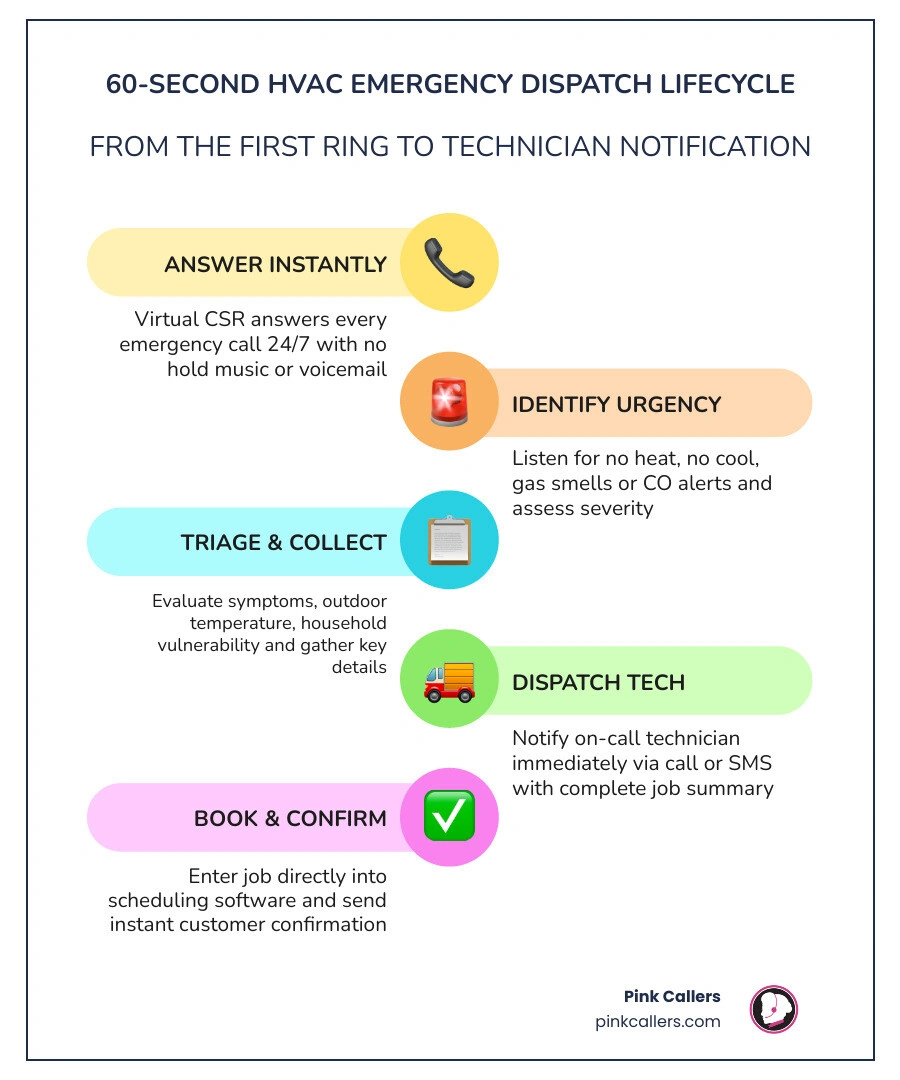
Understanding how a virtual CSR handles HVAC emergency calls is critical for any contractor who has ever lost a job to voicemail at 11 PM. Here is a quick overview of the process:
- Answer instantly - The virtual CSR picks up every call, 24/7, with no hold music or voicemail prompts
- Identify the emergency - The CSR listens for urgent signals like no heat, no cool, gas smells, or CO alerts
- Triage the call - They assess urgency based on symptoms, outdoor temperature, and household vulnerability
- Collect key details - Address, equipment type, system age, error codes, and access instructions are captured
- Dispatch the technician - The on-call tech is notified immediately via call or SMS with a full job summary
- Book and confirm - The job is entered directly into your scheduling software and the customer receives confirmation
When a homeowner's furnace stops working at 2 AM in January, they are not going to wait until morning. They call the first company that picks up — and if that is not you, it is your competitor. The numbers back this up: the average HVAC shop misses 27% of inbound calls year-round, and that number climbs past 35% during extreme weather when call volume surges the most. Worse, 80% of those missed callers never leave a voicemail. They just move on.
For a small to mid-sized HVAC business, that translates to anywhere from $45,000 to $120,000 in lost revenue every single year — from calls that were never answered.
A virtual CSR changes that equation entirely. Instead of routing after-hours emergencies to a voicemail box nobody checks until morning, a trained virtual CSR answers every call, qualifies the situation, and gets the right technician moving — all within minutes, any time of day or night.
Defining the Role: How a Virtual CSR Handles HVAC Emergency Calls Differently

A virtual CSR is a remote customer service representative trained to act like an extension of your HVAC office. Instead of only answering phones during business hours, they support calls across evenings, weekends, holidays, and peak-season surges.
For HVAC companies, that difference matters a lot. Furnaces and AC systems have a habit of breaking when the office is closed, usually with the kind of timing that would make a sitcom writer proud.
Unlike a traditional in-house receptionist, a virtual CSR is built for flexibility and continuity. With a service like our HVAC Virtual Receptionist, the goal is not just to answer the phone. It is to protect revenue, preserve customer trust, and keep dispatch moving.
Here is how virtual CSRs differ from standard in-house coverage:
- They provide 24/7/365 availability instead of office-hours-only coverage
- They follow documented emergency workflows instead of relying on memory or sticky notes
- They scale during heat waves, cold snaps, and lunch-break chaos
- They can work directly in your systems for scheduling and dispatch
- They reduce hold times and missed-call abandonment
- They maintain a consistent brand voice with custom scripts and SOPs
That last point is important. A virtual CSR should not sound like a random call center. They should sound like your company on its best day: calm, organized, empathetic, and ready to help.
If you want a broader look at the business impact, our guide on How Virtual CSRs Help HVAC Companies Grow explains why this role has become so important in 2026.
The Step-by-Step Triage Process for Heating and Cooling Emergencies
When an emergency HVAC call comes in, the process has to be fast, but not sloppy. Good triage is a blend of empathy, urgency, and clean data capture.
At a high level, a virtual CSR usually follows this workflow:
- Answer with a branded greeting
- Confirm the caller's name, callback number, and service address
- Ask what is happening right now
- Identify whether the issue is emergency, urgent, or routine
- Check for safety risks
- Collect equipment and access details
- Follow dispatch or booking rules
- Send confirmation to the customer and internal team
This is where after-hours coverage stops being "message taking" and becomes real operational support. A well-run virtual CSR team can schedule non-urgent calls for the next open slot and escalate true emergencies right away. Our HVAC Appointment Scheduling Guide and How to Handle After Hours Calls Without Losing Leads both expand on how this workflow protects bookings that would otherwise disappear.
Identifying High-Priority Situations in HVAC Emergency Calls
Not every uncomfortable call is a true emergency, but some absolutely are. A virtual CSR needs clear rules for sorting one from the other.
Typical high-priority situations include:
- No heat during cold overnight conditions
- No cooling during extreme heat, especially if children, elderly residents, or medically vulnerable occupants are present
- Burning smells from the system
- Carbon monoxide alarm concerns
- Gas odor reports
- Refrigerant leak concerns, depending on company protocol
- Commercial situations where refrigeration loss or tenant impact raises urgency
The CSR does not diagnose the system. Their job is to identify urgency and trigger the right next step.
A strong triage script often includes questions like:
- Is there currently no heat or no cool?
- When did the issue start?
- Is anyone elderly, very young, or medically vulnerable in the home?
- Do you smell gas, burning, or anything unusual?
- Is a CO alarm sounding?
- Is the unit completely off, or running without heating or cooling?
- Have you checked thermostat settings and power status?
Those questions help the CSR separate a true emergency from something that can wait until morning. They also help avoid unnecessary after-hours dispatches while still keeping safety first. We cover the larger operational side of this in the Ultimate Virtual CSRs Guide HVAC Growth.
Essential Information Collected During an HVAC Emergency Call
Once urgency is established, the next job is collecting dispatch-ready information. This is what prevents the dreaded "tech calls back because the address is wrong" problem.
A virtual CSR should gather:
- Customer full name
- Best callback number
- Service address
- Whether the caller is the homeowner, tenant, or property manager
- Equipment type, if known
- Brand or model, if known
- Approximate system age, if known
- Problem description in the customer's own words
- Any thermostat or panel error codes
- Whether the system is fully down or partially working
- Indoor conditions and urgency factors
- Gate codes, pets, parking, or entry instructions
- Preferred contact method for updates
For a no-heat call, the script may also capture whether space heaters are being used and whether pipes may be at risk. For a no-cool call, it may note if the home is becoming unsafe for infants, seniors, or people with health concerns.
This information does two things at once: it helps dispatch assign the job correctly, and it reassures the customer that someone competent is actually listening. That matters because 68% of customers leave companies because they feel the business does not care, and 80% say the experience is as important as the actual service.
Seamless Integration with Dispatching and CRM Software
A virtual CSR is most valuable when they can do more than take messages. In modern HVAC operations, they should work inside the same software your office already uses.
That typically means integration with platforms like ServiceTitan, Housecall Pro, and Jobber for:
- Real-time appointment booking
- Job record creation
- Dispatch notes
- Customer history lookup
- Technician assignment support
- Status updates and confirmations
At Pink Callers, our ServiceTitan-certified support model is built around reducing re-entry and keeping records accurate. If the CSR has to write notes in one place and your dispatcher has to retype them somewhere else, delays pile up fast. And during emergencies, "fast" matters more than "we'll get to it later."
This is one reason HVAC contractors often turn to a specialized Best HVAC Answering Service approach rather than generic call handling.
A typical software-enabled emergency workflow looks like this:
- Caller is identified by phone number or entered as a new customer
- Address and service area are verified
- The CSR checks customer history, membership status, or prior notes
- A job is created with problem details and urgency tags
- Dispatch notes are added for the technician
- The customer receives a confirmation by text or email when enabled
- The on-call team gets immediate notification
That kind of integration helps the office start the next morning without sorting through a pile of vague overnight messages that say only "customer hot, please call back." Helpful? Barely.
How a Virtual CSR Handles HVAC Emergency Calls Using AI-Enhanced Tools
AI works best in HVAC call handling when it supports humans instead of replacing judgment. That is why our model combines trained CSRs with pAIge, our AI assistant, to speed up intake, improve consistency, and reduce missed details.
In practical terms, AI-enhanced support can help by:
- Detecting urgency keywords like no heat, no cool, gas smell, or CO alert
- Assisting with call summaries and note structure
- Triggering technician notifications faster
- Sending automated SMS confirmations
- Supporting overflow when call volume spikes
- Helping maintain consistent scripts and documentation
Our hybrid approach means the customer still gets empathy and common sense from a real trained CSR, while the technology helps with speed and accuracy behind the scenes. If you want to see how that works operationally, read How Does AI Call Handling Work for Home Service Businesses.
This matters especially during peak seasons. Research shows the average HVAC shop misses 27% of inbound calls year-round, and even more when the weather swings hard. Since 50% of consumers still prefer phone contact and 61% of customers in the buying cycle call the business they are considering, answering quickly is not optional. It is the front door to revenue.
Maximizing Revenue and Retention Through Professional Dispatching
Emergency calls are not just operational interruptions. They are revenue opportunities and relationship starters.
When a call is answered live, handled professionally, and converted into a booked job, the company protects both immediate revenue and future repeat business. When it goes to voicemail, the odds drop fast. Most callers will not wait around politely while your voicemail explains office hours like it is reading a museum plaque.
Here is a simple comparison:
| Call outcome | What usually happens |
|---|---|
| Live emergency response | Caller stays engaged, details are captured, dispatch starts, job is more likely to book |
| Voicemail or missed call | Many callers hang up, do not leave a message, and contact another HVAC company |
The revenue impact is real. Missed calls can cost HVAC businesses tens of thousands of dollars a year. And because emergency customers often become maintenance-plan clients and repeat customers, the lifetime value is larger than the first ticket alone.
That is why we treat call handling as a growth system, not just admin support. Our article on How Virtual CSRs Help HVAC Companies Grow goes deeper on the connection between answer rate, booking rate, and long-term retention.
Maintaining Brand Standards with Custom Scripts for HVAC Emergency Calls
Consistency is what turns "someone answered the phone" into "that felt like your company."
Virtual CSRs use custom scripts, SOPs, escalation trees, and account notes to stay aligned with your process. These scripts are not robotic word-for-word cages. They are structured guides that ensure the same quality standard across every call.
A strong HVAC emergency script usually includes:
- A branded greeting
- An empathy statement
- Safety screening questions
- Dispatch qualification questions
- Data capture fields
- Approved wording for timelines and expectations
- Instructions for escalation to on-call technicians
- Confirmation language before ending the call
For example, instead of sounding abrupt, the CSR might say:
- "I am sorry you are dealing with that tonight. Let me get a few details so we can help as quickly as possible."
- "If you are smelling gas or your carbon monoxide alarm is going off, please leave the home and call emergency services first."
That balance matters. Customers want urgency, but they also want reassurance. Good scripts create both.
This is especially important after hours, when callers may already be stressed, tired, or frustrated. For more on that customer experience side, see Mastering After Hours Service: A Guide for Home Service Businesses.
Frequently Asked Questions about HVAC Emergency Dispatch
How does a virtual CSR determine if a call is a true emergency?
They follow a triage process based on the reported symptom, safety indicators, weather conditions, and household vulnerability. A no-heat call on a mild afternoon may be urgent but schedulable. A no-heat call overnight with an elderly resident, infant, or freezing conditions is more likely to trigger immediate dispatch. Gas smells, burning odors, and CO alarm concerns are treated as safety-first calls.
Can virtual CSRs handle calls during peak seasonal surges or holidays?
Yes. That is one of the biggest advantages of the model. Virtual CSRs are designed to provide overflow support during first-heat and first-cold spikes, weekends, and holiday periods when in-house teams are stretched thin. This kind of flexible coverage is a major reason HVAC businesses use outsourced support in the first place. Our Holiday Season Call Coverage Guide explains how to plan for those periods.
Do virtual CSRs book directly into my existing HVAC software?
They can, depending on your setup and permissions. Many HVAC businesses want CSRs to work directly inside ServiceTitan, Housecall Pro, or Jobber to create customers, book jobs, add dispatch notes, and send confirmations. That direct entry improves speed, accuracy, and visibility for your team.
Conclusion
The short version of how a virtual CSR handles HVAC emergency calls is simple: answer fast, triage correctly, collect the right information, and move the job forward without delay.
That sounds straightforward, but doing it well at 2 AM, during a holiday weekend, or in the middle of a weather-driven call spike takes real process, real tools, and real consistency.
At Pink Callers, we combine trained human CSRs with AI-enhanced support, real scheduling workflows, and ServiceTitan-certified expertise so HVAC businesses can stop losing emergency calls to voicemail and start turning them into booked jobs and loyal customers.
If you are looking for a more complete support model, explore our HVAC Call Center solutions or Contact our team to scale your HVAC operations.
Keep reading
More from the blog
How We Handle Multi-Trade Dispatching for HVAC and Plumbing Combos
Misrouting an ambiguous 'no hot water' call wastes highly skilled technicians' time. We break down the exact intake triage rules that successfully separate plumbing from HVAC tickets.
Read → September 14, 2026Outsourced Customer Service vs Hiring a Local Temp Agency
Losing a dispatcher right before the fall heating rush can overwhelm any contractor. Compare the operational impact of a specialized call center versus a local temp worker to protect your revenue.
Read → September 11, 2026Transitioning Phone Scripts for Northeast Fall Boiler Prep
The first freeze brings a sudden wave of urgent no-heat calls that can easily overwhelm untrained CSRs. Prepare your dispatch board by strategically updating your front-office triage process.
Read →