Blog · Archive
Capture Storm Damage Leads: A Comprehensive Guide
Capture storm damage leads before your competitors with speed-to-lead systems and 24/7 answering that books inspections fast during post-storm surges.

Why Capturing Storm Damage Leads Before Your Competitors Determines Who Wins Storm Season
Capturing storm damage leads before your competitors is the single biggest factor that separates contractors who thrive after a major weather event from those who watch the work go to someone else. When a storm hits, homeowners don't wait. They search, they call, and they hire — often within 72 hours. The contractor who answers first wins. It's that simple.
Here's a quick breakdown of what it takes to get there first:
- Answer every call immediately — missed calls go straight to competitors
- Build local SEO visibility before storm season — you can't rank overnight
- Have surge capacity ready — call volume can spike 400% or more
- Qualify leads on the first touch — focus your crew on the highest-value jobs
- Follow up fast — calling a lead within the first minute boosts conversions by 391%
- Use 24/7 coverage — storms don't follow business hours
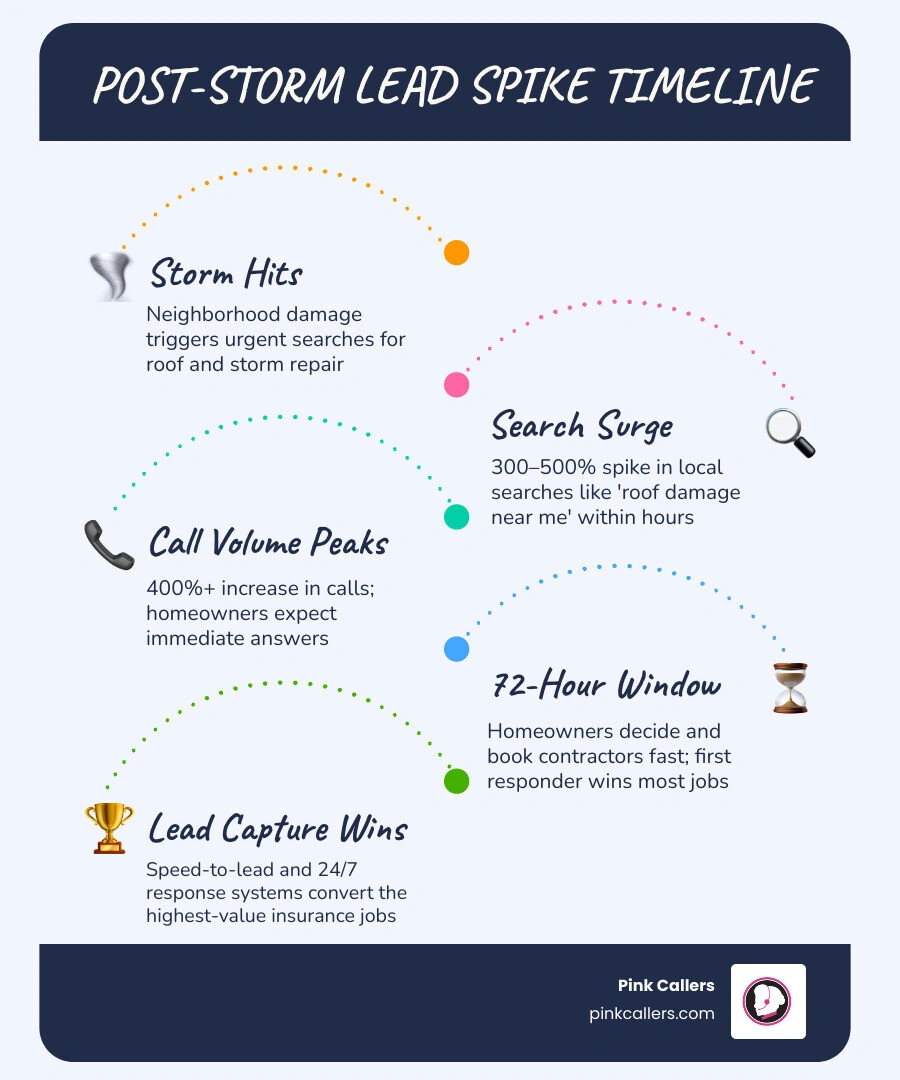
The scale of opportunity is real. A single major storm can spike local search volume by 300–500% within hours. Roofing and restoration contractors can go from 5–10 calls per day to 50–100+ overnight. But most businesses aren't ready for it. Call volume surges while staffing stays flat, voicemails pile up, and leads quietly walk out the door to whoever picked up the phone.
Storm damage jobs are also worth far more than standard service calls — often $15,000 to $50,000 or more, funded through insurance, with close rates that can be double or triple what you'd see on a regular bid. Missing even a fraction of those opportunities carries a steep price.
This guide is built for home service contractors — roofers, restoration companies, and everyone in between — who want a real system for capturing storm leads before the competition does.
Why Storm Events Create Huge Lead Surges
Storms create a kind of demand that regular marketing simply does not. Homeowners can put off a kitchen remodel. They do not put off a leaking roof, missing shingles, water intrusion, or visible hail impact.
That is why storm damage leads arrive in compressed waves. A neighborhood gets hit, and suddenly dozens or hundreds of property owners are looking for help at the same time. Search intent becomes urgent, local, and action-oriented. People type things like "roof damage near me" or "emergency storm repair" on their phones and start calling immediately.
The pattern is consistent across storm-prone service areas such as Fort Worth, Nashville, Charlotte, Jacksonville, San Diego, and Virginia markets. Weather events trigger:
- Immediate homeowner concern
- Insurance-related questions
- Local search spikes
- Call surges to contractors
- Faster hiring decisions
- Higher-value project opportunities
Research shows major storms can push local search volume up by 300% to 500% within hours, while overall inquiry demand may rise 5 to 10 times above normal in affected areas. If you want the full breakdown of how these spikes work, see How Storm Season Creates Lead Surges for Contractors.

The 24- to 72-Hour Window When Demand Peaks
The biggest lead opportunity usually happens in the first 24 to 72 hours after a storm. This is when homeowners are:
- Assessing visible damage
- Hearing from neighbors
- Contacting insurance carriers
- Looking for inspection appointments
- Making shortlists fast
This is also the period when capturing storm damage leads before your competitors matters most. Homeowners under stress often contact 2 to 3 contractors quickly, then move forward with the first company that answers, sounds trustworthy, and can schedule an inspection.
In other words, the lead window is short, emotional, and brutally unforgiving. If your callback happens tomorrow, the job may already belong to someone else today.
What the Data Says About Search and Call Surges
The numbers behind storm demand are hard to ignore:
- Local search volume can jump 300% to 500% after major weather events
- Call volume can surge 400% or more
- Some contractors see daily calls jump from 5 to 10 up to 50 to 100+
- 88% of smartphone users who perform a local search visit or call a business within 24 hours
- More than 60% of "near me" searches result in a call or visit
That means visibility and response speed work together. Ranking well is not enough if nobody answers. Answering quickly is not enough if nobody can find you. During storm season, marketing and operations become the same conversation.
Why Contractors Miss So Many Storm Damage Opportunities
Most contractors do not lose storm work because demand is low. They lose it because their systems break under pressure.
A normal day might be manageable with a small office team, a shared cell phone, and a "call me back if I miss you" approach. A storm day is different. The same setup that felt fine on Tuesday becomes lead leakage on Wednesday.
Common failure points include:
- Calls stacking up at once
- Office staff already busy with current customers
- After-hours calls going unanswered
- Long hold times
- No clear qualification process
- Slow callback routines
- No CRM or dispatch sync
Why 50-70% of Storm Calls Go Unanswered
Research in the space shows roofing companies may miss 50% to 70% of calls after storms, compared with about 27% under normal conditions. That gap is huge, and it happens because call volume explodes while staffing does not.
One source noted businesses are often staffed for only about 92% of normal demand, not post-storm chaos. So when volume spikes by 400%, the math gets ugly fast.
Then there is voicemail, which sounds helpful in theory and performs terribly in real life. Less than 3% of callers pushed to voicemail actually leave a message. Everyone else does what we all do when stressed and busy: hang up and call the next number.
If after-hours coverage is weak, the problem gets worse. Many storm calls come in evenings, weekends, and early mornings. That is why planning for overflow matters so much. For more on that, read How to Handle After Hours Calls Without Losing Leads and Why Contractors Who Answer Their Own Phones Lose Leads.
The Hidden Cost of Slow Follow-Up and No-Response
Missed storm calls are not just missed conversations. They are missed inspections, missed claims, missed contracts, and missed revenue.
The hidden costs include:
- Lost high-value insurance jobs
- Lower crew utilization during peak opportunity windows
- Wasted marketing spend
- Reputation damage from poor responsiveness
- Fewer reviews from successfully completed jobs
- A weaker referral pipeline later
Research cited in your brief shows a contractor missing just 30% of incoming calls during a post-storm period could lose well into six figures in a single month. That is not because every caller buys. It is because storm leads tend to carry stronger urgency, higher average job value, and faster decision-making.
And when follow-up is slow, the odds collapse. A lead contacted within five minutes is dramatically more likely to respond than one contacted after an hour. For practical follow-up workflows, see the Contractor Lead Follow Up Guide and Best Contractor Lead Follow Up Tips.
Capturing Storm Damage Leads Before Your Competitors Starts With Speed
Speed-to-lead is not a buzzword during storm season. It is the system that decides who gets the inspection.
When a homeowner has active damage or suspects insurance-covered issues, they want three things immediately:
- Reassurance
- A clear next step
- A booked inspection time
If your process creates friction, delay, or confusion, the opportunity moves on.
Why the First Response Wins the Most Jobs
Multiple data points in the research point to the same conclusion: the first contractor to respond often captures 50% to 78% of jobs, and in some storm-specific cases even more.
A few speed benchmarks matter most:
- Calling a lead within the first minute can boost conversion by 391%
- Reaching out within five minutes makes leads about 100 times more likely to respond compared with waiting an hour
- The first available inspection often becomes the winning inspection
Why does this happen? Because speed signals competence. To a stressed homeowner, immediate response feels like professionalism, stability, and safety.
During a storm event, "We can get someone out tomorrow morning" beats "We will try to get back to you later." Every time.
How Storm Leads Differ From Regular Leads
Storm leads are not the same as standard contractor leads. They move faster, carry different emotions, and often justify a different intake process.
| Factor | Storm Leads | Regular Contractor Leads |
|---|---|---|
| Urgency | High and immediate | Moderate to variable |
| Buyer intent | Non-discretionary | Often research or comparison-based |
| Average job value | Higher | Usually lower |
| Funding source | Frequently insurance-related | Often out-of-pocket |
| Close rate | Often higher | Usually lower |
| Sales cycle | Faster upfront decision | Longer consideration window |
| Competition intensity | Very high in first 72 hours | More spread out |
| Cash cycle | Can be longer due to claims | Often more predictable |
Research included in your brief suggests storm restoration jobs can produce 20% to 30% more profit than standard bid-based work, with close rates often materially stronger than regular leads. The catch is simple: you only benefit if you capture the call first.
First-Call Qualification Questions That Protect Capacity
Not every storm lead deserves the same response priority. During a surge, qualification protects your crews, calendars, and sanity.
Your team should gather the basics on the first touch:
- Property address
- Service area confirmation
- Type of damage reported
- Residential or commercial property
- Whether damage is active or worsening
- Whether an insurance claim has been filed
- Whether an adjuster meeting is scheduled
- Best callback number and contact method
- Earliest availability for inspection
This helps you prioritize high-intent opportunities, cluster inspections geographically, and avoid wasting field time.
If you want a stronger qualification framework, see Contractor Lead Qualification and Contractor Lead Conversion Guide.
Build Storm Readiness Before Storm Season Starts
Storm lead capture does not begin when the clouds roll in. It begins before the season, while things are still calm and nobody is panic-Googling from the driveway.
A good storm-readiness plan includes people, process, and platform.
The Pre-Season Systems Every Contractor Needs
Before the next major weather event, we recommend building these basics:
- Call routing rules for storms, after-hours, and overflow
- Backup coverage when office staff is maxed out
- First-call scripts for intake and reassurance
- Appointment-setting rules for emergency inspections
- Calendar sync between office, field, and dispatch
- CRM integration so lead records update automatically
- Internal SLA targets for callbacks and booking
- Text and email confirmations for appointments
This is where hybrid support can make a major difference. At Pink Callers, we use an AI-enhanced human model to help contractors maintain 24/7 coverage, route calls intelligently, book jobs, and sync activity into systems like ServiceTitan. That means fewer dropped balls when call volume suddenly stops being polite and starts being very stormy.
For more support on scaling call handling, read How Virtual CSRs Help Roofing Companies Grow and the Roofing Answering Service Complete Guide.
Website and Technical Prep for Traffic Surges
Your phones are not the only thing that need surge capacity. Your website does too.
Storm traffic is heavily mobile, often emotional, and not patient. Make sure your site is ready with:
- Fast mobile load times
- Caching and CDN support
- Click-to-call buttons above the fold
- Phone numbers in text, not images
- Simple storm landing pages by service area
- Short forms that work on mobile devices
- Tracking for calls, forms, and source attribution
- Clear trust elements like reviews and license information
Research shows bounce rate can rise sharply with each extra second of mobile load time. In plain English: if your page loads like it is taking a coffee break, your lead may be gone.
The Right Year-Round Marketing Balance
Storm readiness should not replace steady lead generation. It should sit beside it.
A smart approach is a year-round balance that keeps your pipeline healthy while reserving capacity for storm activation. One research source recommended a 70/30 split:
- 70% focused on steady, everyday lead generation
- 30% reserved for storm readiness and rapid deployment
That 30% is not just ad spend. It also includes:
- Prebuilt landing pages
- review generation systems
- database reactivation
- local SEO content
- no-damage lead nurturing
- post-storm outreach workflows
And yes, "no damage" leads still matter. Properties that do not convert this storm can become strong opportunities after a future event if you keep records clean and stay in touch. For off-season nurture ideas, visit Off Season Lead Nurturing Strategies for Contractors.
How to Be Found First With Local SEO, Reviews, and Trust Signals
Being first to answer only helps if homeowners can find you first.
That is why local SEO, Google Business Profile strength, and review quality matter so much in storm markets. Organic visibility cannot be built overnight. If you wait until the radar lights up, you are already late.
Local SEO Foundations You Must Build Before the Storm
Contractors in places like Fort Worth, Nashville, Charlotte, Jacksonville, San Diego, Middleburg, and other Virginia service areas should build local authority before storm season with:
- A fully completed Google Business Profile
- Accurate categories and service areas
- Consistent local citations
- Unique city or service area pages
- Regional storm-related content
- Clear NAP consistency
- Mobile-first site structure
- Regular GBP updates and posts
Map pack visibility is especially important because emergency searchers often click one of the top few local listings and call immediately. That is why local presence beats last-minute scrambling.
Why Reviews and Professional Presentation Close Storm Leads Faster
Homeowners do not just choose the first contractor they see. They choose the first contractor they trust.
Reviews do a lot of the heavy lifting here:
- 94% of customers are more likely to choose a business with positive reviews
- 98% of consumers read online reviews before choosing a local roofing company
That means your review profile is not decoration. It is conversion infrastructure.
To build trust faster, combine reviews with:
- Before-and-after photos
- Clear inspection next steps
- Transparent communication
- Professional proposals
- Simple explanations of scope and timeline
- Safety and licensing proof where appropriate
During storm season, homeowners are stressed. Clarity wins. Fancy jargon does not.
What to Publish During and After a Storm
Once a storm hits, publish helpful, local, fast-moving content. Good examples include:
- Google Business Profile posts about inspection availability
- Service-area storm updates
- FAQ pages about common damage signs
- Pages about water intrusion or secondary damage
- Posts explaining what homeowners should document before an inspection
- Follow-up content for mold risk or delayed damage symptoms
- Short mobile-first pages tied to affected service areas
The goal is not to sound dramatic. The goal is to be useful, local, and easy to contact.
Handling 400%+ Storm Lead Surges Without Losing Calls
This is where many contractors either scale up beautifully or melt into a puddle of voicemails.
A storm surge demands more than good intentions. It requires call handling that can absorb volume without sacrificing quality.
How AI-Enhanced Answering and Automation Keep Up With Demand
When we talk about capturing storm damage leads before your competitors, this is one of the biggest operational levers available.
AI-enhanced answering can help with:
- Instant pickup
- 24/7 coverage
- Overflow call handling
- Basic qualification
- Appointment requests
- Text follow-up
- Lead logging into the CRM
- Multi-channel intake from calls, forms, and messages
At Pink Callers, our hybrid AI + human model is designed for exactly this kind of surge environment. AI helps manage speed and scale, while trained CSRs handle nuance, empathy, and scheduling accuracy. For contractors using ServiceTitan, integrated workflows make it easier to keep lead data clean and visible across the team.
That combination matters during weather spikes because homeowners do not care whether your office is overwhelmed. They just care whether someone answered.
Operational Workflow for High-Volume Storm Lead Management
A storm surge SOP should be simple, repeatable, and visible to everyone involved.
Core steps include:
- Answer every inbound call immediately
- Tag the lead source and storm event
- Qualify for service area, damage type, urgency, and claim status
- Check for duplicate records
- Route high-priority leads first
- Book inspections based on territory clusters
- Send confirmation by text or email
- Push notes into CRM or dispatch software
- Trigger fast follow-up for leads not yet booked
- Monitor missed calls and callback queues in real time
Geographic clustering is especially useful in dense post-storm zones because it reduces drive time and helps crews complete more inspections per day.
The Metrics to Watch During a Storm Event
You cannot improve what you do not measure, especially when volume gets chaotic.
Track these numbers during and after each storm:
- Answer rate
- Missed call rate
- Speed-to-lead
- First-response time
- Booking rate
- Lead-to-inspection rate
- Inspection-to-close rate
- Source attribution
- Review volume growth
- Pipeline velocity
These metrics will tell you where the leaks are. Sometimes it is marketing. Often it is call handling. Occasionally it is both, which is always a fun surprise nobody wanted.
Conclusion
Storm season rewards the prepared. The contractors who win are usually not the ones who start fastest after the storm. They are the ones who planned earliest before it.
If you want to improve your odds of capturing storm damage leads before your competitors, focus on the fundamentals:
- Build local visibility before demand spikes
- Answer every call, day or night
- Respond within minutes, not hours
- Qualify quickly and route smartly
- Support your team with systems that scale
- Follow up until the opportunity is clearly won or lost
At Pink Callers, we help contractors build those systems with 24/7 hybrid AI + human answering, lead management, scheduling support, and CRM integration designed for real-world surge conditions.
If you want a stronger follow-up process before the next storm hits, start here: More info about x services
Keep reading
More from the blog
How We Handle Multi-Trade Dispatching for HVAC and Plumbing Combos
Misrouting an ambiguous 'no hot water' call wastes highly skilled technicians' time. We break down the exact intake triage rules that successfully separate plumbing from HVAC tickets.
Read → September 14, 2026Outsourced Customer Service vs Hiring a Local Temp Agency
Losing a dispatcher right before the fall heating rush can overwhelm any contractor. Compare the operational impact of a specialized call center versus a local temp worker to protect your revenue.
Read → September 11, 2026Transitioning Phone Scripts for Northeast Fall Boiler Prep
The first freeze brings a sudden wave of urgent no-heat calls that can easily overwhelm untrained CSRs. Prepare your dispatch board by strategically updating your front-office triage process.
Read →