Blog · Archive
Can Your Virtual Receptionist Actually Close the Deal?
Discover if virtual receptionists actually book jobs or just take messages. Learn human, AI & hybrid booking rates for HVAC, plumbing & more!

Do Virtual Receptionists Actually Book Jobs or Just Take Messages?
Do virtual receptionists actually book jobs or just take messages? The short answer: it depends entirely on the type of service and how it's set up — but modern solutions, especially hybrid human + AI models, absolutely can and do book jobs directly.
Quick Answer:
| Receptionist Type | Books Jobs? | Takes Messages? | Notes |
|---|---|---|---|
| AI Virtual Receptionist | Yes — automatically | Yes | 24/7, integrates with calendars and CRMs |
| Live Human Virtual Receptionist | Yes — when given access | Yes | Depends on calendar access and scripts |
| IVR / Phone Tree | No | Limited | Routes calls only, no booking |
| Voicemail | No | Yes | 62% of callers won't even leave one |
| Human + AI Hybrid | Yes — most reliably | Yes | Best for urgent, high-value, or complex calls |
If you run an HVAC, plumbing, or electrical business, this question isn't just academic — it's costing you real money right now. Research across tens of thousands of contractor calls found that nearly three out of four incoming calls go unanswered. Of those missed callers, 85% won't call back, and 62% won't leave a voicemail.
That's not a messaging problem. That's a booking problem.
A virtual receptionist that only logs messages is still better than voicemail — but it's not solving the core issue. The businesses winning more jobs are the ones using services that can actually get a customer on the calendar the moment they call, whether that's at 2 PM on a Tuesday or 11 PM on a Sunday.
This article breaks down exactly what separates a job-booking receptionist from a message-taking service, which types perform best, and what setup you need to make sure calls turn into confirmed appointments — not just notes in a queue.
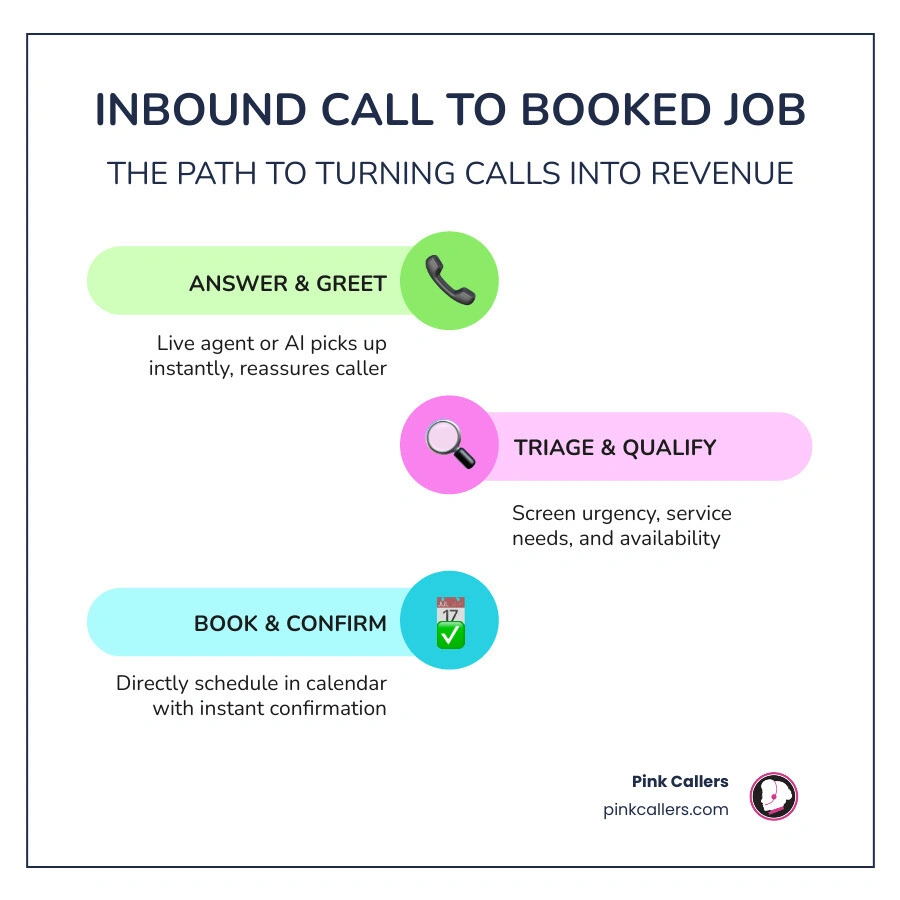
A good virtual receptionist is not just a polite voice with a keyboard. In service businesses, the real job is call resolution. That can mean:
- booking an estimate
- scheduling a service window
- qualifying the lead
- routing emergencies to the on-call tech
- confirming the caller is in your service area
- adding dispatch notes to your CRM
If none of that happens and the caller only gets, "We'll pass along a message," then no, that service did not really close the loop.
What “booking a job” really means in service businesses
Booking is more than dropping a name into a spreadsheet. For contractors, it usually includes:
- checking calendar availability in real time
- matching the request to the right job type
- gathering intake details
- applying urgency rules
- assigning the proper service window or next step
- sending confirmations or reminders
For example, a plumbing call about a burst pipe should not be treated like a general estimate request for a remodel next month. One needs immediate escalation. The other may need qualification, location verification, and a scheduled estimate slot.
That is why a booking-capable receptionist needs systems access, clear workflows, and permission to act.
When the answer is yes: do virtual receptionists actually book jobs or just take messages?
Yes, they absolutely can book jobs directly when they have the right setup. In practice, that means they can:
- schedule new customer appointments
- book repeat service calls
- handle overflow calls during peak hours
- schedule after-hours requests for the next available slot
- route urgent calls immediately
- capture complete intake information for dispatch
At Pink Callers, this is exactly why we focus on workflows, CRM access, and the handoff between AI and trained CSRs. Booking happens when the caller gets a real next step, not just a promise of one.
What separates a booking receptionist from a message-taking service
The biggest difference is authority plus access.
A message-taking service can answer the phone and collect details. A booking receptionist can actually do something useful with those details while the caller is still on the line.
Here are the features that make that possible:
- calendar integration
- CRM integration
- dispatch notes and job tags
- qualification scripts
- service-area screening
- emergency escalation rules
- confirmation texts or emails
- multilingual handling when needed
If you want a deeper breakdown, see How Does a Virtual Receptionist Differ from an Answering Service.
| Capability | Message-Only Service | Booking-Capable Receptionist |
|---|---|---|
| Answers live calls | Yes | Yes |
| Collects caller details | Yes | Yes |
| Books appointments | No or rarely | Yes |
| Handles urgency triage | Limited | Yes |
| Uses your CRM/calendar | Usually no | Yes |
| Sends confirmations | Usually no | Yes |
| Supports dispatch workflows | Limited | Yes |
The must-have setup for direct job booking
If you want bookings instead of messages, you need more than a phone number forwarding rule. You need infrastructure.
At minimum, that includes:
- real-time calendar availability
- booking permissions and rules
- custom call flows by service type
- service-area qualification
- dispatch or technician assignment logic
- CRM integration, ideally with the system your team already uses
For contractors, that often means setup around platforms and workflows your office already relies on. Our Virtual CSR Services are built around that reality, especially for home service businesses that need calls, scheduling, and customer records to stay connected.
Why some services only take messages instead of booking
Sometimes the limitation is not the receptionist. It is the setup.
A service may only take messages when:
- it has no access to your calendar
- you have not defined booking rules
- certain jobs require owner approval
- the intake process is too vague
- compliance or claim requirements prevent immediate scheduling
- after-hours bookings are not allowed internally
In other words, if your process says "someone has to review this tomorrow," then even the best receptionist will probably just capture the lead.
That is not always wrong. For custom quotes, insurance-heavy jobs, or unusual requests, message capture may be the correct next step. But for routine service calls, maintenance, and common estimate requests, message-only handling usually creates friction.
How well do human, AI, and hybrid virtual receptionists convert calls into appointments?
This is where the conversation gets more interesting. Different models perform well in different situations.
- Human receptionists are strong at reassurance, nuance, and unusual conversations.
- AI receptionists are strong at speed, consistency, and 24/7 handling.
- Hybrid models usually perform best when your call volume includes both simple bookings and higher-stakes exceptions.
The real question is not "human or AI?" It is "Which model resolves the most calls correctly?"
Do live human virtual receptionists actually book appointments and jobs directly?
Yes. Live human virtual receptionists can absolutely book appointments when they have clear permissions and system access.
They are especially useful for:
- estimate scheduling
- new customer intake
- service explanations
- reassuring frustrated callers
- handling transfers for special cases
Humans are still excellent at conversations that wander a bit. And let us be honest, some callers tell the whole story from the thermostat to their cousin's recommendation before ever asking for the appointment.
For businesses that need flexible support without staffing a full internal front desk, Fractional CSR coverage can be a practical fit. You can also compare staffing models in Fractional CSR vs Full-Time Virtual Receptionist Comparison.
How effective are AI-powered virtual receptionists at booking jobs automatically?
For routine and well-defined calls, AI can be extremely effective.
Research in the brief shows that modern AI receptionists now resolve about 90% to 95% of real business calls without human intervention. That includes:
- scheduling
- intake
- FAQ handling
- emergency identification
- multi-step requests
AI is especially strong when:
- the call comes in after hours
- multiple calls hit at once
- the request is common and easy to classify
- the business has clear scheduling rules
- instant action matters more than callback speed
AI also does not put callers into the "please leave a message and hope for the best" black hole. It can answer immediately, book instantly, and reduce callback requests. That matters because many callers disappear fast if they do not get a response. For small contractors, that gap can be huge, which is why we often recommend systems that support true workflow execution, not just call logging. Related reading: How Fractional CSR Services Work for Small Contractors.
Why hybrid models often perform best on high-value or urgent calls
Hybrid models combine the strengths of both.
AI can:
- answer instantly
- handle routine calls 24/7
- collect consistent intake
- process multiple calls at once
Human CSRs can:
- step in for exceptions
- calm upset customers
- manage unusual job details
- handle nuanced escalation
- protect brand experience on high-value calls
That is why hybrid often works best for home services. A simple maintenance call can be booked automatically. A no-cooling emergency during a heat wave can be triaged immediately, then escalated to a trained human if needed. That balance matters during seasonal surges, storm events, and unpredictable call spikes.
Where virtual receptionists book jobs most reliably
Virtual receptionists book jobs most reliably in industries where:
- the phone is still a primary sales channel
- requests are time-sensitive
- jobs can be categorized quickly
- scheduling rules are clear
- missed calls equal lost revenue
Best-fit industries include:
- HVAC
- plumbing
- roofing
- electrical
- healthcare
- legal
- real estate
Home services stand out because the booking path is often simple enough to automate, but urgent enough that delays hurt conversion immediately.
Home services: the clearest case for immediate booking
The data here is hard to ignore.
Research cited in the brief shows:
- 60% of consumers prefer to contact local businesses by phone
- 74.1% of calls from contractors in one large dataset went unanswered
- 62% of callers will not leave a voicemail
- 85% of callers who do not reach someone will not call back
That means if your phones are not being answered and booked in real time, you are not just missing conversations. You are missing jobs.
This is especially true in HVAC, plumbing, and roofing, where urgency often drives the first call. If your business is in one of those trades, these resources may help:
Urgent and after-hours calls: can they actually be booked?
Yes, if the workflow supports it.
The research shows that 6.2% of contractor calls are true emergencies, and 15.9% include urgency language. Those calls cannot sit in a voicemail inbox until morning like leftovers nobody wants to claim.
A capable receptionist workflow should be able to:
- detect emergency keywords
- route the call to on-call staff
- book the next urgent slot
- collect dispatch notes
- send immediate confirmation
This is one of the biggest reasons after-hours coverage matters. Emergencies do not check the clock before happening. For contractor workflows that need round-the-clock intake and booking logic, see Contractor Scheduling Service.
When booking is less reliable
Not every inbound call should be booked instantly. Booking tends to be less reliable when the call involves:
- highly custom quoting
- complex diagnosis before dispatch
- insurance claim requirements
- specialty approvals
- compliance-heavy intake
In those cases, the right outcome may be a qualified lead, a scheduled callback, or escalation to someone internal. That is still better than a vague voicemail, because the information is captured accurately and routed correctly.
What the data says about bookings, missed calls, and revenue impact
A lot of content online treats "answered calls" as the goal. We think that misses the point. The goal is booked work.
Still, the answer-rate data tells us why booking systems matter so much.
The research summary includes:
- 130,175 contractor calls analyzed over seven months
- 74.1% unanswered rate in that contractor dataset
- 347,609 real business calls used in broader AI call-resolution reporting
- 90% to 95% automated resolution for modern AI systems
- 25.4% of contractor callers specifically asking for callbacks
That last number matters more than it may seem. A callback request is not a sale. It is a lead at risk.
Proof that faster answering leads to more booked work
Phone-first buyers move fast. In home services, the first company to answer and offer a next step often wins.
Research in the brief notes that lead qualification odds fall sharply after just a few minutes of delay. That matches what most contractors already know from experience: when you call someone back hours later, they have usually already hired someone else, solved it another way, or forgotten why they called in the first place.
That is why owner-answered phones often fail during busy periods. If you are on a roof, under a sink, or in the middle of a service call, speed to answer disappears. This is a big reason we encourage contractors to review Why Contractors Who Answer Their Own Phones Lose Leads.
What real-world booking performance looks like
In the real world, strong performance usually looks like this:
- very high live answer rate
- high booking rate on routine calls
- low abandonment rate
- low callback dependence
- strong after-hours conversion
- accurate emergency triage
- confirmation messages that reduce no-shows
The biggest gap is between message capture and appointment resolution. Taking a message feels productive, but it leaves the sale unfinished. Booking creates an actual commitment and moves the caller into your workflow.
Do callers care whether a human or AI books the job?
Usually, callers care more about outcome than architecture.
They want:
- someone to answer
- a clear next step
- confidence that the issue was understood
- a confirmed appointment or escalation
If the greeting is natural, the questions make sense, and the appointment gets booked correctly, most callers do not obsess over whether the first layer was AI, human, or both.
What they do notice is friction. Long hold times, clunky phone trees, repeated questions, and message-only handling all create doubt. Brand experience comes from smooth handling, not from making the caller guess how your office is staffed. For more on that, read Can a Virtual CSR Really Represent My Brand.
How to make sure your virtual receptionist books jobs instead of just logging messages
If you want a receptionist to book jobs, build for booking from day one. Here is the practical checklist:
- Define which call types can be booked immediately.
- Set service-area rules.
- Create urgency and emergency criteria.
- Connect the calendar and CRM.
- Build intake forms for each service type.
- Decide when AI handles the call and when a human steps in.
- Set confirmation and reminder workflows.
- Review reporting weekly.
This is not glamorous, but it works. Booking success is usually operational, not magical.
Build the right scripts, workflows, and integrations from day one
Your script should not sound robotic, but it should be structured.
A strong setup includes:
- greeting and brand tone
- service-area screening
- call reason classification
- emergency keywords
- booking windows
- required intake fields
- FAQs for common objections
- reminder and follow-up logic
For trade-specific scheduling help, see:
The goal is simple: fewer dead-end calls, more confirmed appointments.
Track the KPIs that prove whether calls are being converted
Do not judge performance only by "messages sent."
Track:
- answer rate
- booking rate
- transfer rate
- callback rate
- abandonment rate
- after-hours conversion rate
- emergency escalation accuracy
- no-show rate after confirmation
If booking rate stays low while answer rate looks great, that is your clue that the receptionist is functioning more like a note taker than a revenue engine.
Choose a model that fits your call complexity
The best model depends on your call mix.
- If most calls are routine service requests, automation can do a lot.
- If your calls involve lots of exceptions, human support becomes more important.
- If you have seasonal spikes, overflow coverage matters.
- If you want both speed and nuance, hybrid is usually the safest choice.
At Pink Callers, we built our model around that reality. Our Human + AI approach helps contractors capture routine bookings fast while still giving complex and urgent calls the human judgment they need. If you want to explore that further, our Virtual CSR Services page is a good place to start.
Conclusion
So, do virtual receptionists actually book jobs or just take messages?
They can do either. The difference comes down to setup, integrations, permissions, and workflow design.
If a service only answers and forwards notes, it is basically a nicer version of voicemail. Helpful, sure. Transformational, not really.
If it can answer live, qualify the caller, check availability, book the appointment, route emergencies, and confirm the next step, then yes, your virtual receptionist can absolutely help close the deal.
That is the standard we believe contractors should expect in 2026.
For HVAC, plumbing, electrical, and other home service businesses, the biggest wins usually come from fewer missed calls, faster response times, and more appointments booked while your team stays focused on the work in front of them. If that is the outcome you want, explore our Virtual CSR Services.
Keep reading
More from the blog
How We Handle Multi-Trade Dispatching for HVAC and Plumbing Combos
Misrouting an ambiguous 'no hot water' call wastes highly skilled technicians' time. We break down the exact intake triage rules that successfully separate plumbing from HVAC tickets.
Read → September 14, 2026Outsourced Customer Service vs Hiring a Local Temp Agency
Losing a dispatcher right before the fall heating rush can overwhelm any contractor. Compare the operational impact of a specialized call center versus a local temp worker to protect your revenue.
Read → September 11, 2026Transitioning Phone Scripts for Northeast Fall Boiler Prep
The first freeze brings a sudden wave of urgent no-heat calls that can easily overwhelm untrained CSRs. Prepare your dispatch board by strategically updating your front-office triage process.
Read →