Blog · Archive
How to Avoid Overwhelmed Phones During Peak Demand in 5 Steps
Learn how to avoid overwhelmed phones during peak demand with 5 proven steps for home service businesses handling seasonal surges and emergency calls.

Why Overwhelmed Phones During Peak Demand Cost Home Service Businesses Real Money
How to avoid overwhelmed phones during peak demand is one of the most pressing challenges facing HVAC, plumbing, and roofing contractors today — especially when a single storm, heat wave, or freeze event can flood your phone lines overnight.
Here's a quick answer if you're looking for the core steps:
- Predict and prepare for seasonal surges using historical call data
- Deploy AI call handling to manage unlimited simultaneous calls without added headcount
- Set up smart routing to triage emergencies from routine inquiries
- Use industry-specific surge protocols matched to your trade and peak triggers
- Track post-surge metrics to sharpen your response for next time
Every step above helps you stay ahead of demand instead of reacting to it after calls — and customers — are already lost.
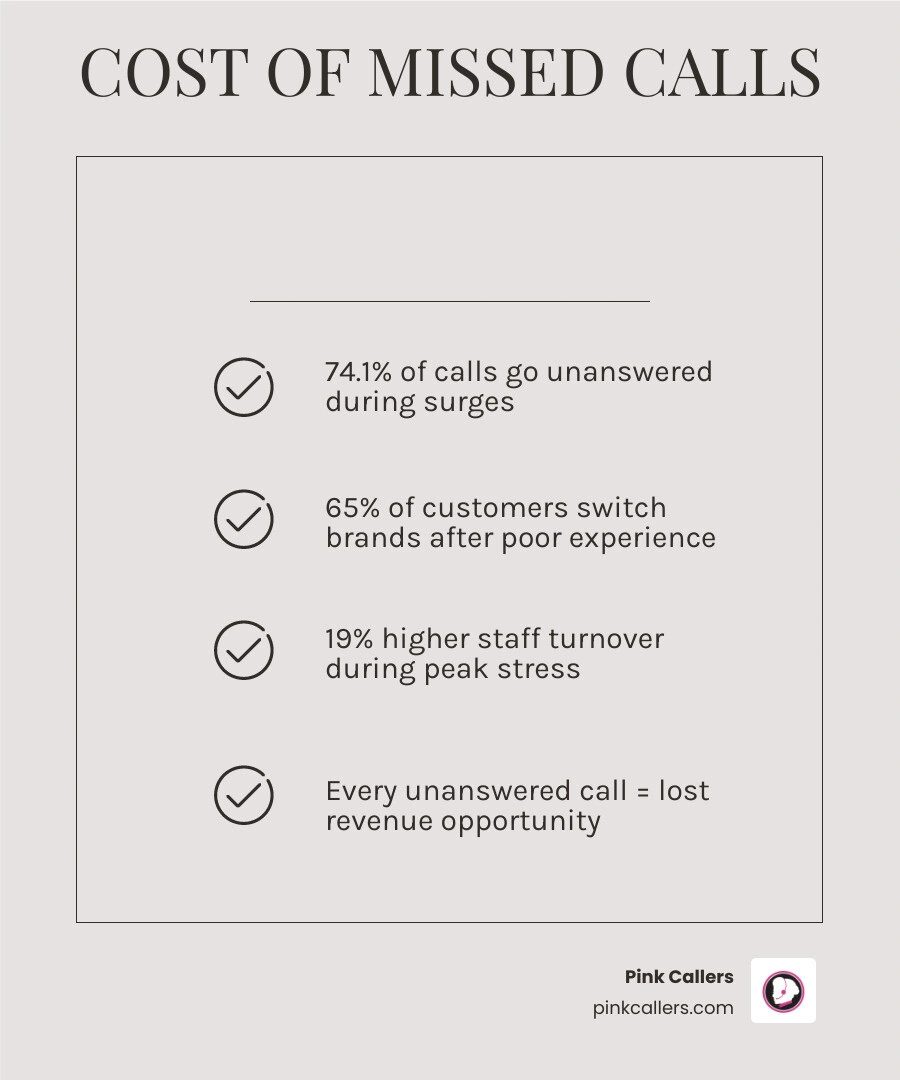
Think about what happens when a hailstorm tears through your service area on a Thursday night. By Friday morning, your phone is ringing off the hook. Your receptionist can handle one call at a time. The rest go to voicemail. Research shows that 74.1% of calls to home service businesses already go unanswered during normal operations — and that number climbs even higher during a surge.
The cost isn't just missed calls. It's missed revenue, damaged reputation, and burned-out staff. Studies show that 65% of customers have switched to a different brand after a single poor experience, and agents under peak-period stress are 19% more likely to leave their jobs.
The good news? With the right systems in place before a surge hits, you can answer every call, book every job, and protect your team — without scrambling to hire temps or pay for expensive overflow services.
This guide walks you through five practical steps to surge-proof your phone system for good.
Step 1: Predict and Prepare for Seasonal Call Surges
In the home services world, we don't just have busy days; we have "seasons of chaos." Whether it's the first 90-degree day in Charlotte or a sudden freeze in Fort Worth, these events are predictable if you look at the data. Preparation is the difference between a record-breaking revenue month and a month of missed opportunities.
Identifying Your Peak Triggers
We’ve found that most call surges aren't random. They are triggered by specific, identifiable events:
- Weather Events: A hailstorm for roofers or a cold snap for plumbers.
- Marketing Campaigns: That big "Spring Tune-Up" mailer you sent to 50,000 homes.
- Seasonal Shifts: The "Great Switch-On" when everyone realizes their AC is broken at the same time.
- Service Outages: Local utility issues that drive customers to seek immediate help.
By identifying these triggers, we can start Adding Virtual Support Before Your Busiest Months. For predictable surges, we recommend beginning your configuration at least 30 days before the peak hits.
The Cost of Unpreparedness
When we ignore the warning signs, the numbers get ugly fast. About 61% of call center managers report significant volume increases during peak periods, with spikes often reaching 30% to 500% above typical daily rates.
If your phone system isn't ready, you face:
- High Abandonment: 64% of callers will hang up if they can't reach a human within five minutes.
- Revenue Loss: During a surge, every missed call is a missed job. For an HVAC company, a single heatwave weekend of missed calls can equal tens of thousands in lost revenue.
- Agent Burnout: High-stress levels make staff 19% more likely to quit, leaving you even more short-handed during the next surge.
- Brand Erosion: 65% of customers will switch to a competitor after one bad experience, like being stuck on hold for 20 minutes.
Preparation isn't just a "nice to have"—it's a survival strategy. Check out our Holiday Season Call Coverage Guide to see how we help businesses plan for the most intense times of the year.

Step 2: Leveraging AI: How to Avoid Overwhelmed Phones During Peak Demand
Traditional phone systems are like a narrow bridge. They work fine for steady traffic, but when a convoy arrives, everything stops. Hiring temporary staff is often too slow, and training them takes weeks. This is where AI technology completely changes the game.
Overcoming Traditional Staffing Limitations
The old way of handling surges was to "throw bodies at the problem." But hiring and training temporary agents is expensive and inefficient. It takes roughly four hours just for a "fast-path" certification, and even then, new hires lack the deep industry knowledge your customers expect.
Furthermore, traditional overflow answering services often charge high per-call fees, which can eat your margins during a high-volume event. This is why many are moving toward a Flat Rate Live Answering Service or a hybrid AI model.
Simultaneous Call Handling Without Quality Loss
Unlike a human receptionist who can only handle one conversation at a time, AI scales "horizontally." If 50 people call your plumbing business in Jacksonville at 8:01 AM after a freeze, an AI receptionist like our proprietary "pAIge" can spawn 50 concurrent instances.
| Feature | Traditional Staffing | Pink Callers Hybrid AI |
|---|---|---|
| Call Capacity | Limited by headcount | Unlimited simultaneous calls |
| Response Time | Increases as volume grows | Consistently under 5 seconds |
| Training Time | Weeks/Months | Instant (Pre-trained) |
| CRM Integration | Manual entry | Real-time ServiceTitan sync |
| Quality | Drops under stress | 100% consistent script adherence |
With a 24/7 Business Answering Service, you eliminate the "busy signal" forever. The AI answers, qualifies the lead, and integrates directly with your CRM. If you've been searching for a Live Answering Service Near Me, cloud-based AI offers a level of scalability that physical offices simply cannot match. This makes it the Best Business Phone Answering Service for companies that can't afford to miss a single lead.
Step 3: Optimize Routing and Triage for Emergency Calls
Not all calls are created equal. During a surge, a "no heat" emergency in a house with an infant is more critical than a routine maintenance request. Knowing how to avoid overwhelmed phones during peak demand requires a system that can tell the difference instantly.
Setting Expectations: How to Avoid Overwhelmed Phones During Peak Demand
When volume is high, transparency is your best friend. We use several tools to manage customer expectations:
- IVR Banners: Update your greeting to acknowledge the surge. "We are currently experiencing high volume due to the storm. Emergency calls are being prioritized."
- Automated Callbacks: 75% of customers prefer a callback over waiting on hold. This "smooths" the call arrival curve, moving morning spikes into manageable afternoon work.
- SMS Templates: If a call can't be answered by a human immediately, an instant text acknowledging the request can prevent the customer from calling your competitor.
Balancing Routine Inquiries and Emergencies
Our hybrid AI model uses "urgency detection." The system listens for keywords like "flooding," "burst pipe," "gas smell," or "sparks." When these are detected, the call is immediately flagged or transferred to a priority line.
We categorize calls into three tiers:
- Safety Hazards: Immediate risk to life or property (e.g., gas leaks, electrical fires).
- Property Damage: Issues like active leaks or total HVAC failure during extreme weather.
- Routine Maintenance: General inquiries and non-urgent repairs.
By using Mastering After Hours Service: A Guide for Home Service Businesses, you ensure that your high-value emergency leads are never buried under a mountain of routine questions. This is essential for How to Handle After Hours Calls Without Losing Leads.
Step 4: Implement Industry-Specific Surge Protocols
A roofer in Nashville needs a different surge plan than a retailer in San Diego. Each industry has unique "pain points" during peak demand.
Contractor Protocols: How to Avoid Overwhelmed Phones During Peak Demand
For contractors, speed is the only metric that matters. During a storm, the first company to answer the phone usually wins the job.
- Roofing: After a hailstorm, call volume can jump from 30 to 200 calls in a single morning. We help roofers set up specific scripts for insurance claim inquiries. See How Storm Season Creates Lead Surges for Contractors.
- HVAC: During a heatwave, volume can spike 300-600%. Our Ultimate Virtual CSRs Guide: HVAC Growth explains how to use AI to handle routine troubleshooting so your techs can focus on repairs.
- Plumbing: Freeze events create a "concentrated demand" where everyone needs help in the first 48 hours.
Retail and Service-Based Peak Strategies
Even for non-contractor businesses, surges like Black Friday or major promotions can be devastating to customer service quality.
- Self-Service is King: 81% of customers try to solve issues themselves before calling. Providing a robust FAQ or a "Where Is My Order" (WISMO) automated tool can deflect up to 40-60% of peak volume.
- Intent Classification: Use AI to identify if a caller is asking about a return, a new purchase, or a shipping delay, and route them to the specialized team member immediately.
Step 5: Track Post-Surge Metrics to Refine Performance
The surge isn't over when the phones stop ringing. To truly master how to avoid overwhelmed phones during peak demand, you must look at the data while it’s fresh. We recommend a "post-mortem" review within 72 hours of the event ending.
Analyzing the Data for Future Readiness
Look at the following metrics to see where your system held up and where it cracked:
- Average Speed of Answer (ASA): Did it stay under 20 seconds?
- Abandonment Rate: Did it stay below the 8-10% danger zone?
- First Call Resolution (FCR): Were callers getting their issues solved, or were they calling back multiple times?
- Conversion Rate: How many of those 200 storm calls actually turned into booked appointments?
Improving the Customer Journey
Customer expectations are higher than ever. 96% of customers want to deal with businesses that are responsive. By tracking your performance, you can create a feedback loop that improves your brand loyalty.
If you noticed a high volume of calls asking the same question (e.g., "Do you handle insurance claims?"), you can update your AI script or IVR greeting for the next surge. This proactive approach ensures that your business becomes more resilient with every peak season.
Frequently Asked Questions about Peak Demand
What causes phone systems to become overwhelmed?
Phone systems typically fail due to a combination of limited concurrent lines (SIP trunks) and a lack of human bandwidth. When more callers dial in than there are available paths or people to answer, callers get a busy signal or are stuck in a queue. External triggers like extreme weather, viral marketing, or service outages are the most common catalysts.
Can AI handle complex emergency calls during a surge?
Yes, but the best approach is a hybrid one. AI can detect "urgency language" in real-time. While it can handle the initial data collection and triage, it can be programmed to immediately escalate life-safety emergencies to a live human supervisor or an on-call technician via SMS or a direct transfer.
How does high call volume affect employee retention?
It is a major driver of turnover. Agents who feel constantly overwhelmed are 19% more likely to leave. This creates a "vicious cycle" where you have fewer staff to handle the next surge, leading to more stress and more resignations. Using AI to handle the "grunt work" of routine inquiries significantly reduces this burnout.
Conclusion
As we move through May 2026, the technology available to home service businesses has never been more powerful. You no longer have to choose between an astronomical phone bill and a mountain of missed leads.
By following these five steps — predicting triggers, leveraging AI, optimizing routing, implementing industry protocols, and tracking your data — you can transform peak demand from a source of stress into your greatest competitive advantage.
At Pink Callers, we specialize in this exact transition. Our hybrid AI + Human model ensures that you have the "infinite" scalability of technology combined with the empathy and expertise of ServiceTitan-certified professionals. Whether you are in San Diego, Charlotte, or right here in Middleburg, we are ready to help you surge-proof your business.
Don't wait for the next storm to hit. Contact Pink Callers for Home Service Call Center Solutions today and ensure your phones are never overwhelmed again.
Keep reading
More from the blog
How We Handle Multi-Trade Dispatching for HVAC and Plumbing Combos
Misrouting an ambiguous 'no hot water' call wastes highly skilled technicians' time. We break down the exact intake triage rules that successfully separate plumbing from HVAC tickets.
Read → September 14, 2026Outsourced Customer Service vs Hiring a Local Temp Agency
Losing a dispatcher right before the fall heating rush can overwhelm any contractor. Compare the operational impact of a specialized call center versus a local temp worker to protect your revenue.
Read → September 11, 2026Transitioning Phone Scripts for Northeast Fall Boiler Prep
The first freeze brings a sudden wave of urgent no-heat calls that can easily overwhelm untrained CSRs. Prepare your dispatch board by strategically updating your front-office triage process.
Read →