Blog · Archive
The Ultimate Guide to After Hours Answering vs Voicemail
After hours answering vs voicemail which books more jobs by delivering faster lead capture and higher conversion for home service businesses.

Why After Hours Answering vs Voicemail Which Books More Jobs Is the Question Every Contractor Should Be Asking
When it comes to after hours answering vs voicemail which books more jobs, the answer is clear: after-hours answering services win, and it's not close.
Quick answer:
| Factor | After-Hours Answering | Voicemail |
|---|---|---|
| Callers who hang up | ~20% | 60-80% |
| Callers who don't call back | Low | 85% |
| Appointments booked in real time | Yes | No |
| Emergency dispatch | Yes | No |
| Lead capture rate | High | ~4.8% response rate |
| CRM integration | Yes | No |
Bottom line: If your business depends on phone leads — especially for HVAC, plumbing, or electrical work — voicemail is quietly costing you jobs every single night.
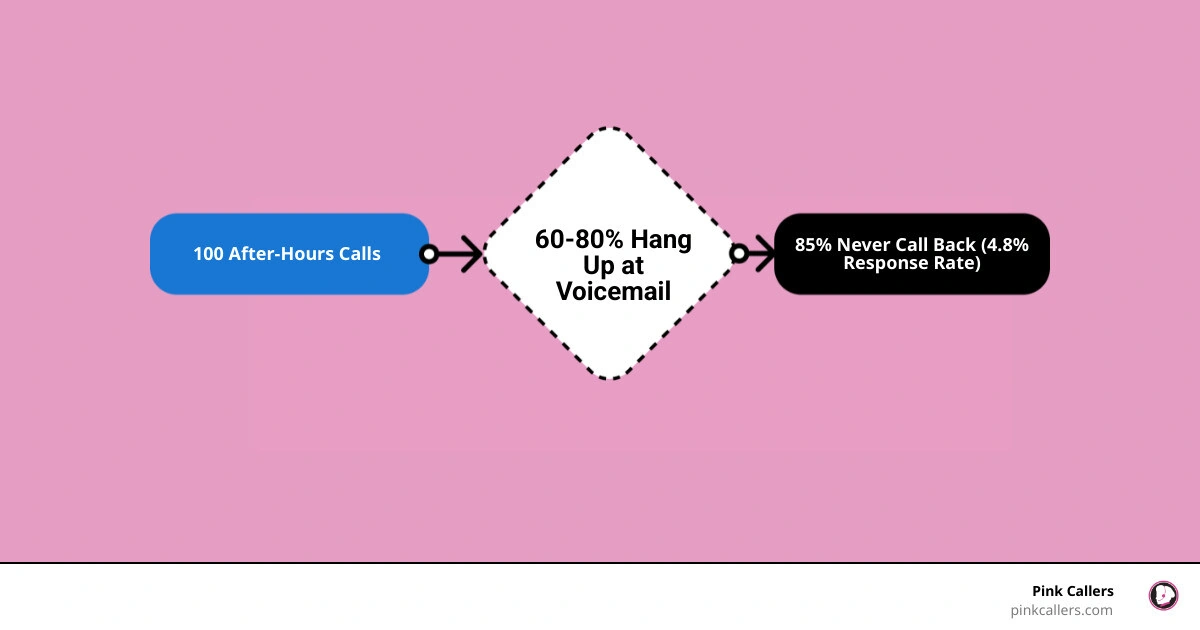
Picture this: it's 9 PM on a Tuesday. A homeowner's furnace just stopped working. They grab their phone, call the first contractor they find, and hit voicemail. Research shows there's a 60-80% chance they hang up without leaving a message — and then call the next business on the list.
That next business answers. They book the job.
For home service contractors, this isn't a rare edge case. According to industry data, roughly 28-35% of business calls arrive outside regular business hours. That's nearly a third of your potential revenue ringing into a black hole every week.
The good news? There's a better way to handle it — and it doesn't require hiring a full-time receptionist.
After Hours Answering vs Voicemail Which Books More Jobs?
If we strip away the buzzwords and look at what actually happens on a real call, the difference is simple:
- Voicemail records a message for later
- After-hours answering engages the caller right now
That one difference changes everything.
With voicemail, the caller hears a greeting, waits for the beep, decides whether it's worth leaving a message, and then hopes someone calls back. That is a lot of friction for somebody with a leaking pipe, a dead AC, or a sparking panel.
With after-hours answering, the caller reaches a live response path immediately. That may be a trained receptionist, AI-assisted call handling, or a hybrid model like ours. Either way, the caller gets interaction, not silence followed by a beep.
Research consistently points the same direction:
- Around 80% of callers sent to voicemail do not leave a message
- About 60-80% hang up when they reach voicemail
- 85% of customers whose calls go unanswered will not call back
- The average voicemail response rate is only 4.8%
So if your goal is to book more jobs, voicemail is not really a booking system. It is a storage system.
An after-hours answering service can do the things voicemail cannot:
- Answer questions
- Collect complete lead details
- identify urgency
- Book appointments while the caller is still on the line
- Escalate emergencies to on-call staff
- Send clean call notes into your workflow
For contractors, that is the difference between "we'll get back to you tomorrow" and "you're on the schedule."
If you want a broader framework for building dependable evening and weekend coverage, our guide on mastering after-hours service for home service businesses is a helpful next read.
Live answering vs voicemail at a glance
| Feature | After-hours answering | Voicemail |
|---|---|---|
| Answers in real time | Yes | No |
| Captures full caller details | Yes | Sometimes |
| Can detect urgent situations | Yes | No |
| Can schedule jobs | Yes | No |
| Can transfer to on-call tech or manager | Yes | No |
| Gives customers immediate reassurance | Yes | No |
| Supports CRM workflows | Yes | No |
| Risk of caller abandoning call | Lower | Much higher |
For most HVAC, plumbing, and electrical contractors, the comparison is not close. The option that talks to people books more jobs than the option that asks them to talk into the void.
The Impact of Response Speed on Conversion Rates
Speed matters because intent fades fast.
Research shows contact rates drop by more than 10% for every hour that passes after the initial inquiry. That means even if someone does leave a voicemail, every hour you wait to respond lowers the odds that you will actually connect and convert.
That hurts even more after hours because many of those callers are not casually browsing. They are often motivated, stressed, and ready to act.
Several findings from the research support this:
- A significant share of after-hours callers use urgent language
- After-hours leads often show strong buying intent
- Customers place a very high value on having their time respected
- In urgent service situations, poor responsiveness pushes people to switch providers quickly
This is exactly why voicemail underperforms. It introduces delay by design.
A caller reaches voicemail at 8:30 PM.You listen at 7:00 AM.You call back at 7:30 AM.They already hired someone else at 8:37 PM.
That is not bad luck. That is just how modern buying behavior works.
Response speed also affects first impressions. If your business answers quickly, you sound organized, available, and trustworthy. If your business sends people to voicemail, you sound busy, understaffed, or unavailable, even if your actual team is excellent.
We see this often with contractors who try to answer every call themselves. It feels cost-effective until the phone rings during dinner, on a ladder, in traffic, or during another job. Our article on why contractors who answer their own phones lose leads explains that trap in more detail.
The short version: the first business to respond often has the best shot at winning the work.
Key Features That Drive More Booked Appointments
Real-time answering is the foundation, but certain features make after-hours coverage far more effective than simple message taking.
Why After Hours Answering vs Voicemail Which Books More Jobs for HVAC Teams
For HVAC companies, many after-hours calls are time-sensitive. No cooling during a heat wave and no heat on a winter night are not "leave a message and wait until morning" situations.
The features that help HVAC teams book more work include:
- Emergency triage so no-heat and no-cool calls get flagged correctly
- Appointment scheduling that places callers directly into available time slots
- Calendar integration so bookings happen while the customer is still engaged
- On-call escalation for true urgent situations
- Consistent scripts that collect system type, symptoms, location, and callback info
That last point matters more than it gets credit for. A voicemail might say, "Hey, my AC isn't working. Call me back." Helpful? Barely.
A strong after-hours answering workflow captures details like:
- Is the system fully down or just underperforming?
- Is there a child, elderly resident, or medical need in the home?
- Has the breaker been checked?
- What equipment type is involved?
- What is the best appointment window?
Now your team starts the next step with context instead of detective work.
For more on round-the-clock call coverage, see our guide to a 24/7 business answering service.
After Hours Answering vs Voicemail Which Books More Jobs for Plumbing Businesses
Plumbing calls are where voicemail really struggles. Water does not like to wait politely until business hours.
For plumbing businesses, the most valuable booking features often include:
- Lead qualification to separate emergencies from routine requests
- Detailed intake notes on leak source, water shutoff status, and damage severity
- CRM synchronization so nothing gets lost between the call and the dispatch board
- ServiceTitan integration for faster, cleaner handoff into existing workflows
- Priority routing for burst pipes, sewer backups, and water heater failures
These tools do more than improve organization. They increase booking rates because they reduce friction for both the caller and your internal team.
Instead of:
- Missed call
- Vague voicemail
- Morning callback
- Phone tag
- Lost lead
You get:
- Immediate answer
- Accurate qualification
- Fast scheduling or escalation
- Clean record in the system
- Better chance of closing the job
If you are comparing provider capabilities, our post on the best business phone answering service breaks down what to look for.
Leveraging AI and Hybrid Models for 24/7 Coverage
In 2026, the conversation is no longer just live answering versus voicemail. It is also about what kind of answering model gives you the best mix of speed, consistency, and flexibility.
That is where AI and hybrid answering come in.
Modern conversational AI can:
- Answer calls instantly
- Handle multiple calls at the same time
- Follow custom scripts and business rules
- Collect caller details accurately
- Detect keywords tied to urgency
- Trigger escalations
- Book appointments
- Push information into connected systems
Research also shows that 85% of customer service leaders were exploring conversational AI in 2025, which tells you this is not some futuristic side project anymore. It is becoming standard operating territory.
But pure automation is not always enough. Some calls need empathy, judgment, or a human handoff. That is why we believe hybrid models are often the strongest option for home service contractors.
A hybrid AI + human setup can:
- Let AI answer immediately, even during call spikes
- Use defined trigger phrases for escalation
- Route complex or emotional calls to trained CSRs
- Maintain consistency across nights, weekends, and holidays
- Support multi-channel monitoring beyond just voice
This is especially useful in HVAC, plumbing, and electrical environments where calls vary from simple scheduling requests to urgent safety issues.
For example:
- A routine tune-up request can be booked automatically
- A no-power call can be flagged and escalated based on your rules
- A caller who is upset, confused, or asking layered questions can be handed to a person
That balance is one of the big reasons hybrid systems outperform voicemail. Voicemail gives every caller the same dead-end experience. A hybrid model gives each caller the right next step.
If you want a deeper look at how this works in practice, read how AI call handling works for home service businesses.
Decision Framework: When to Upgrade Your Phone Strategy
Not every business needs the exact same setup, but most contractors hit a point where voicemail stops being "good enough" and starts becoming expensive in lost opportunities.
Here are the clearest signs it is time to upgrade.
Voicemail may be sufficient if:
- You get very few after-hours calls
- Those calls are mostly low urgency
- Phone leads are not a major sales channel
- You reliably return every message quickly
- Missing one lead does not materially affect revenue
That said, this is a pretty small group. And even then, voicemail should be monitored carefully, not treated like an autopilot setting.
After-hours answering becomes necessary when:
- A meaningful share of your calls come in evenings or weekends
- You provide emergency or urgent services
- Your team cannot respond immediately after hours
- You depend on inbound calls to fill the schedule
- Callers often ask for appointments, quotes, or dispatch
- Brand consistency matters across every customer touchpoint
A simple internal audit can help. Review the last 60 to 90 days and ask:
- How many calls arrived after business hours?
- How many went unanswered?
- How many voicemails were incomplete?
- How long did callbacks take?
- How many leads were actually booked?
- Which call types were most urgent?
- How often did callers mention calling multiple contractors?
If the answers make you wince a little, that is your sign.
A defined after-hours policy also helps. It ensures your team knows exactly what happens after closing time, who gets escalated, what gets booked, and how follow-up is handled. Without a policy, even a good answering setup can turn messy.
Frequently Asked Questions about After Hours Call Handling
What is the difference between an answering service and voicemail?
An answering service responds to the caller in real time. Voicemail records a message for later.
That means an answering service can:
- Interact with the caller
- Ask follow-up questions
- Capture complete details
- Schedule appointments
- Route urgent calls
- Update your systems
Voicemail can only take a recording and wait for someone on your team to deal with it later.
If you want the fuller version, our article on professional phone answering service explains how answering support fits into a contractor's day-to-day operations.
Do customers actually leave voicemails in 2026?
Sometimes, yes. Reliably, no.
The research is pretty blunt here:
- Roughly 80% of callers sent to voicemail do not leave a message
- About 60-80% hang up instead of speaking after the beep
- 85% of unanswered callers will not call back
So while voicemail still exists, it is often acting more like a lead filter than a lead capture tool, and not in a good way.
That is why we often call voicemail the digital junk drawer of after-hours call handling. Things go in. Important things disappear. Everyone assumes someone will deal with it later.
If you are trying to stop that pattern, read how to handle after-hours calls without losing leads.
Can an answering service integrate with my CRM?
Yes, and that is one of its biggest advantages over voicemail.
A modern after-hours answering setup can often integrate with platforms such as:
- ServiceTitan
- Jobber
- Housecall Pro
That means call data can be captured in a structured way instead of living inside a voice recording and somebody's memory.
Good CRM integration improves:
- Data accuracy
- Speed to follow-up
- Scheduling efficiency
- Reporting
- Lead accountability
For HVAC, plumbing, and electrical contractors, this matters a lot. If your calls, notes, tags, and appointments move directly into your workflow, your office team is not rebuilding every lead by hand the next morning.
Our guide on finding a live answering service near me covers some of the practical considerations for choosing the right fit.
Conclusion
So, in the debate over after hours answering vs voicemail which books more jobs, the evidence points one way: after-hours answering wins because it does the one thing voicemail cannot do - move the conversation forward while the customer is still ready to act.
Voicemail delays.After-hours answering engages.
Voicemail creates a callback task.After-hours answering creates a booking opportunity.
Voicemail loses context.After-hours answering captures it.
For contractors in HVAC, plumbing, and electrical, that difference shows up in real outcomes:
- More leads captured
- Faster follow-up
- Better customer experience
- More booked appointments
- Fewer emergency calls slipping away overnight
At Pink Callers, we build after-hours coverage around what actually helps contractors win more work: hybrid AI support, trained human expertise, 24/7 responsiveness, scalable workflows, and strong CRM alignment, including ServiceTitan-ready processes.
If your current setup still sends valuable evening and weekend calls to voicemail, now is a good time to fix the leak before it becomes part of the business model.
Start capturing more leads with a professional after hours policy
Keep reading
More from the blog
How We Handle Multi-Trade Dispatching for HVAC and Plumbing Combos
Misrouting an ambiguous 'no hot water' call wastes highly skilled technicians' time. We break down the exact intake triage rules that successfully separate plumbing from HVAC tickets.
Read → September 14, 2026Outsourced Customer Service vs Hiring a Local Temp Agency
Losing a dispatcher right before the fall heating rush can overwhelm any contractor. Compare the operational impact of a specialized call center versus a local temp worker to protect your revenue.
Read → September 11, 2026Transitioning Phone Scripts for Northeast Fall Boiler Prep
The first freeze brings a sudden wave of urgent no-heat calls that can easily overwhelm untrained CSRs. Prepare your dispatch board by strategically updating your front-office triage process.
Read →