
Blog · Archive
Virtual CSR vs In-House Employee: The Real Cost Comparison
Uncover hidden costs of hiring in house vs virtual support. Save on overhead, turnover & management—scale with Pink Callers VAs now!

Why the Hidden Costs of Hiring In-House vs Virtual Support Matter More Than You Think
The hidden costs of hiring in house vs virtual support go far beyond what shows up on a paycheck — and for HVAC, plumbing, and electrical business owners, those invisible expenses can quietly drain thousands of dollars every year.
Most contractors look at a base salary and think they understand the cost of a hire. They don't. Once you factor in employer payroll taxes, benefits, paid time off, equipment, office space, recruiting fees, onboarding time, and turnover risk, the true cost of an in-house employee can run 30% to 40% higher than base salary alone. For a role like a full-time receptionist or customer service rep, that gap between what you think you're paying and what you're actually paying is significant.
Virtual support — whether that's a virtual CSR, a fractional representative, or an AI-assisted service — operates on a fundamentally different cost structure. You pay for productive hours and outcomes, not downtime, benefits, or desk space.
Here's a quick breakdown of where the hidden costs actually live:
In-House Employee — Hidden Cost Categories:
- Employer payroll taxes (typically 7–10% of salary)
- Benefits and insurance (adds 25–40% on top of base pay)
- Recruitment and onboarding (can reach 30% of annual salary per hire)
- Equipment and office space overhead
- Paid sick leave, vacation, and holidays
- Turnover and retraining costs (50–200% of annual salary per event)
- Management time spent briefing, correcting, and supervising
Virtual Support — What You Typically Pay For:
- Hours worked or tasks completed
- Agency or platform fees (often bundled)
- Minimal or no onboarding investment (pre-trained talent)
- No equipment, office, or benefits overhead
- Scalable up or down without contract penalties
For home service businesses managing call volume, scheduling, and lead follow-up across peak and off-peak seasons, the staffing model you choose has a direct impact on both your bottom line and your ability to grow.
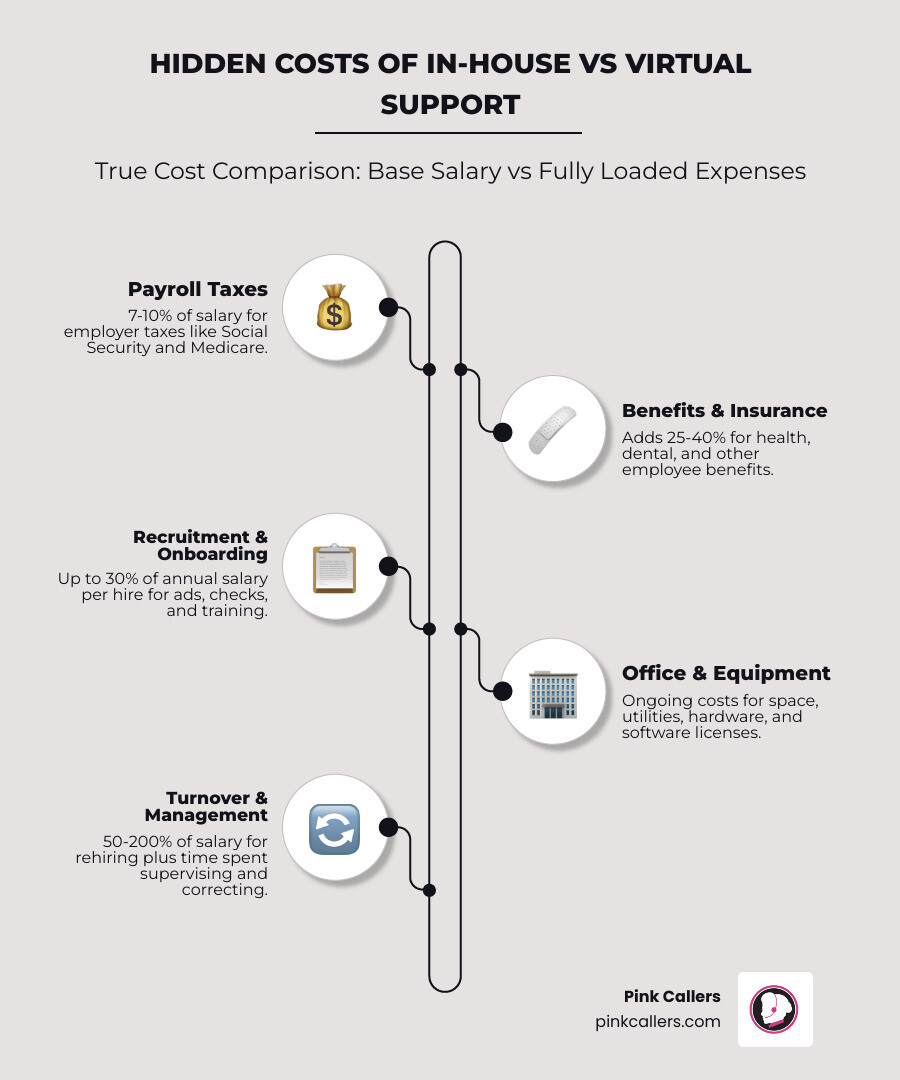
The Hidden Costs of Hiring In-House vs Virtual Support Beyond Base Salary

When we look at the financial ledger of a growing HVAC or plumbing company, the "base salary" is just the tip of the iceberg. To understand the hidden costs of hiring in house vs virtual support, we have to look at what industry experts call the "fully loaded" cost. In the United States, a mid-level administrative employee might have a base salary of $45,000 to $55,000, but the total annual cost to the business often tops $80,000 or even $90,000.
The Breakdown of In-House Overheads
The moment you hire someone in-house in cities like Nashville or Charlotte, you aren't just paying their hourly wage. You are immediately responsible for:
- Employer Taxes: Federal and state payroll taxes (including FICA) typically add 7% to 10% on top of the salary.
- Benefits Packages: Health insurance, dental, and vision are standard expectations. These benefits often add 25% to 40% to the base pay.
- Retirement Contributions: Matching 401(k) or pension contributions adds another layer of financial commitment.
- Paid Time Off (PTO): When an in-house employee takes a two-week vacation or a few sick days, you are paying for zero productivity. You’re also likely paying someone else overtime to cover their shift.
In contrast, when utilizing Virtual Assistant Services, these burdens vanish. You aren't responsible for their health insurance, their retirement, or their taxes. You pay for the service provided, turning a complex, variable expense into a predictable line item.
| Cost Element | In-House Employee | Virtual Support (Pink Callers) |
|---|---|---|
| Base Pay | Fixed Salary | Scalable/Fractional |
| Payroll Taxes | 7-10% extra | Included in service |
| Health/Retirement | 25-40% extra | $0 |
| Equipment/Desk | $3,000 - $5,000 | $0 |
| PTO/Sick Leave | Paid by employer | $0 (Agency covers gaps) |
| Total Multiplier | 1.3x - 1.4x salary | 1.0x service fee |
Analyzing the Management Tax and Productivity Fluctuations
There is a subtle "management tax" that comes with every in-house hire. This includes the time you, as the owner or manager, spend briefing the team, correcting errors, and conducting performance reviews. In an office setting, the "water cooler effect" is real. Statistics show that in-house employees often spend a portion of their day on non-productive tasks, social interactions, or personal errands.
With virtual support, the focus shifts to a results-driven model. The Value of Virtual Assistants lies in their efficiency; they are often pre-trained in industry-specific tools like ServiceTitan, meaning you spend less time explaining how to book a job and more time watching your calendar fill up. You aren't paying for their lunch break or the time they spend chatting with the technicians in the warehouse.
Evaluating 24/7 Coverage and Multi-Time Zone Support
For a contractor in Jacksonville or Fort Worth, a pipe burst or an AC failure doesn't happen on a 9-to-5 schedule. If you rely solely on in-house staff, you face a difficult choice: pay expensive overtime for after-hours leads, or let those calls go to voicemail—where 80% of callers will simply hang up and call your competitor.
To achieve 24/7/365 human coverage in-house, you would need to hire three to four full-time employees to cover nights, weekends, and holidays. The cost is astronomical. By using a Fractional CSR model, you gain access to a team that is already awake and ready to handle emergency dispatching at 2:00 AM on a Sunday, without the need for you to manage a graveyard shift.
Recruitment, Onboarding, and the True Price of Turnover
The hidden costs of hiring in house vs virtual support are perhaps most painful during the hiring phase. The average cost to onboard a new in-house hire is estimated at $4,700, but that’s just the direct spend. When you factor in advertising fees on job boards, background checks, and the dozens of hours spent interviewing candidates, the price tag climbs.
Then comes the "training period." A new in-house CSR typically takes 30 to 90 days to reach full productivity. During this time, you are paying a full salary for half-speed work. If that employee leaves within the first year—which happens to about 34% of new hires—you lose all that invested capital. The total cost of turnover can range from 50% to 200% of the employee's annual salary. For a $40,000 receptionist, a single turnover event could cost your business $20,000 to $80,000 in lost productivity and re-hiring fees.
This is a primary reason why many contractors ask, "Why Hire a Virtual Assistant?" It removes the risk of the "bad hire" cycle.
Mitigating the Hidden Costs of Hiring In-House vs Virtual Support Through Stability
When you partner with an agency, you aren't just hiring a person; you’re hiring a system. If a specific virtual CSR moves on, the agency handles the replacement and training at no cost to you. This agency-backed continuity ensures that your Virtual Business Assistant workflows remain uninterrupted. You don't lose the "institutional knowledge" of how your business operates because the processes are documented and managed by the service provider.
Infrastructure and Technology: Office Space vs. Remote Scalability
In cities like San Diego or Middleburg, commercial real estate is a major line item. Every in-house employee requires:
- Physical Space: A desk, a chair, and approximately 100-150 square feet of office space.
- Utilities: Increased electricity, water, and high-speed internet usage.
- Hardware: A professional-grade computer, dual monitors, a headset, and a desk phone.
- Software: Licenses for your CRM, VOIP system, and office suites.
These infrastructure costs can easily add $5,000 to $10,000 per year per employee. Virtual support requires zero square footage. They provide their own hardware and high-speed internet. Furthermore, they are often experts in CRM Management Services, meaning they can help you optimize your existing technology rather than just taking up space in the office.
Scalability is another hidden financial factor. If your HVAC business in Phoenix hits a massive heatwave, you might need double the call capacity for three weeks. You can't hire and train an in-house employee that fast. Conversely, when the "shoulder season" hits and calls slow down, you're stuck paying a full-time salary to an in-house employee who has nothing to do. Virtual models allow you to scale up or down based on actual demand.
Security, Accountability, and the Hidden Costs of Hiring In-House vs Virtual Support
One of the most common concerns we hear involves data protection and accountability. "How do I know they are actually working?" or "Is my customer data safe?"
Interestingly, the hidden costs of hiring in house vs virtual support often favor the virtual model here as well. Professional Virtual CSR Services use advanced time-tracking and screen-monitoring software that provides more accountability than an in-house employee sitting at a desk.
From a security standpoint, reputable virtual agencies carry professional indemnity insurance and use secure, encrypted system access. In-house employees, while physically present, can actually pose a higher risk for data breaches if they lack rigorous, agency-level security training or if they use unvetted personal devices on the office network. By using a hybrid AI + human model, every interaction is logged, recorded, and searchable, providing a level of transparency that is difficult to replicate with a traditional receptionist.
Frequently Asked Questions about Staffing Costs
Does a virtual assistant require physical office space?
No. One of the greatest savings of a virtual model is the total elimination of office overhead. Your virtual support team works from their own secure, professional environments. You don't need to provide a desk, a chair, or even a cup of coffee. This allows you to either downsize your commercial lease or use that extra office space for more profitable activities, like parts storage or technician training.
How quickly can a virtual support model scale during peak seasons?
In the home services industry, demand is often dictated by the weather. A virtual support model can typically scale within days, compared to the weeks or months it takes to recruit, background check, and train an in-house hire. Because the talent is already pre-trained in home service workflows and CRM software, they can jump into your queue and start booking jobs immediately during a surge.
What is the 'management tax' associated with in-house employees?
The "management tax" refers to the hidden cost of the time business owners spend on HR-related tasks. This includes processing payroll, managing interpersonal office conflicts, conducting annual reviews, and supervising daily activity. For many contractors, their time is worth $100+ per hour. Spending five hours a week on employee management is a $500/week "tax" on the business. Virtual support significantly reduces this tax by providing self-managed, agency-supervised professionals.
Conclusion: Choosing the Smarter Path for Growth
Strategic staffing is no longer just about who sits in the office; it’s about who provides the best return on investment. The hidden costs of hiring in house vs virtual support make it clear that for the modern HVAC, plumbing, or electrical contractor, the traditional in-house model is often the most expensive and least flexible option.
At Pink Callers, we help you bypass these hidden expenses through our hybrid AI + human model. By combining our proprietary AI assistant, "pAIge," with ServiceTitan-certified, U.S.-based representatives, we ensure your business has 24/7/365 coverage without the overhead of a traditional call center or the risk of in-house turnover. Whether you are looking for Virtual CSR Services Atlanta or support in any of our other service locations, we provide the scalability and professionalism your business needs to thrive.
Stop paying for the desk, the taxes, and the downtime. Start paying for the booked jobs and the happy customers. Let us handle the phones so you can handle the growth.
Keep reading
More from the blog
How We Handle Multi-Trade Dispatching for HVAC and Plumbing Combos
Misrouting an ambiguous 'no hot water' call wastes highly skilled technicians' time. We break down the exact intake triage rules that successfully separate plumbing from HVAC tickets.
Read → September 14, 2026Outsourced Customer Service vs Hiring a Local Temp Agency
Losing a dispatcher right before the fall heating rush can overwhelm any contractor. Compare the operational impact of a specialized call center versus a local temp worker to protect your revenue.
Read → September 11, 2026Transitioning Phone Scripts for Northeast Fall Boiler Prep
The first freeze brings a sudden wave of urgent no-heat calls that can easily overwhelm untrained CSRs. Prepare your dispatch board by strategically updating your front-office triage process.
Read →