
Blog · Archive
How Technology Is Transforming Contractor Customer Service
Discover how technology is transforming contractor customer service with AI, virtual receptionists, and real-time tools that boost response speed and customer satisfaction.

Why Technology Is Reshaping How Contractors Serve Customers in 2026
How technology is transforming contractor customer service is one of the most important questions facing HVAC, plumbing, electrical, and roofing business owners right now. The short answer: faster responses, smarter call handling, automated scheduling, and AI-powered tools are replacing phone tag and paper trails — and homeowners are starting to expect it.
Here is a quick look at the key ways technology is changing contractor customer service today:
- AI-powered call handling answers every inbound call instantly, 24/7, even when your team is on a job
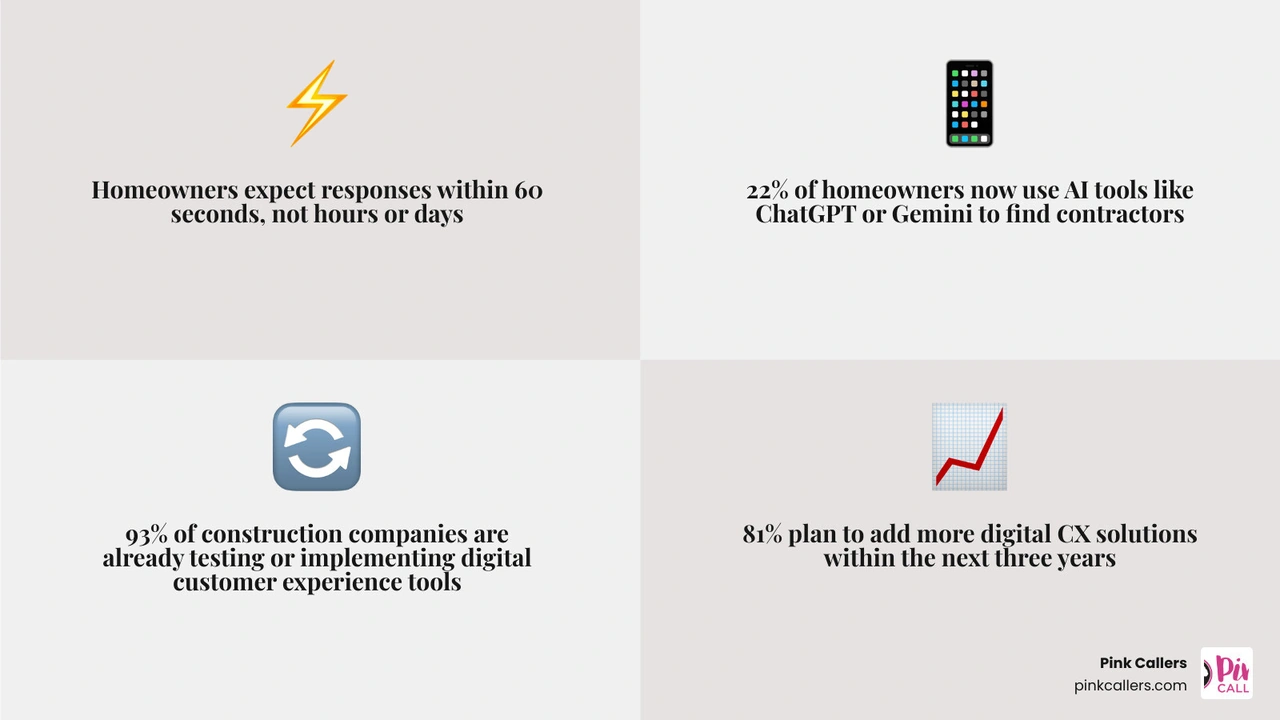
- Automated lead follow-up responds to new inquiries in under 60 seconds instead of hours
- Smart CRM integrations (like ServiceTitan) keep scheduling, dispatch, and job notes synced in real time
- Client portals give homeowners live project updates without needing to call the office
- AI search visibility means platforms like ChatGPT and Gemini are now recommending contractors to homeowners — 22% of homeowners already use AI tools to find service providers
- Reputation automation sends review requests after every job, building trust at scale
- Hybrid AI + human models combine speed and automation with the empathy and judgment customers need for complex situations
The construction and trades industry has never moved fast when it comes to new technology. For decades, "the system" meant a whiteboard, a stack of sticky notes, and someone in the office who knew where everything was. But that model is cracking under pressure.
Homeowners today expect instant responses, transparent communication, and professional follow-through from the first call to the final invoice. Meanwhile, 93% of industrial manufacturing and construction companies are already experimenting with or implementing digital customer experience tools — and 81% plan to add more within the next three years. The gap between contractors who adapt and those who don't is widening fast.
For busy owners of HVAC, plumbing, and electrical businesses, this shift is not just about keeping up with trends. It is about not losing jobs to competitors who answer the phone at 9 PM when you cannot.
The Shift in Homeowner Expectations and Discovery
The way homeowners find and interact with contractors has fundamentally shifted. In the past, a customer would open a phone book or ask a neighbor for a recommendation, call three different businesses, leave voicemails, and wait days for a callback. Today, the modern homeowner wants immediate answers and complete transparency.
This transformation is heavily driven by consumer experiences in other industries. When people can order groceries, track a rideshare driver in real time, and book a flight in seconds, they expect the exact same level of convenience when their water heater leaks or their air conditioner stops working. To stay competitive, trade businesses must understand these shifting Industry Trends in Home Service Customer Experience and adapt their operational models accordingly.
How Technology Is Transforming Contractor Customer Service Through AI Search
One of the most surprising shifts in 2026 is how homeowners actually find contractors in local markets like San Diego, Fort Worth, or Charlotte. Traditional search engines are no longer the sole gatekeepers of local business discovery. Instead, AI search platforms are taking over.
Recent data shows that 22% of homeowners now use ChatGPT to find contractors and research local service providers. Instead of typing "plumber near me" into a search engine and browsing through pages of ads, customers are asking conversational questions to AI tools like Gemini, Perplexity, and Siri. A homeowner might ask: "Who is a highly rated local electrician in Nashville who specializes in EV charger installations and has great weekend availability?"
For contractors, this means that online visibility is no longer just about basic SEO. Your business must be optimized for AI search engines. These AI models crawl your website, read your customer reviews, and analyze your service descriptions. If your business lacks a clear, data-rich digital footprint, AI tools will recommend your competitors instead. Having up-to-date, detailed service pages and a high volume of recent, positive reviews is now essential to ensure these intelligent platforms recommend your brand.
The Rise of the 24/7 Instant Response Standard
Once a customer finds your business, the clock starts ticking. The modern consumer has zero patience for voicemail. In fact, studies show that up to 60% of callers will simply hang up without leaving a message if they are sent to voicemail after hours.
This is where the "speed-to-lead" metric becomes make-or-break for your bottom line. Research from the Harvard Business Review reveals that responding to a sales lead within 5 minutes versus 30 minutes makes a company 100 times more likely to successfully connect with the prospect. If you take three to four hours to reply to an online form submission or return a missed call, that homeowner has already booked an appointment with another contractor who responded instantly.
Missing these calls is an incredibly expensive habit. When you calculate the average job ticket across the trades, The Real Cost of a Missed Phone Call for Service Businesses can easily add up to hundreds of thousands of dollars in lost annual revenue. Homeowners equate responsiveness with reliability. If you do not answer the phone when they are dealing with a midnight plumbing emergency or a sweltering HVAC failure, they will immediately move on to the next option.
Core Technologies Driving the Contractor Customer Experience
To meet these rising expectations, leading contractors are building robust digital foundations. They are moving away from fragmented, manual processes and adopting integrated software ecosystems that connect the field, the office, and the customer.

Smart CRM and Dispatching Integrations
At the center of this digital transformation is the Customer Relationship Management (CRM) platform. For home service businesses, specialized CRMs like ServiceTitan, Jobber, and Housecall Pro have become the operational command centers.
These platforms do far more than just store customer phone numbers. They enable:
- Real-Time Scheduling: Customers can book their own appointments online based on actual technician availability, eliminating back-and-forth emails.
- Automated Dispatching: GPS-enabled dispatching software matches the right technician to the right job based on location, skill level, and parts inventory.
- Technician Tracking: Homeowners receive a text message when their technician is en route, complete with the technician’s photo, bio, and a live map tracking their arrival.
By integrating these CRM systems with your customer service operations, your team always has access to clean, real-time data. When a customer calls, the representative can instantly see their entire job history, active warranties, and past invoices, allowing for a personalized, efficient experience.
Client Portals and Real-Time Project Updates
For larger projects like roof replacements or complete system installations, transparency is the key to customer retention. Homeowners often feel anxious during major home projects because they do not know what is happening behind the scenes.
Client portals solve this problem by providing a secure, 24/7 digital window into the project. Through these portals, customers can:
- View real-time project timelines and daily updates.
- Review and digitally sign estimates, proposals, and change orders.
- Access job site photos and observational data.
- Make secure digital payments or apply for consumer financing instantly.
Digital payments and financing are particularly powerful. Giving homeowners the ability to pay via credit card, Apple Pay, or quick-financing options directly through their portal or a technician's mobile device drastically improves cash flow. It also reduces the administrative burden of chasing down unpaid invoices, making the entire transaction smooth and professional.
How Technology Is Transforming Contractor Customer Service in Call Handling
While client portals and CRMs are incredibly valuable, the phone remains the primary lifeline for most home service businesses. However, managing high call volumes while running a busy field operation is a constant struggle. This is where AI-driven call handling is making the biggest waves.
AI Voice Agents and Automated Lead Qualification
AI voice agents have evolved far beyond the frustrating, robotic menus of the past. Today's conversational AI assistants can handle complex, natural phone conversations with homeowners.
To understand how this works in practice, it helps to look at How Does AI Call Handling Work for Home Service Businesses. When a customer calls your business, an AI assistant can answer within two rings, 24/7/365. The AI is trained on your specific trade vocabulary, service areas, and scheduling rules.
These systems can:
- Pre-Qualify Leads: The AI asks targeted questions to determine the job type, scope, and urgency (e.g., separating a routine maintenance request from an active basement flood).
- Book Appointments: The AI integrates directly with your CRM calendar to schedule appointments in real time.
- Provide Ballpark Estimates: For simple, flat-rate services, the AI can provide standard pricing ranges based on your pre-configured rules.
This ensures that your business never misses a lead, even at 2 AM on a Sunday, without requiring you to pay for expensive internal night-shift staff.
Balancing Automation with the Human Touch
As powerful as AI is, it is not a complete replacement for human empathy. Homeowners dealing with a collapsed sewer line or a freezing house in the middle of winter are often stressed, frustrated, or anxious. They need to hear a reassuring, empathetic human voice that can understand nuance and provide emotional comfort.
This is why top-performing contractors rely on a hybrid model. Understanding What is a Hybrid AI and Human Customer Service Model is crucial for balancing efficiency with customer trust. In this model, AI handles the repetitive, high-volume tasks—such as answering basic FAQs, scheduling routine tune-ups, and sending text confirmations—while seamlessly routing complex, emotional, or high-value calls to skilled human representatives.
If a customer is upset about an invoice or has a highly technical question that requires human judgment, the AI performs a "warm handoff," transferring the caller to a live customer service representative (CSR) along with all the context it has already gathered. When considering this balance, it becomes clear that relying on Is AI Alone Enough for Contractor Call Handling is a risky strategy; the human touch remains irreplaceable for building long-term, trust-based relationships.
Overcoming Barriers to Tech Adoption in the Trades
Despite the clear benefits, many contracting businesses struggle to adopt new technologies. The trades have a reputation for being slow to change, often due to a few common roadblocks:
- Resistance to Change: Field technicians and office staff may be comfortable with their existing manual habits and fear a steep learning curve.
- Fragmented Systems: Buying multiple software tools that do not talk to each other creates more manual work and data silos, rather than less.
- Upfront Resource Investment: While modern cloud-based tools are highly scalable, setting them up and training your team requires dedicated time and focus.
However, the risk of staying manual is far greater than the temporary friction of onboarding new software. Contractors who rely on paper and voicemail are actively losing market share. To help visualize this transition, let us look at how manual workflows compare to modern automated systems:
| Business Workflow | Traditional Manual Method | Modern Automated Method |
|---|---|---|
| Inbound Call Handling | Sent to voicemail if the office is busy or closed; high rate of hang-ups. | Answered instantly 24/7 by AI or virtual CSRs; appointments booked immediately. |
| Lead Response Time | 3 to 5 hours on average; handled manually when office staff have free time. | Under 60 seconds via automated, multi-channel text and email follow-ups. |
| Technician Dispatch | Manual phone calls or texts to technicians; no real-time ETA for the customer. | Automated routing via CRM; automated text to customer with live GPS tracking. |
| Invoicing & Payments | Paper invoices mailed or left behind; check or manual card processing. | Digital invoices sent instantly via SMS/email; secure, one-click online payments. |
| Review Generation | Techs must remember to ask; manual email follow-ups are rare. | Automated review requests sent via SMS immediately after job completion. |
To make this transition successfully, business owners must learn How Contractors Can Scale Without Losing Customer Service Quality. The secret is to start small. Do not try to overhaul your entire business in a single weekend. Identify your single biggest bottleneck—whether it is missed after-hours calls or slow proposal turnaround times—fix that workflow first, and then scale your technology stack from there.
How Technology Is Transforming Contractor Customer Service Training and Onboarding
Introducing new technology to your team requires a structured approach. If your field technicians find a new mobile app too complicated, they will simply stop using it, leading to poor data and wasted investments.
When rolling out new software:
- Focus on the "Why": Explain to your team how the new tool will make their lives easier (e.g., "This app will eliminate two hours of paperwork at the end of your shift").
- Provide Structured Training: Run hands-on training sessions and create simple, step-by-step cheat sheets.
- Choose Intuitive, Industry-Specific Tools: Use platforms designed specifically for the trades, which feature simple interfaces optimized for mobile phones on rugged job sites.
Furthermore, if you are outsourcing your call handling to virtual assistants, you might wonder: Can a Virtual CSR Really Represent My Brand effectively? The answer is yes—if you partner with a service that integrates deeply with your brand voice, understands your local service areas (like Middleburg, Virginia, or Jacksonville, Florida), and undergoes continuous training on your specific business processes and CRM workflows.
Frequently Asked Questions about Contractor Customer Service Tech
What is the most impactful customer service technology for a small contractor?
For a small contractor, the single most impactful technology is automated lead follow-up and instant call answering. Because small businesses often lack a dedicated, full-time receptionist, they miss a high percentage of incoming calls while working in the field. Implementing an automated system that answers every call and instantly texts back new leads ensures you capture every opportunity, providing the fastest and most measurable return on investment.
How do digital portals improve customer retention in plumbing and roofing?
Digital portals build trust through radical transparency. In trades like roofing and plumbing, where customers cannot easily see the work being done (such as on a roof or inside a crawlspace), portals allow contractors to share real-time photos, videos, and diagnostic reports.
To see how this impacts growth, you can read about How Virtual CSRs Help Plumbing Companies Grow and How Virtual CSRs Help Roofing Companies Grow. By keeping customers informed and making payments effortless, portals turn one-time emergency service calls into lifelong relationships.
Can AI handle complex customer service scenarios without human intervention?
No, AI cannot handle every scenario alone. While AI is excellent for structured tasks like scheduling a standard maintenance appointment or answering basic FAQs, it lacks the emotional intelligence, empathy, and complex problem-solving skills required for high-stress situations. A successful system must have pre-defined escalation paths that immediately route complex inquiries, billing disputes, or emotional customers to a live, human representative.
Conclusion
The digital revolution in the home service industry is no longer a future prediction—it is the current reality of 2026. How technology is transforming contractor customer service is clear: it empowers businesses to operate faster, communicate more clearly, and capture revenue that used to slip through the cracks of missed calls and disorganized schedules.
At Pink Callers, we help HVAC, plumbing, electrical, and roofing contractors navigate this digital shift. Our unique Human + AI Hybrid model combines our advanced voice AI assistant, "pAIge," with our highly trained, ServiceTitan-certified virtual customer service representatives. Operating 24/7/365 from our headquarters in Middleburg, Virginia, and serving home service businesses nationwide, we ensure your business never misses a call, while maintaining the personal, empathetic touch your customers deserve.
Ready to scale your business while delivering world-class customer service? Let us help you build a winning customer experience. Learn more about Building a Customer Service Culture in Your Contracting Business, or explore our dedicated Plumbing Customer Service Support to see how we can streamline your operations today.
Keep reading
More from the blog
How We Handle Multi-Trade Dispatching for HVAC and Plumbing Combos
Misrouting an ambiguous 'no hot water' call wastes highly skilled technicians' time. We break down the exact intake triage rules that successfully separate plumbing from HVAC tickets.
Read → September 14, 2026Outsourced Customer Service vs Hiring a Local Temp Agency
Losing a dispatcher right before the fall heating rush can overwhelm any contractor. Compare the operational impact of a specialized call center versus a local temp worker to protect your revenue.
Read → September 11, 2026Transitioning Phone Scripts for Northeast Fall Boiler Prep
The first freeze brings a sudden wave of urgent no-heat calls that can easily overwhelm untrained CSRs. Prepare your dispatch board by strategically updating your front-office triage process.
Read →