
Blog · Archive
How to Handle Emergency Calls During Holidays in 5 Easy Steps
Learn how to handle emergency calls during holidays with 5 proven steps that protect your team and keep customers safe.

Why Knowing How to Handle Emergency Calls During Holidays Can Make or Break Your Business
Knowing how to handle emergency calls during holidays is one of the most critical — and most overlooked — decisions a home service business owner can make. Pipes burst on Christmas Eve. Furnaces fail on New Year's morning. Garbage disposals quit mid-Thanksgiving dinner. These aren't rare scenarios. They happen every year, and the contractor who answers is the one who wins the job.
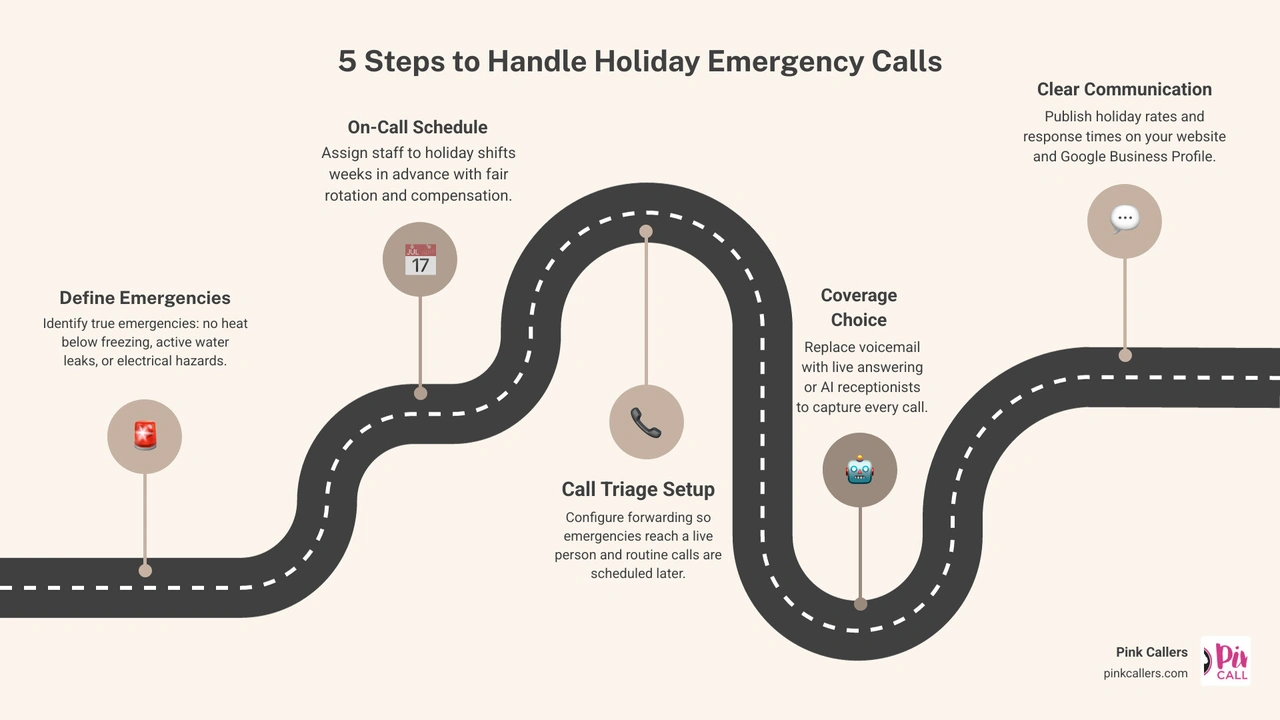
Here is a quick overview of how to handle emergency calls during holidays:
- Define your emergencies - Decide in advance which situations qualify as true emergencies (no heat below freezing, active water leak, sparking electrical panel).
- Set up an on-call schedule - Assign staff to specific holiday windows well before the holiday arrives.
- Configure call forwarding and triage - Route calls automatically so emergencies reach a live person and routine requests get booked for later.
- Choose the right coverage option - Voicemail loses callers. A live or AI-powered answering service keeps them.
- Communicate rates and expectations - Tell customers upfront what holiday emergency service costs and when to expect a response.
The stakes are real. Home service businesses see anywhere from 50% to 100% more calls on major holidays compared to a normal day. At the same time, 80% of callers won't leave a voicemail — they hang up and call the next contractor on the list. That means every unanswered call on Christmas Day is a paying job walking straight to your competitor.
This guide walks you through each step so your team stays protected, your customers get help, and your business keeps running — even when everyone else is at the dinner table.
The Reality of Holiday Emergency Calls: 9-1-1 vs. Home Services
When we think of holiday emergencies, we often picture flashing lights, sirens, and public safety dispatchers. Public safety operators do not get holidays off. Whether it is Christmas Day, New Year’s Eve, or Thanksgiving, 9-1-1 dispatch centers in major hubs like Nashville, Charlotte, and Jacksonville remain fully staffed and operational around the clock.
However, the holiday season introduces unique, high-stress challenges for these public safety heroes. First, call volumes spike due to seasonal hazards. An estimated 15,000 people end up in the emergency room as a result of holiday decoration injuries alone during the holiday season. Furthermore, there is a 20% increase in car collisions during the month of December, driven by winter weather, holiday travel, and increased traffic.
These factors, combined with severe winter weather conditions, make locating and sending emergency services highly complex. For dispatchers, managing this relentless influx of high-stakes calls while their own families are celebrating can quickly lead to severe stress and burnout.
For a deeper look at managing seasonal spikes, check out our Holiday Season Call Coverage Guide.
Why Holiday Call Volumes Spike for Emergency Services
The winter holiday season is a perfect storm for public safety emergencies. Frigid December road conditions cause traffic accidents to multiply, while dry Christmas trees and unattended holiday cooking lead to a rise in residential fires.
At the same time, medical emergencies do not take a holiday. From cooking mishaps to seasonal depression and family disputes, emergency call takers must maintain absolute composure, actively listening to background noises and deploying rapid solutions during the busiest time of the year.
How to Handle Emergency Calls During Holidays for Home Service Contractors
While public safety dispatchers handle life-and-death crises, home service contractors are the unsung heroes of property preservation. When a homeowner's heating system fails in the freezing temperatures of Fort Worth, or a major pipe bursts in Middleburg, Virginia, it is a true residential emergency.
For contractors, holiday calls are incredibly high stakes. If you fail to answer, the consequences are immediate. Statistics show that 80% of callers won't leave a voicemail; they simply hang up and call the next contractor on the list.
Additionally, 77% of customers expect an immediate response after reaching out to a business. Missing just one of these high-value calls does not just lose you a single job—it can permanently damage your local reputation and hand a lifelong customer to your competitor.
To understand the financial impact of these missed opportunities, read about The Real Cost of a Missed Phone Call for Service Businesses.
How to Handle Emergency Calls During Holidays in 5 Steps
Successfully managing holiday calls requires a delicate balance. You must capture high-value emergency leads while protecting your hard-working technicians from burnout. Achieving this balance is impossible without a structured, proactive strategy.
To help you navigate this busy season, we have broken down the process into five actionable steps. For an in-depth look at managing your after-hours operations, explore our guide on Mastering After Hours Service: A Guide for Home Service Businesses.
Step 1: Define What Constitutes a True Holiday Emergency
Before the holiday season begins, you must explicitly define what constitutes a true emergency for your specific trade. If you do not set these boundaries, your on-call technicians will find themselves dispatched to fix minor issues like a slow-draining sink on Christmas night, leading to frustration and rapid burnout.
An emergency should be strictly defined as a situation that threatens the immediate safety of the occupants or the structural integrity of the home.
- Plumbing Emergencies: A major, uncontrollable water leak that cannot be isolated; a sewage backup flooding the home; or a total loss of water in freezing temperatures.
- HVAC Emergencies: A complete loss of heat when outdoor temperatures drop below freezing (especially in households with infants, elderly residents, or medical conditions); or a total loss of air conditioning during extreme southern summer holidays.
- Electrical Emergencies: A sparking electrical panel, a burnt outlet smell, or a partial power outage that threatens medical equipment.
By establishing these clear parameters, you can quickly filter out routine service requests and schedule them for normal business hours. For more tips on keeping your lead pipeline full without sacrificing your personal time, read How to Handle After Hours Calls Without Losing Leads.
Step 2: Establish a Fair and Sustainable On-Call Schedule
Forcing your technicians into an automatic, rigid holiday rotation is one of the fastest ways to accelerate employee burnout. On-call shifts during major holidays disrupt irreplaceable family moments that cannot be rescheduled, and these experiences heavily influence your team's long-term career satisfaction.
To build a sustainable scheduling system, follow these best practices:
- Plan Far in Advance: Publish your holiday on-call schedules at least 60 to 90 days ahead of time. This gives your team plenty of time to coordinate family gatherings and travel plans.
- Implement a Volunteer-First System: Offer premium holiday incentives to encourage volunteers before forcing a rotation. Many technicians are happy to trade holiday availability for extra compensation.
- Provide Premium Holiday Compensation: Industry standard incentives include 1.5x to 2x hourly pay for on-call hours, plus a substantial flat dispatch bonus (such as $50 to $100) for every completed job.
- Allow Early Schedule Swaps: Encourage your team to coordinate and swap shifts early. For example, a technician who does not observe Thanksgiving may gladly swap shifts with a teammate who values that time off.
Step 3: Set Up Holiday Call Forwarding and Triage Protocols
Your phone system should never be left to ring unanswered, nor should it simply forward every single holiday call directly to your on-call technician's personal cell phone. Doing so will overwhelm your staff with non-emergency inquiries, telemarketers, and routine scheduling requests.
Instead, utilize modern phone overrides to route calls systematically. Many advanced phone systems allow you to pre-schedule holiday overrides weeks in advance.
Your call routing should follow a strict three-tier triage system:
- Tier 1 (Safety/Emergency): The caller is experiencing a defined emergency. These calls are immediately routed to your live on-call technician or dispatched for rapid response.
- Tier 2 (Urgent but Non-Emergency): The caller has a significant issue that does not threaten safety (e.g., a broken water heater that is not leaking). These calls are captured, and the customer is booked for the first available slot on the next business day.
- Tier 3 (Routine): General inquiries, billing questions, or routine maintenance requests. These callers are greeted with an automated message or a professional virtual receptionist who records their details and assures them of a follow-up after the holiday.
Integrating this workflow with your CRM (such as ServiceTitan, Jobber, or Housecall Pro) ensures that every lead is recorded, jobs are booked, and dispatchers have real-time visibility. To learn why answering your own phone can hurt your business growth, read Why Contractors Who Answer Their Own Phones Lose Leads.
Step 4: Choose the Right Holiday Phone Coverage Option
When it comes to holiday phone coverage, you have several options. While voicemail is the easiest to set up, it is also the most expensive in terms of lost revenue. If a homeowner with a burst pipe reaches a voicemail box, they will hang up and call your competitor.
To keep your business protected, consider how traditional answering services compare to modern, AI-enhanced solutions:
| Feature | Traditional Answering Service | AI-Enhanced Hybrid Service (Pink Callers) |
|---|---|---|
| Holiday Fees | Often charges 1.5x to 2x normal rates or flat holiday surcharges | Consistent, scalable flat rates with no hidden holiday fees |
| Capabilities | Basic message taking; rarely integrates directly with your CRM | Full CRM integration (ServiceTitan), live booking, and intelligent triage |
| Response Time | Can experience high wait times during major holiday spikes | Immediate response, capturing 100% of incoming leads |
| Accuracy | Prone to human error when handling complex trade terminology | Highly accurate AI ("pAIge") backed by professional human CSRs |
Using a hybrid model—where an intelligent voice AI handles immediate intake and partners with professional customer service representatives—allows you to maintain a flawless customer experience without paying exorbitant holiday fees.
To discover how round-the-clock support can transform your business, read about our 24/7 Business Answering Service.
Step 5: Communicate Emergency Rates and Expectations Clearly
Transparency is your best tool for managing customer expectations and avoiding disputes. Homeowners in genuine emergency situations are usually willing to pay premium rates, but they expect to be informed of those costs upfront.
- Explicitly State Holiday Rates: If you charge a holiday dispatch fee or elevated emergency hourly rates, ensure your call takers communicate this clearly before sending a technician.
- Set Realistic SLAs: Let the customer know exactly when they can expect a technician to arrive. Under-promise and over-deliver on your response times.
- Update Your Online Presence: By mid-December, update your Google Business Profile, social media accounts, and website homepage to state your holiday hours and confirm that your emergency lines are monitored 24/7.
Frequently Asked Questions About Holiday Emergency Calls
Managing holiday operations can bring up many questions for home service business owners. Below are some of the most common inquiries we receive regarding holiday call management.
Do 9-1-1 operators and emergency services work on Christmas and New Year's Day?
Yes, public safety dispatchers, police officers, firefighters, and medical personnel work 24/7/365, including Christmas, New Year's Day, Thanksgiving, and all other major holidays. Because emergencies do not take breaks, these essential workers remain on duty to keep our communities safe.
How should contractors handle non-emergency calls during holidays?
The best approach is to answer the call, reassure the customer that their request has been received, and book them into the first available slot on the next regular business day. Most non-emergency callers are happy to wait as long as they speak to a live person and secure a scheduled appointment.
Using a professional Live Phone Answering Service ensures these non-emergency leads are captured and booked, preventing them from calling your competitors.
What is the best way to manage how to handle emergency calls during holidays without burning out my team?
The most effective strategy is to separate call answering from actual technician dispatch. By utilizing a hybrid model that combines smart automation with professional virtual receptionists, you can filter out non-emergency calls entirely.
This ensures your on-call technicians are only disturbed for true, high-value emergencies, allowing them to enjoy their holidays while your business continues to capture valuable leads. Learn more about how a Remote Live Answering Service can streamline your holiday operations.
Conclusion
Mastering how to handle emergency calls during holidays is the key to protecting your team's sanity while maximizing your seasonal revenue. When you establish clear emergency criteria, build a fair on-call schedule, and put the right call-handling systems in place, you no longer have to choose between family time and business growth.
At Pink Callers, we specialize in helping HVAC, plumbing, electrical, and roofing businesses navigate these high-stress seasons seamlessly. Our unique hybrid model combines our advanced voice AI, "pAIge," with professional, ServiceTitan-certified virtual CSRs to ensure that every holiday call is answered immediately, triaged accurately, and booked directly into your CRM.
Ready to experience holiday peace of mind? Visit our After Hours Policy Guide to learn how we can help you build the perfect coverage strategy for your business.
Keep reading
More from the blog
How We Handle Multi-Trade Dispatching for HVAC and Plumbing Combos
Misrouting an ambiguous 'no hot water' call wastes highly skilled technicians' time. We break down the exact intake triage rules that successfully separate plumbing from HVAC tickets.
Read → September 14, 2026Outsourced Customer Service vs Hiring a Local Temp Agency
Losing a dispatcher right before the fall heating rush can overwhelm any contractor. Compare the operational impact of a specialized call center versus a local temp worker to protect your revenue.
Read → September 11, 2026Transitioning Phone Scripts for Northeast Fall Boiler Prep
The first freeze brings a sudden wave of urgent no-heat calls that can easily overwhelm untrained CSRs. Prepare your dispatch board by strategically updating your front-office triage process.
Read →