Blog · Archive
How Robots and Humans Can Save Your Home Service Business
Discover how AI and human CSRs work together for home service businesses to boost bookings, cut missed calls & scale 24/7 in 2026.

The Missed Call Crisis Hitting HVAC, Plumbing, and Electrical Businesses Right Now
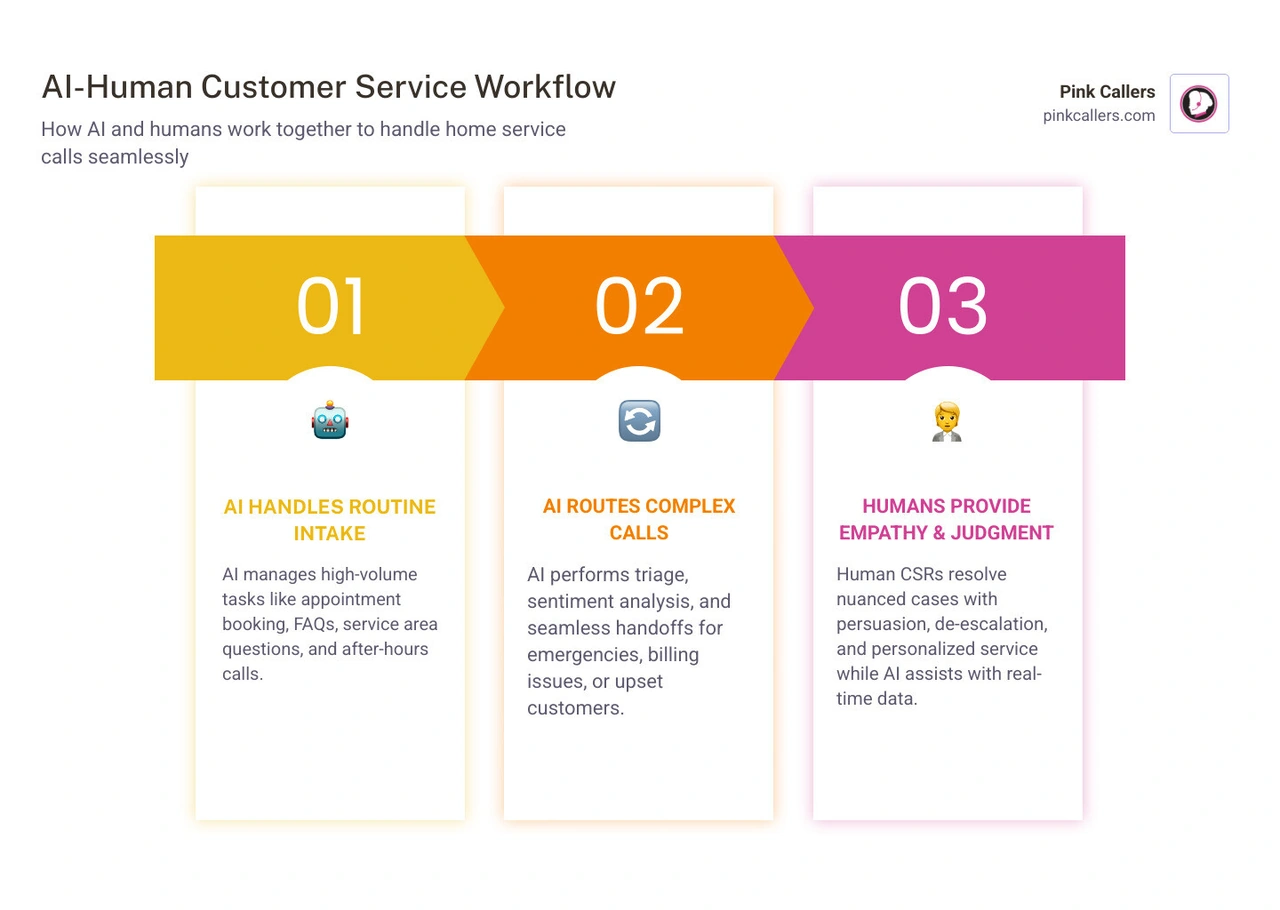
Understanding how AI and human CSRs work together for home service businesses comes down to a simple idea: AI handles the volume, humans handle the nuance — and together, they make sure no lead slips through the cracks.
Here's a quick breakdown of how the model works:
| Role | Who Handles It | Examples |
|---|---|---|
| Routine intake & booking | AI | Scheduling, FAQs, service area questions, after-hours calls |
| Surge overflow | AI | Heatwave spikes, storm season, weekend call floods |
| Complex or emotional calls | Human CSR | Billing disputes, emergencies, upset customers |
| Escalation & handoff | AI passes to Human | Burst pipe at midnight, no-cooling emergency |
| Real-time agent support | AI assists Human | Call notes, customer history, recommended responses |
If you run an HVAC, plumbing, or electrical business, you already know the feeling. Your phone rings while you're under a sink or on a roof — and by the time you're free, the customer has already called someone else.
That's not a rare situation. Research shows that roughly 74% of calls to small home service businesses go unanswered or to voicemail during busy periods. And of those callers, 85% will never call back.
Every one of those missed calls is a job that went to a competitor.
The problem isn't effort. It's capacity. A small team of human customer service reps simply can't be available 24 hours a day, 7 days a week — and they can't scale up overnight when a summer heatwave sends call volume through the roof. But a fully automated AI system, on its own, can feel cold and robotic when a homeowner is panicking about a flooded kitchen at 2 AM.
That's exactly why the hybrid AI and human CSR model is gaining ground fast in the trades. It combines the always-on availability of AI with the judgment and empathy that only a real person can provide — giving your customers a seamless experience no matter when they call or what they need.
What “How AI and Human CSRs Work Together for Home Service Businesses” Really Means in 2026
In 2026, a hybrid model is not just a phone tool. It is a workforce strategy.
That means we do not ask, "Should AI replace people?" We ask, "What should AI do best, and what should humans do best?" The answer is usually an 80/20 split. AI handles the repeatable, high-volume work. Human CSRs handle the moments that require empathy, judgment, persuasion, and flexibility.
This matters because customer expectations are higher than ever. Research shows 64% of customers expect real-time responses, while 64% still prefer a human for more complex issues. Those two facts are not in conflict. They are the whole point of a hybrid model.
A strong setup has:
- An automation layer for speed, consistency, and 24/7 coverage
- An empathy layer for trust, de-escalation, and problem-solving
- A human-in-the-loop system for escalation when the call gets messy, urgent, or emotional
If you want a deeper overview, see What is a Hybrid AI and Human Customer Service Model and AI in Customer Service for Home Service Contractors.
Why AI-only and human-only teams both fall short
AI-only support has obvious strengths: speed, availability, and consistency. But left alone, it can get trapped in what customers hate most: the robotic loop. You know the one. The bot asks for the same thing three times while the caller slowly loses the will to live.
Human-only teams have the opposite problem. They are great at understanding context, calming upset callers, and handling unusual situations. But humans have limits:
- They need breaks
- They cannot answer three ringing lines at once forever
- They are expensive to scale during sudden surges
- They cannot be everywhere after hours without burnout
So each model fails where the other shines.
Why how ai and human csrs work together for home service businesses is becoming the standard
By 2026, hybrid is becoming the standard because it solves the exact problems that hurt contractors most:
- Missed calls
- Slow answer times
- After-hours lead loss
- Seasonal spikes
- Staff overload
- Inconsistent customer experience
Research in this space shows hybrid teams can deliver 3.7x more value than AI-only or human-only approaches. They can also absorb contact spikes of up to 400% without a noticeable drop in response speed. That is a big deal when no-cooling calls flood in during a heatwave or electrical calls stack up after a storm.
For trades businesses, hybrid support means you can act like a much larger operation without losing the human touch that wins trust.
How to Divide the Work Between AI and Human CSRs Without Hurting the Customer Experience
The secret is not to automate everything. The secret is to automate the right things.
As a rule, AI should handle the routine, repeatable, structured tasks that follow clear rules. Human CSRs should handle the high-stakes, high-emotion, or high-judgment situations.
Here is the simplest way to think about it:
| Best for AI | Best for Human CSR |
|---|---|
| Answering after-hours calls | Handling upset callers |
| Booking and rescheduling | Managing billing disputes |
| FAQs and service area questions | Explaining unusual situations |
| Basic lead qualification | Emergency reassurance |
| Spam and robocall filtering | Complex sales conversations |
| Maintenance reminders | Exception handling |
| Gathering intake details | Saving difficult calls |
For more on task design, see How Does AI Call Handling Work for Home Service Businesses and Virtual CSR Services.
Use the 80/20 rule to assign routine vs high-stakes conversations
A good starting point is the 80/20 rule:
- AI handles roughly 80% of routine interactions
- Humans handle the 20% where trust, judgment, or creativity matter most
Typical AI-friendly tasks include:
- Booking appointments
- Rescheduling
- Confirming service areas
- Giving office hours
- Answering common questions
- Collecting contact details
- Sending reminders
- Filtering out spam calls
Typical human-led tasks include:
- Billing complaints
- Emotional emergency calls
- Complicated scheduling exceptions
- Calls with unclear symptoms
- Escalations from frustrated customers
- High-value sales opportunities where trust matters
AI can also help with triage and sentiment analysis. If the caller's tone shifts toward anger, panic, or confusion, the system can flag that and move the call to a person fast.
How ai and human csrs work together for home service businesses during emergencies and complex calls
Home service calls are not all equal. "I'd like a tune-up next Thursday" is not the same as "My kitchen is flooding right now."
In emergencies, AI's job is speed and structure:
- Answer immediately
- Identify the issue
- Confirm location and callback number
- Determine urgency
- Route to the correct on-call person or human CSR
The human CSR's job is reassurance and judgment:
- Calm the customer
- Confirm next steps clearly
- Handle exceptions
- Make decisions when the script no longer fits reality
Think of a burst pipe, no-cooling call in extreme weather, or possible electrical hazard. Those situations need empathy and confidence. Customers want to feel that someone understands the stakes, not that they are trapped in menu option purgatory.
How to audit call logs and identify what should be automated first
If you are a small home service business, do not start by trying to automate your entire front office in one weekend. That is how chaos is born.
Start with a simple audit of the last 6 to 12 months of call activity:
- List the most common call reasons
- Identify which calls happen after hours
- Note where calls are missed or delayed
- Tag repeat questions and repeat workflows
- Highlight calls that required empathy or complex judgment
- Separate spam, routine, urgent, and sales-related calls
Usually, patterns appear fast. You will often find that a large share of calls are repetitive and ideal for automation, while a smaller group drives the biggest need for live human skill.
That makes the best first pilot obvious: after-hours and overflow.
The Seamless Handoff: How to Transfer Customers From AI to a Human Without Repetition
A hybrid system only works if the handoff works.
Nothing destroys trust faster than this sequence:
- Customer explains problem to AI
- AI transfers to human
- Human says, "How can I help you today?"
That is not a handoff. That is a memory wipe.
A real seamless handoff should include live transfer, notes, routing logic, and CRM updates. Learn more about this approach through Home Service Call Center and How Does a Virtual Receptionist Differ from an Answering Service.
The four pieces every handoff must include
Every handoff should pass these four things to the human CSR:
- Caller identity
- Name
- Phone number
- Address
- Existing customer or new lead
- Problem summary
- Why they called
- What system or issue is involved
- What they are trying to book or solve
- Urgency level
- Routine
- Same-day
- Emergency
- Safety concern
- Emotional tone
- Calm
- Frustrated
- Confused
- Panicked
When identity, intent, context, and sentiment move together, the human starts the call informed instead of blind.
What a bad handoff looks like and how to prevent it
A bad handoff usually includes:
- No call summary
- No urgency tag
- No customer history
- A generic transfer to the wrong queue
- A dropped call or forced callback
- The customer repeating everything
To prevent that, your workflow needs:
- Dynamic routing rules
- Real-time summaries
- Shared CRM visibility
- Clear escalation triggers
- Human review of failed transfers
If customers keep repeating themselves, the system is broken. Full stop.
How AI sidekicks make human CSRs faster and more accurate
AI is not only the front-door greeter. It can also be the sidekick behind the scenes.
When a human CSR is on the call, AI can:
- Pull customer history in real time
- Surface prior jobs and notes
- Suggest next-best responses
- Create call summaries automatically
- Update dispositions and tags
- Flag sentiment changes during the conversation
This is where productivity jumps. Research shows AI-enhanced support can reduce call times by 10% to 20%, improve efficiency by 50%, and increase agent productivity by up to 60% by giving real-time context and recommendations.
That means your human team spends less time typing notes and more time actually helping customers.
How a Hybrid Team Solves the Missed Call Crisis and Handles Seasonal Surges
The missed call crisis is one of the biggest growth leaks in the trades.
When roughly 74% of calls to small businesses go unanswered during busy periods, and 85% of those callers never try again, the math gets ugly fast. A missed call is not just a missed conversation. It is often a lost job, a lost maintenance customer, or a lost replacement opportunity.
A hybrid team fixes this by making sure someone, or something useful, always answers.
Explore industry-specific support for Home Services, Contractors, HVAC, Plumbing, Electrical, and Roofing.
Why after-hours calls are too valuable to send to voicemail
After-hours callers are often the highest-intent leads:
- The water heater failed tonight
- The AC is out on a hot weekend
- The power issue feels unsafe
- The leak cannot wait until Monday
These people are not browsing casually. They need help now. If they get voicemail, most will move to the next company immediately.
A hybrid model solves this by using AI to answer instantly, gather details, and either book the job or escalate to the right human based on urgency.
How AI absorbs 400% spikes while humans focus on the highest-value calls
Seasonal surges are where human-only systems struggle most.
During a heatwave, call volume can explode. During storms, roofing and electrical lines can light up. During winter cold snaps, heating calls pile in at once. Hiring enough people to sit idle most of the year just in case one brutal week hits is not realistic for many businesses.
AI gives you elastic capacity. Research shows hybrid teams can handle volume spikes of up to 400% without a visible drop in speed. AI can answer, screen, capture job details, and queue or route calls while humans focus on:
- Emergencies
- Angry callers
- High-value opportunities
- Exceptions that need judgment
That is how you keep speed without sacrificing quality.
Measurable business outcomes from better AI-human coordination
The benefits are not theoretical.
Research shows hybrid AI-human support can produce:
- About 30% lower operational expense over the first two years
- A 15% to 20% improvement in CSAT
- 10% to 20% shorter calls
- Up to 50% efficiency gains
- 96% faster time-to-answer
- 114% higher answer rates
In plain English: more calls answered, more jobs booked, less chaos, better customer experience.
How CRM Integration Makes the Whole Customer Journey Feel Connected
A hybrid model feels smooth to the customer only when the data is connected behind the scenes.
That is why CRM integration matters so much. With ServiceTitan, the AI and human team can work from the same source of truth:
- Customer history
- Previous jobs
- Tags and notes
- Technician availability
- Scheduling windows
- Dispatch details
That creates continuity across phone, text, booking, and follow-up.
Why CRM-connected AI creates a better experience than disconnected tools
Disconnected tools create duplicate work and bad customer moments.
If your AI takes a call but does not sync with your CRM, someone has to re-enter everything manually. That adds delays, errors, and the classic "Wait, let me look that up" pause that customers never enjoy.
CRM-connected workflows create:
- One customer record
- Fewer mistakes
- Real-time booking visibility
- Better dispatch accuracy
- Faster follow-up
- Smoother handoffs across channels
This is also how omnichannel support differs from hybrid support. Omnichannel is about where the conversation happens, like phone, SMS, or chat. Hybrid is about who handles the work, AI or human. The best systems do both.
A simple rollout plan for small home service businesses
Small businesses do not need a giant transformation project. A phased rollout works best.
- Start with after-hours coverage
- Add overflow support during busy periods
- Build scripts for common call types
- Set clear escalation triggers
- Test handoffs for speed and context
- Tune the AI voice and wording to match your brand
- Review call recordings and outcomes weekly
- Expand to reminders, follow-up, and outbound workflows later
This step-by-step approach reduces disruption and helps the team trust the system. It is also why flexible support models like Fractional CSR are useful, especially alongside guidance from Fractional CSR vs Full-Time Virtual Receptionist Comparison.
How to keep the human element at the center as automation grows
The more automation grows, the more the human moments matter.
Customers are usually happy with AI when:
- It answers fast
- It is clear and natural
- It solves simple needs quickly
- It can escalate without friction
Customers get frustrated when:
- AI hides the human option
- It does not understand urgency
- It sounds generic
- It traps them in a loop
That is why we believe in transparency and human-centered design. Human CSRs are still the trust builders. They are the ones who de-escalate, explain the unusual, and represent your brand with warmth and confidence. For more on that, see Can a Virtual CSR Really Represent My Brand.
Frequently Asked Questions About How AI and Human CSRs Work Together for Home Service Businesses
Will customers accept AI answering calls for a home service company?
Yes, if the experience is fast, natural, and helpful. Most callers care less about whether the first voice is AI and more about whether they get help quickly. The best practice is simple:
- Be clear
- Sound natural
- Solve the easy stuff fast
- Escalate quickly when needed
Customers do not hate AI. They hate bad AI.
Can a small HVAC, plumbing, or electrical business implement this without disruption?
Yes. In fact, smaller businesses often benefit the most because they feel missed calls and staffing gaps more sharply.
The best path is to start small:
- Launch after-hours coverage first
- Add overflow next
- Map your call types
- Train escalation paths
- Monitor outcomes and adjust
You can explore industry-specific options like HVAC Virtual Receptionist and Plumbing Virtual Receptionist.
Why are human CSRs still essential if AI keeps improving?
Because home service calls are not just transactions. They are trust moments.
A human CSR is still better at:
- Reading emotion
- Calming a stressed customer
- Handling gray-area problems
- Saving a difficult call
- Building long-term loyalty
- Representing your brand in high-stakes conversations
Even as AI improves, human CSRs become more valuable, not less. Their role shifts from basic order-taking to high-level problem-solving and relationship management.
Conclusion
The future of the trades is not AI alone and it is not human-only support stretched too thin. It is the combination of both.
That is the real answer to how AI and human CSRs work together for home service businesses in 2026: AI gives you instant response, round-the-clock coverage, and scalable capacity. Human CSRs bring judgment, empathy, and trust. Together, they create the kind of customer experience that captures more leads, protects your brand, and keeps operations running smoothly when the phones go wild.
At Pink Callers, we believe the best customer service model for contractors is one where technology supports people, not replaces them. Our hybrid approach combines AI-enhanced workflows with human expertise, 24/7 responsiveness, and ServiceTitan-certified support built for the home services world.
If you want to see how this can work for your team, learn more about our Virtual CSR Services and explore how the hybrid future is already taking shape at /careers/cst-remote-human-with-a-headset---csr-ai-sidekick-required-3-120525.
Keep reading
More from the blog
How We Handle Multi-Trade Dispatching for HVAC and Plumbing Combos
Misrouting an ambiguous 'no hot water' call wastes highly skilled technicians' time. We break down the exact intake triage rules that successfully separate plumbing from HVAC tickets.
Read → September 14, 2026Outsourced Customer Service vs Hiring a Local Temp Agency
Losing a dispatcher right before the fall heating rush can overwhelm any contractor. Compare the operational impact of a specialized call center versus a local temp worker to protect your revenue.
Read → September 11, 2026Transitioning Phone Scripts for Northeast Fall Boiler Prep
The first freeze brings a sudden wave of urgent no-heat calls that can easily overwhelm untrained CSRs. Prepare your dispatch board by strategically updating your front-office triage process.
Read →