
Blog · Archive
The Great Debate: Virtual Receptionists vs Traditional Answering Services
Discover the virtual receptionist vs answering service difference. Boost leads, book appointments, and scale your trade business with expert insights.

Why the Virtual Receptionist vs Answering Service Difference Matters for Your Trade Business
The virtual receptionist vs answering service difference is something every HVAC, plumbing, and electrical contractor needs to understand — because choosing the wrong option could mean lost leads, frustrated customers, and revenue walking straight to a competitor.
Here's a quick breakdown:
| Feature | Traditional Answering Service | Virtual Receptionist |
|---|---|---|
| Primary function | Takes messages, relays basic info | Full call handling, scheduling, lead qualification |
| Availability | Often after-hours focused | 24/7, including overflow and peak seasons |
| Appointment booking | Rarely | Yes, including CRM integration |
| Personalization | Scripted, shared agents | Dedicated, brand-trained representatives |
| Administrative tasks | Limited | Yes — follow-ups, outbound calls, intake |
| Best for | High-volume, simple message taking | Complex inquiries, lead conversion, business growth |
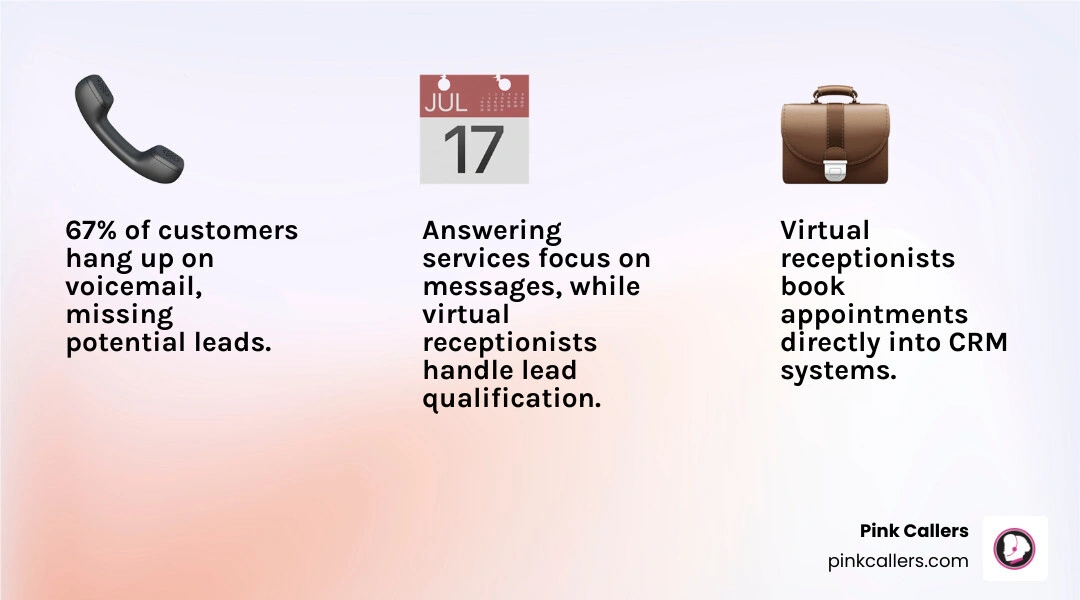
Think about the last time a potential customer called your business after hours. Did they get a real answer — or a voicemail? Research shows that more than two-thirds of customers will simply hang up when they can't reach a live person. And 34% of those callers will never call back.
For trade businesses, every missed call is a missed job. In April 2026, the stakes are higher than ever — customers expect immediate, helpful responses, and the tools available to deliver that experience have evolved well beyond a simple message-taking service.
Answering services and virtual receptionists are often lumped together, but they serve very different purposes. Understanding that gap is the first step toward building a customer experience that actually wins business.
Defining the Virtual Receptionist vs Answering Service Difference
When we talk about the virtual receptionist vs answering service difference, we are really talking about the depth of the relationship between the service provider and your business. In the home services industry of 2026, the distinction is no longer just "who answers the phone," but "what can they actually do for the customer?"
A traditional answering service is essentially a safety net. It exists to prevent the phone from ringing into an empty void or a generic voicemail box. A virtual receptionist, on the other hand, is an extension of your office. They don’t just take a name and number; they take ownership of the customer’s problem.
Imagine a homeowner in Nashville or Charlotte with a burst pipe at 2:00 AM. If they call an answering service, they might hear, "We've taken your message and someone will call you in the morning." If they reach a virtual receptionist, they hear, "I can see our emergency plumber has an opening at 4:00 AM; shall I book that for you now?" That is the fundamental how does a virtual receptionist differ from an answering service in action.
Core Functions of a Traditional Answering Service
Traditional answering services have been around for decades. Their primary goal is message relay. They are often staffed by shared agents who may be answering calls for a doctor’s office one minute and a funeral home the next. Because they handle such a high volume of diverse calls, their ability to dive deep into your specific business processes is limited.
Key characteristics include:
- Basic Scripting: They follow a rigid "if/then" script to gather contact information.
- After-Hours Focus: Historically used to cover the phones when the main office is closed.
- Message Passing: They act as a middleman, sending you an email or text with the caller’s details.
- Bilingual Support: Many offer basic Spanish-speaking agents to help with broader demographics.
While this model is better than a busy signal, it often leaves the heavy lifting to you. You still have to call the lead back, qualify them, and find a spot on the calendar. To learn more about how these basic setups function, you can read about how a professional answering service can help your business.
The Expanded Role of a Virtual Receptionist
A virtual receptionist takes the "answering" part for granted and moves straight into "reception." In 2026, a professional virtual receptionist is trained specifically on your brand, your service area, and your software. They don’t just answer; they execute.
At Pink Callers, we see our Virtual CSR Services as a way to clear the "busy work" off your plate. Their role includes:
- Lead Qualification: Asking the right questions to ensure the job is a fit for your technicians.
- Appointment Scheduling: Having direct access to your calendar to book jobs in real-time.
- Administrative Tasks: Managing emails, following up on quotes, and updating customer records.
- Outbound Follow-ups: Calling back "stale" leads or confirming tomorrow’s appointments to reduce no-shows.
By the time you see the notification, the job is already booked, the customer is happy, and your technician has all the info they need.
Advanced Capabilities and Integration Potential
One of the biggest shifts in the virtual receptionist vs answering service difference over the last few years has been the level of technical integration. Gone are the days of manual data entry. If your office support isn't talking to your CRM, you're losing money through "data leaks."
Modern virtual receptionists are tech-savvy partners. They don't just "take a message"; they live inside your software. This ensures that every interaction is logged accurately and that your dispatchers have a clear view of the day's schedule without having to cross-reference multiple emails or spreadsheets.
Why Integration Matters for the Virtual Receptionist vs Answering Service Difference
For contractors in Fort Worth or Jacksonville, time is the most valuable resource. When a virtual receptionist integrates with your CRM—like our ServiceTitan-certified team does—the workflow efficiency skyrockets.
- Automated Booking: The moment a call ends, the appointment is already on your board. No delay, no double-booking.
- Customer History: When a repeat customer calls, the virtual receptionist can see their history, their equipment details, and any past issues. This makes the customer feel valued, not like a stranger.
- Data Accuracy: Manual message relay is prone to typos. Direct CRM entry ensures the phone number, address, and job notes are exactly what the customer said.
- Lead Management: You can track exactly where your leads are coming from, helping you understand which marketing efforts are actually ringing the bell.
This level of support is why many choose a Fractional CSR model. It allows you to have a high-level professional managing your backend without the overhead of a full-time in-house employee. If you've ever wondered why hire a virtual assistant, the answer is almost always "to get your time back."
Personalization and Brand Perception
Your brand isn't just your logo on a truck; it’s the voice that answers the phone. Statistics tell us that 60% of customers will share a bad service experience with others, and they’ll do it three times more often than they share a good one. Conversely, 93% of customers are likely to make repeat purchases with companies that offer excellent customer service.
A traditional answering service often feels... well, like an answering service. The tone can be clinical or rushed. A virtual receptionist, however, provides a personalized touch. They use your custom greetings, understand your specific "way of doing things," and can handle complex questions about your services.
For a specialized trade, this is vital. A Plumbing Virtual Receptionist needs to know the difference between a leaky faucet and a main line backup. When the person on the phone sounds like they actually work for your company, it builds immediate trust and brand loyalty.
Choosing the Right Model for Your Trade Business
Deciding between these two services depends on your current stage of growth. If you are a solo operator in San Diego just looking to make sure you don't miss calls while you're under a sink, a basic service might be a starting point. But if you are looking to scale, the virtual receptionist vs answering service difference becomes a question of ROI.
An in-house receptionist can easily cost over $40,000 per year when you factor in salary, benefits, and taxes. A virtual solution can often provide the same level of professional coverage for a fraction of that cost, allowing you to reinvest those savings into your fleet or marketing.
High-Volume vs. Complex Inquiry Handling
Some businesses deal with "noise"—lots of calls that are just people looking for directions or checking hours. An answering service can handle that volume easily. However, trade businesses deal with "complexity." Every call is a potential multi-thousand-dollar job that requires technical screening.
Our HVAC Virtual Receptionist teams, for example, are trained to qualify leads. They can distinguish between a routine maintenance request and a "no heat" emergency. They can also monitor multiple channels—not just phone calls, but web chats and emails—to ensure no inquiry falls through the cracks.
For specialized industries like roofing, where the lead-to-sale cycle involves significant coordination, having a Roofing Virtual Receptionist who understands the urgency of a storm-damaged roof can be the difference between winning a contract and losing it to the guy who answered first. 78% of customers buy from the first company that responds.
Understanding the Virtual Receptionist vs Answering Service Difference in 24/7 Coverage
The "9 to 5" business day is a myth in the trades. In fact, more than 45% of booking requests for service industries often come in after-hours. If your phones go to voicemail at 5:01 PM, you are effectively closed for half the day.
While both services offer 24/7 availability, the quality of that coverage varies. A traditional service might just take a message on a holiday. A virtual receptionist provides 365-day operations, meaning they can dispatch an emergency tech on Christmas morning just as easily as on a Tuesday afternoon.
This "always-on" approach is critical for customer retention. An increase in customer retention by just 5% can lead to a company’s profits growing by 25% to 95% over time. When comparing a Fractional CSR vs Full-Time Virtual Receptionist Comparison, the 24/7 capability is often the deciding factor for contractors who want to dominate their local market.
The Impact of AI and Human Hybrid Solutions
As we move through 2026, the virtual receptionist vs answering service difference has been further refined by the introduction of Artificial Intelligence. At Pink Callers, we don't believe AI should replace humans; we believe it should empower them. Our hybrid model uses our proprietary voice AI, "pAIge," to handle the initial "first ring" and basic routing, while our ServiceTitan-certified human CSRs handle the complex, empathetic side of the conversation.
| Model | Speed | Empathy | Task Complexity | Scalability |
|---|---|---|---|---|
| AI Only | Instant | Low | Low-Medium | Infinite |
| Human Only | Variable | High | High | Limited by Staff |
| Hybrid (Pink Callers) | Instant | High | High | Highly Scalable |
This hybrid approach solves the "hold time" problem. AI can answer five calls at once, handle the basic intake, and then "warm transfer" the caller to a human expert if the situation requires a deeper touch. This ensures zero hold times and 100% accuracy. This is the future of Virtual CSR Services.
Frequently Asked Questions about Call Handling
Can an answering service book appointments directly into my CRM?
Typically, no. Most traditional answering services are not trained on specific software like ServiceTitan or Housecall Pro. They simply send you the information for you to enter later. A virtual receptionist, however, is trained to work directly within your CRM to book jobs in real-time.
Is a virtual receptionist better for lead qualification in the trades?
Absolutely. Because virtual receptionists are trained on your specific industry (HVAC, plumbing, electrical), they know which questions to ask to determine if a lead is high-value or an emergency. This saves your technicians from driving out to "tire-kicker" calls.
How does 24/7 coverage affect customer retention for contractors?
It’s massive. More than two-thirds of customers hang up if they don't reach a live person. By providing 24/7 live answering, you ensure that every time a customer reaches out, they are met with a professional voice. This builds trust and ensures they don't call the next contractor on the Google search results list.
Conclusion
The virtual receptionist vs answering service difference isn't just about semantics; it's about the growth trajectory of your business. If you want to move beyond just "taking messages" and start "taking over your market," you need a partner that understands the home services industry from the inside out.
At Pink Callers, we provide that bridge. Our U.S.-based, ServiceTitan-certified teams combine the best of human empathy with the efficiency of modern AI. Whether you are in Middleburg, Virginia, or serving customers across the country, we act as the professional voice of your brand 24/7/365.
Ready to stop missing opportunities and start scaling your trade business? Contact our team for professional call management and see how a hybrid virtual receptionist model can transform your bottom line.
Keep reading
More from the blog
How We Handle Multi-Trade Dispatching for HVAC and Plumbing Combos
Misrouting an ambiguous 'no hot water' call wastes highly skilled technicians' time. We break down the exact intake triage rules that successfully separate plumbing from HVAC tickets.
Read → September 14, 2026Outsourced Customer Service vs Hiring a Local Temp Agency
Losing a dispatcher right before the fall heating rush can overwhelm any contractor. Compare the operational impact of a specialized call center versus a local temp worker to protect your revenue.
Read → September 11, 2026Transitioning Phone Scripts for Northeast Fall Boiler Prep
The first freeze brings a sudden wave of urgent no-heat calls that can easily overwhelm untrained CSRs. Prepare your dispatch board by strategically updating your front-office triage process.
Read →