Blog · Archive
The Ultimate Guide to Managing HVAC and Plumbing Leads Without Going Crazy
Master lead management best practices for home service contractors. Boost HVAC & plumbing conversions with speed-to-lead, AI automation & qualification tips.

Why Lead Management Best Practices for Home Service Contractors Determine Whether Your Business Grows or Stalls
Lead management best practices for home service contractors come down to one core idea: every lead you miss is money you hand to a competitor.
Here's a quick breakdown of what actually moves the needle:
- Respond within 5 minutes — businesses that do are 100x more likely to convert the lead
- Centralize all leads — capture every call, form, text, and chat into one system
- Qualify fast — score leads by urgency, service type, and budget readiness
- Route smartly — send the right lead to the right team member automatically
- Nurture consistently — follow up with email, SMS, and retargeting until the job is booked
- Track what works — measure cost per booked job, not just cost per lead
Running an HVAC, plumbing, or electrical contracting business in 2026 means competing in a market that moves faster than ever. There are now over 278,000 new home service businesses that opened in the U.S. in 2023 alone — a 32% jump year over year. Meanwhile, 97% of home service customers start with a Google search, and 78% of them hire the first company that picks up the phone or responds to their message.
That's the problem most busy contractors face. Leads come in from a dozen different places — Google, referrals, your website, third-party platforms — and without a clear system, they fall through the cracks. A missed call here, a slow text reply there, and suddenly a $2,000 job walks straight to your competitor.
This guide breaks down exactly how to build a lead management system that captures every opportunity, responds fast, qualifies intelligently, and converts more jobs — without burning out your team.
The Core Stages of the Lead Management Process
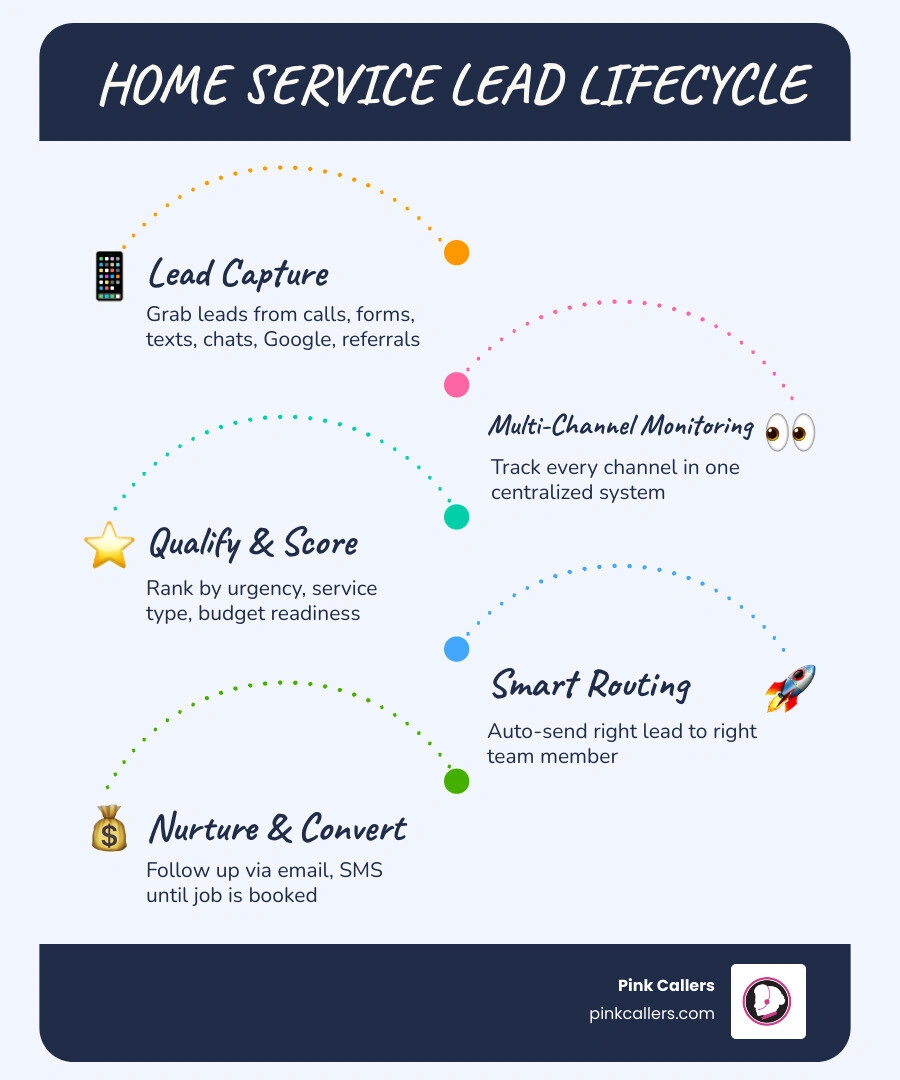
To master lead management, we have to view it as a relay race, not a single event. If the baton is dropped at any stage, the race is lost. For home service pros in cities like Fort Worth or Charlotte, the process moves through five critical phases.
1. Lead Capture and Multi-Channel Monitoring
Leads no longer just come from the Yellow Pages. Today, they flow in from Google Local Services Ads (LSAs), Facebook, website forms, live chat, and direct phone calls. 68% of customers now prefer texting or online chat over phone calls. If we aren't monitoring every channel 24/7, we are essentially leaving the front door of our business unlocked and unattended.
2. Lead Qualification and CRM Entry
Not every "ping" is a paycheck. We need to differentiate between a homeowner with a burst pipe in Nashville and someone looking for "DIY plumbing tips." This is where a Contractor Lead Tracking Complete Guide becomes essential. Every lead must be entered into a CRM immediately to ensure no data is lost.
3. Distribution and Routing
Once a lead is captured, it needs to go to the right person. An emergency repair lead should go to the on-call technician or dispatcher immediately, while a request for a kitchen remodel quote might go to a project estimator.
4. Nurturing the Sales Pipeline
Companies that excel at lead nurturing generate 50% more sales-ready leads at a 33% lower cost. If a customer isn't ready to book today, we don't ignore them. We use automated follow-ups to stay top-of-mind.

Lead Management Best Practices for Home Service Contractors
If we want to dominate our local market, whether that's in San Diego or Middleburg, VA, we have to commit to speed and consistency.
The 5-Minute Rule and Speed to Lead
The most important of all lead management best practices for home service contractors is the 5-minute rule. If we respond within five minutes, we are 100x more likely to convert that lead. After just one hour, the chances of qualifying that lead drop by 10x. In the home services industry, the first company to respond almost always wins the job.
24/7 Availability and the Human Touch
Home emergencies don't stick to a 9-to-5 schedule. A pipe can burst at 2 AM in Jacksonville just as easily as it can at 2 PM. Providing 24/7 coverage ensures we capture those high-urgency leads while our competitors are sleeping. However, automation alone isn't enough. While AI can handle the initial intake, customers still value the empathy and expertise of a human voice. Following a Contractor Lead Follow-Up Guide Home Services helps balance these automated responses with personal engagement.
Multi-Channel Follow-Up and SMS Engagement
Email is great, but SMS is king. With 78% of customers expecting a response within an hour, a quick text message can acknowledge the inquiry and set expectations while we prepare a formal quote.
| Feature | Emergency Service Protocol | Planned Service Protocol |
|---|---|---|
| Response Time Target | Under 5 Minutes | Under 30 Minutes |
| Primary Channel | Phone Call / Instant SMS | Email / Text / CRM Portal |
| Follow-Up Frequency | Immediate & Continuous | Daily for 3-5 days |
| Goal | Immediate Dispatch | Appointment Scheduling |
Implementing Lead Management Best Practices for Home Service Contractors in HVAC
HVAC contractors face unique challenges, specifically seasonal surges. During a heatwave in Austin or a cold snap in Virginia, lead volume can triple overnight.
- Maintenance Agreements: Use lead management to prioritize existing agreement holders.
- Replacement Leads: High-value system replacements require a different nurturing path than a simple filter change.
- Prioritization: Our HVAC Lead Management strategies focus on identifying "no-cooling" or "no-heat" emergencies to ensure they are handled first.
Applying Lead Management Best Practices for Home Service Contractors in Plumbing
Plumbing is often driven by high-urgency needs. A water heater that fails on a Friday night is a lead that won't wait until Monday.
- Immediate Dispatch: For leaks and clogs, the lead management system must trigger an immediate alert to the dispatch team.
- Service Context: Use our Contractor Lead Follow-Up techniques to ask the right questions upfront—like the location of the shut-off valve—to add value before the technician even arrives.
Qualifying and Distributing High-Value Opportunities
Not all leads are created equal. To grow efficiently, we must focus our best resources on the highest-value opportunities. This requires a robust Contractor Lead Qualification system.
Lead Scoring Indicators
We assign points to leads based on specific "high-value" indicators:
- Urgency: "My basement is flooding" scores higher than "I might want a new faucet next month."
- Service Context: Specific requests (e.g., "tankless water heater installation") indicate a more serious buyer than a general inquiry.
- Property Ownership: Confirming the lead is the homeowner ensures we aren't wasting time on tenants who can't authorize repairs.
- Budget Acknowledgment: Leads who ask about financing or provide a budget range are often further down the sales funnel.
Smart Routing and Alignment
By using smart routing, we ensure that a "system replacement" lead in Nashville goes to our top sales closer, while a "drain cleaning" lead goes to the service technician best suited for that task. This alignment between marketing (who brings the lead in) and sales (who closes the job) is the secret sauce of successful contractors.
Leveraging AI and Automation for Scalable Growth
As a business grows, manual lead management becomes impossible. This is where technology steps in to bridge the gap.
AI Chatbots and 24/7 Qualification
AI-powered assistants like "pAIge" can handle the initial intake 24/7. They ask the basic qualification questions—name, address, service needed, and urgency—and book the appointment directly into the CRM. This ensures the customer feels heard immediately, even if it's the middle of the night. Using CRM Management for Contractors allows this data to flow seamlessly into the rest of the business operations.
ServiceTitan and Housecall Pro Integration
For those of us using industry-standard tools, integration is non-negotiable. Whether you follow a Contractor Lead Follow-Up Housecall Pro Guide or utilize ServiceTitan, your lead management system must "talk" to your scheduling software. This prevents double-booking and ensures technicians have all the info they need before they pull into the driveway.
Essential Lead Management KPIs
To know if our efforts are paying off, we must track these metrics:
- Cost Per Lead (CPL): What are we paying to get the phone to ring?
- Lead-to-Appointment Rate: How many inquiries actually result in a technician on-site?
- Speed to Lead: What is our average response time across all channels?
- Cost Per Booked Job: This is the ultimate metric. A $50 lead that doesn't book is more expensive than a $150 lead that turns into a $5,000 HVAC install.
Frequently Asked Questions about Lead Management
What is the ideal response time for a new home service lead?
The gold standard is under 5 minutes. Research shows that businesses responding within this window are 100x more likely to convert the lead compared to those waiting 30 minutes. In a world of instant gratification, customers will move to the next name on the Google search list if they don't get an immediate response.
How do I calculate ROI from my lead management efforts?
The formula is simple: ROI = (Revenue - Marketing Cost) / Marketing Cost × 100. However, to get an accurate number, you need solid attribution. You must know which leads came from Google LSAs versus Facebook or referrals. To Maximize Business with CRM tools, ensure every job is tagged with its original lead source.
Can AI handle lead qualification without losing the personal touch?
Yes, through a hybrid model. AI is excellent for the "heavy lifting"—answering the call instantly, gathering basic details, and checking the schedule. However, it should always have a "human escalation" path. If a customer is distressed or has a complex problem, the AI should seamlessly hand the lead off to a trained human CSR. This provides 24/7 consistency without sacrificing the empathy that builds long-term trust.
Conclusion
Managing leads shouldn't feel like a game of Whac-A-Mole. By implementing lead management best practices for home service contractors, we move from a reactive state of "putting out fires" to a proactive state of "building a pipeline."
At Pink Callers, we understand that you didn't get into the HVAC or plumbing business to sit behind a computer screen all day managing spreadsheets. Our hybrid AI + human model is designed specifically for contractors in cities like Charlotte, Fort Worth, and Nashville. We provide 24/7 coverage, ServiceTitan certified expertise, and the scalability you need to grow your business without the overhead of a full-time office staff.
Ready to stop losing leads and start booking more jobs? Let us help you master your Contractor Lead Follow-Up and turn every inquiry into a loyal customer. Based in Middleburg, Virginia, we are the extension of your team that never sleeps, ensuring your business stays ahead of the competition every single day.
Keep reading
More from the blog
How We Handle Multi-Trade Dispatching for HVAC and Plumbing Combos
Misrouting an ambiguous 'no hot water' call wastes highly skilled technicians' time. We break down the exact intake triage rules that successfully separate plumbing from HVAC tickets.
Read → September 14, 2026Outsourced Customer Service vs Hiring a Local Temp Agency
Losing a dispatcher right before the fall heating rush can overwhelm any contractor. Compare the operational impact of a specialized call center versus a local temp worker to protect your revenue.
Read → September 11, 2026Transitioning Phone Scripts for Northeast Fall Boiler Prep
The first freeze brings a sudden wave of urgent no-heat calls that can easily overwhelm untrained CSRs. Prepare your dispatch board by strategically updating your front-office triage process.
Read →