Blog · Archive
How Contractor Customer Expectations Are Shifting Fast
Discover industry trends in home service customer experience: AI scheduling, on-demand booking, personalization & 2026 insights for contractors.

Why Industry Trends in Home Service Customer Experience Are Reshaping Contractor Success in 2026
The industry trends in home service customer experience are moving faster than most contractors realize — and the gap between businesses that adapt and those that don't is widening every year.
Here's a quick look at the key shifts defining home service CX in 2026:
- Digital-first booking — 94% of customers are more likely to book when an online option is available
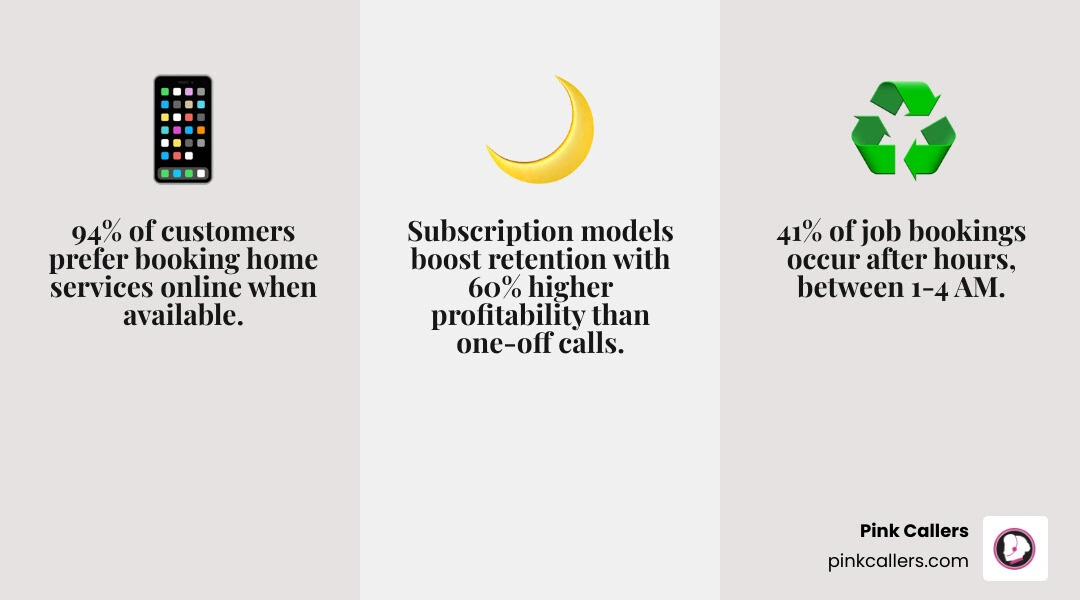
- Speed-to-lead — 41% of online job bookings happen after hours, including between 1–4 AM
- Hyper-personalization — 80% of customers expect service tailored to their history and preferences
- Reputation management — 36% of consumers check at least two review sites before choosing a provider
- AI and automation — Agentic AI now resolves 70%+ of routine customer queries without human involvement
- Subscription models — Recurring maintenance plans are replacing one-off service calls as the loyalty standard
- Sustainability expectations — Homeowners increasingly demand energy-efficient solutions with measurable cost savings
The U.S. home services market was valued at around $520 billion in 2023 and is projected to reach over $1 trillion by 2030. That growth isn't just about more homes needing service — it's being driven by a fundamental shift in what homeowners expect from the businesses they invite through their front doors.
Customers today compare their experience with a plumber or HVAC tech to ordering a ride or getting same-day delivery. They want real-time updates, instant confirmations, transparent pricing, and a friendly face. And when they don't get it? They leave a review, and they don't call back.
For contractors running lean operations, meeting these expectations without burning out your team — or blowing your budget on full-time staff — is the central challenge of 2026.
The 2026 Landscape: Industry Trends in Home Service Customer Experience
As we navigate through April 2026, the home services market has officially entered its "Trillion Dollar Era." This massive growth isn't just a fluke; it's driven by a combination of an aging U.S. housing stock—where over 40% of units were built before 1970—and a consumer base that has zero patience for "old school" service delays.
In cities like Nashville, Charlotte, and Jacksonville, the demand for reliable plumbing, HVAC, and electrical work is skyrocketing. However, homeowners aren't just looking for someone who can swing a wrench. They are looking for a professional partner who values their time. This is why Building a Customer Service Culture in Your Contracting Business has become the number one priority for thriving companies. If your team treats a service call as a transaction rather than an experience, you’re already behind the curve.
The Shift Toward Proactive Maintenance
One of the most significant industry trends in home service customer experience is the death of the "break-fix" model. Thanks to IoT (Internet of Things) sensors, we are moving into the age of predictive diagnostics. Imagine a water heater in a Middleburg, VA home that sends an alert to the contractor before it leaks. By 2026, these smart systems are reducing emergency breakdown calls by as much as 25%. Customers no longer want to wait for a disaster; they want the peace of mind that comes with proactive care.
Meeting the "On-Demand" Standard
The modern homeowner lives in a mobile-first world. Whether they are in San Diego or Fort Worth, they expect 24/7 availability. If a pipe bursts at 2 AM, they don't want to leave a voicemail and wait for a callback at 9 AM. They want to know help is on the way now. This is why Mastering After-Hours Service: A Guide for Home Service Businesses is no longer an "extra" service—it is a baseline requirement for staying competitive in 2026.
Digital-First Interactions and the Speed-to-Lead Revolution
The data is clear: 94% of customers are more likely to book a service if they can do it online. The days of playing phone tag are over. In the current market, "speed-to-lead" is the ultimate differentiator. If you don't respond to a digital inquiry within minutes, that customer has already moved on to the next contractor on Google.
Interestingly, 41% of online bookings now occur after traditional business hours. We see a massive spike in demand between 1 AM and 4 AM. Homeowners lying awake worrying about a noisy AC unit or a flickering light will book the first company that offers a confirmed slot through a digital portal. This is exactly Why Contractors Who Answer Their Own Phones Lose Leads—you simply cannot be awake and available 24/7 while also performing the actual trade work.
AI-Powered Scheduling and Industry Trends in Home Service Customer Experience
Artificial Intelligence has evolved from a buzzword into a vital team member. "Agentic AI" can now manage entire workflows—processing a repair request, checking your CRM for technician availability, and sending a calendar invite without a human ever touching a keyboard. This type of AI in Customer Service for Home Service Contractors ensures that your scheduling is tight, your routes are optimized, and your customers are never left hanging.
Frictionless Payments and Touchless Service
In 2026, the physical invoice is a relic of the past. Customers expect frictionless, touchless payments. Whether it’s through biometric security on a mobile app or a quick link sent via text, the goal is to make the "paying" part of the job as invisible as possible. Paperless quotes and digital invoices aren't just eco-friendly; they provide the transparency that modern consumers demand.
Hyper-Personalization and Subscription Loyalty Models
Homeowners in 2026 don't want to feel like "Job #402." They want you to know their home's history, their preferred filter sizes, and even their dog's name. This is where hyper-personalization comes in. By leveraging data analytics, businesses can offer tailored recommendations that feel helpful rather than pushy.
| Service Feature | One-Off Service Calls | Subscription-Based Models |
|---|---|---|
| Revenue Predictability | Volatile/Seasonal | Stable/Recurring |
| Customer Retention | Low (Price-driven) | High (Relationship-driven) |
| Maintenance Style | Reactive (Emergency) | Proactive (Preventative) |
| Customer Loyalty | Minimal | High Lifetime Value |
Focusing on Quality Control for Home Service allows you to use your CRM data to anticipate needs, making the customer feel like you are truly looking out for their home’s health.
Driving Profitability Through Retention
It is a well-known industry fact: businesses that focus on retention are 60% more profitable. Even a 5% increase in customer retention can drastically lower your acquisition costs. Furthermore, customers are willing to spend 17% more with a company that provides high-quality, consistent service. When you provide a subscription model, you aren't just selling a tune-up; you're selling a "moat" around your business that competitors can't easily cross.
Omnichannel Communication as Part of Industry Trends in Home Service Customer Experience
Whether a customer reaches out via Instagram, a website chatbot, or a traditional phone call, the experience must be seamless. They might start a conversation on a mobile app and want to finish it via SMS. This fluid transition is the hallmark of Exceeding Customer Expectations in the Digital Age. If you force a customer to repeat their problem three times to three different people, you've already lost the "experience" battle.
Transparency, Reputation, and the Trust Economy
Trust is the ultimate currency in 2026. With 36% of consumers looking at at least two different review sites before making a decision, your online reputation is your most valuable asset. Contractors who ignore their digital footprint are essentially invisible to the modern market. This is why Amplifying Your Business with Strategic Review Management is a core business strategy, not a side task for the weekend.
The Courtesy Factor in Modern Reviews
Here is a surprising statistic: in positive HVAC reviews, 41% of customers cited "courtesy and friendliness" as the highest-ranking factor—above technical skill or punctuality. In 2026, homeowners assume you know how to fix the furnace; what they are really grading you on is how you treated them and their home. Soft skills are no longer "soft"—they are the drivers of 5-star ratings. We've seen that Using Reviews to Grow Home Service Business starts with the very first "Hello" on the phone.
Real-Time Tracking and Technician Transparency
Safety and transparency go hand-in-hand. Modern customers expect an Uber-like experience: a text notification when the tech is 10 minutes away, a GPS map showing their location, and a bio/photo of the technician who will be entering their home. This level of transparency builds immediate trust and sets a professional tone before the technician even rings the doorbell.
Sustainability and the Rise of "Green ROI"
Sustainability has shifted from a "nice-to-have" to a core financial decision for homeowners. We call this "Green ROI." Customers in 2026 are looking for energy-efficient heat pumps, smart thermostats, and water conservation systems because they want to see lower utility bills.
Building Trust Through Industry Trends in Home Service Customer Experience
Homeowners are increasingly savvy about data. They want to know that the AI you use is ethical and that their data is private. Brands that can prove their environmental impact—showing exactly how much energy a new HVAC system saved a family—see a 30% increase in customer trust. It’s about providing transparent, measurable results.
Smart Home Integration
The "Smart Home" is no longer a futuristic concept; it is the standard. From zoning systems that learn a family's schedule to AR-assisted repairs where a senior technician can "see" through a junior tech's glasses to troubleshoot a complex electrical panel, technology is everywhere. Homeowners expect their service providers to be experts in these integrated systems.
Frequently Asked Questions about Home Service CX
How has the U.S. home services market changed by 2026?
The market has surpassed $1 trillion in valuation, driven by aging homes and a massive shift toward digital platforms. Convenience and "speed-to-lead" are now more important to consumers than the lowest price.
Why is online booking now a requirement for contractors?
Because 94% of customers prefer it. If you don't offer instant booking, especially for the 41% of people looking for help after hours, you are essentially handing your leads to the competition.
What role does AI play in modern customer service?
AI manages routine tasks like scheduling, job confirmations, and basic troubleshooting. This allows human staff to focus on complex customer issues, providing a "high-tech, high-touch" experience that builds long-term loyalty.
Conclusion
Navigating the industry trends in home service customer experience in 2026 requires a delicate balance of cutting-edge technology and old-fashioned human empathy. At Pink Callers, we’ve mastered this balance through our Hybrid AI and human CSR model. Our proprietary voice AI assistant, "pAIge," works alongside our ServiceTitan-certified professionals to ensure that your Nashville, San Diego, or Jacksonville business never misses a beat.
Whether you need 24/7 coverage, seamless CRM integration, or a scalable way to manage your leads, we provide the infrastructure to help you grow without the overhead of a full-time office staff. By staying ahead of these trends, you aren't just surviving the digital shift—you're leading it.
For more insights on keeping your operations sharp, check out Elevating Quality Control in Home Services: Your Blueprint for Excellence or find More info about plumbing customer service to see how we can support your specific trade.
Keep reading
More from the blog
How We Handle Multi-Trade Dispatching for HVAC and Plumbing Combos
Misrouting an ambiguous 'no hot water' call wastes highly skilled technicians' time. We break down the exact intake triage rules that successfully separate plumbing from HVAC tickets.
Read → September 14, 2026Outsourced Customer Service vs Hiring a Local Temp Agency
Losing a dispatcher right before the fall heating rush can overwhelm any contractor. Compare the operational impact of a specialized call center versus a local temp worker to protect your revenue.
Read → September 11, 2026Transitioning Phone Scripts for Northeast Fall Boiler Prep
The first freeze brings a sudden wave of urgent no-heat calls that can easily overwhelm untrained CSRs. Prepare your dispatch board by strategically updating your front-office triage process.
Read →