Blog · Archive
How to pick a CRM that won't leave your virtual receptionist hanging
Discover key features for choosing the right crm for virtual call handling. Boost productivity, scalability & AI-driven performance in remote teams!

Why Choosing the Right CRM for Virtual Call Handling Can Make or Break Your Operation
Choosing the right CRM for virtual call handling is one of the most important decisions a home service business can make in 2026. The global contact center market is on track to hit $496 billion by 2027 — and the businesses winning in that space aren't the ones with the most agents. They're the ones with the right systems behind those agents.
For HVAC, plumbing, and electrical contractors, the stakes are especially high. Missed calls mean missed jobs. Scattered customer data means slower service. And without a CRM built for virtual operations, your team is flying blind.
Here's a quick overview of what to look for when evaluating your options:
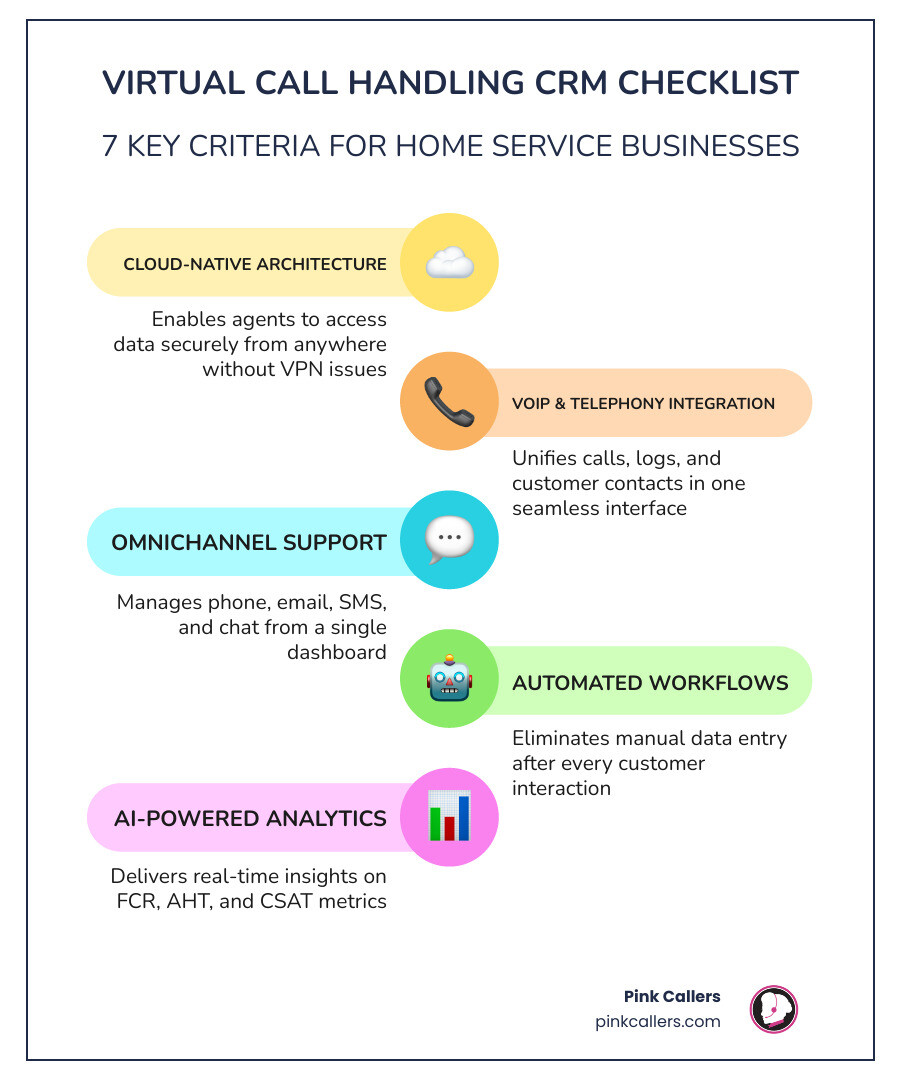
- Cloud-native architecture — so agents can work from anywhere without VPN headaches
- VoIP and telephony integration — calls, logs, and contacts all in one place
- Omnichannel support — phone, email, SMS, and chat handled from a single dashboard
- Automated workflows — no manual data entry after every call
- Real-time analytics — track First Call Resolution, Average Handle Time, and CSAT without digging through spreadsheets
- AI-powered features — call summaries, sentiment analysis, and live coaching built in
- Scalability — add seats and features as your team grows, without a full system overhaul
The right CRM doesn't just store contacts. It keeps your virtual team coordinated, your leads followed up, and your customers happy — whether your CSRs are working from an office or a home setup across three time zones.
What defines a CRM for virtual call handling?
When we talk about a CRM for virtual call handling, we are looking at a specialized digital ecosystem. Unlike a simple digital Rolodex, this software acts as the central nervous system for your remote operations. It uses cloud infrastructure to ensure that a dispatcher in Fort Worth and a virtual receptionist in Charlotte see the exact same data at the exact same time.
Customer Relationship Management in a virtual environment relies heavily on Voice over Internet Protocol (VoIP) technology. This allows the CRM to "talk" to the phone system. When a call comes in, the system identifies the number and instantly pulls up the customer’s history. This real-time syncing is what allows a distributed workforce to function as a unified team. For CRM Home Service Businesses, this means the person answering the phone knows exactly when the customer's last furnace tune-up was, even if they’ve never met in person.
Why virtual call center CRM software differs from traditional solutions
Traditional call center setups often rely on "on-premise" hardware—think big, dusty server closets and expensive desk phones hardwired into the wall. These systems are rigid and tie your staff to a physical location. If a storm hits Nashville and your office loses power, your business goes dark.
Virtual CRM solutions provide geographic flexibility and business continuity. Because the "brains" of the operation live in the cloud, your team can work from anywhere with a stable internet connection. According to our CRM Management Specialist Complete Guide, the scalability of these systems is a game-changer. You don't need to call a technician to install a new phone line; you simply click a button to add a new user. This eliminates heavy maintenance requirements and allows your business to scale up during the busy summer cooling season and down during the milder months without wasted overhead.
Essential features for choosing the right crm for virtual call handling
Selecting the right platform requires looking beyond the marketing fluff. You need tools that actually help your agents perform.

- Unified Agent Desktop: Your team shouldn't have to toggle between fifteen tabs. A great CRM provides a single view of the customer.
- Omnichannel Support: Customers today expect to reach you via text, email, or chat as easily as a phone call. Your CRM should funnel all these into one queue.
- Call Recording: This is vital for quality assurance. Linking recordings directly to customer profiles helps in Mastering Your CRM for Home Service Pros by providing a training library of real-world interactions.
- Automated Workflows: The system should handle the boring stuff. If a call is missed, the CRM can automatically send a "Sorry we missed you" text.
- Lead Management: Every inquiry must be tracked. If a lead doesn't book immediately, the CRM should remind your team to follow up.
Telephony and VoIP integrations for choosing the right crm for virtual call handling
The "magic" happens through Computer Telephony Integration (CTI). This is the bridge that allows your CRM to control your phone system. Features like CTI dialers enable "click-to-call" functionality, saving agents seconds on every interaction—which adds up to hours over a month.
Advanced systems also use Interactive Voice Response (IVR) menus. A well-designed IVR can resolve simple needs (like checking an appointment time) without a live agent, which is up to 48x cheaper than a human interaction. We also see great success with skill-based routing, which ensures a high-priority plumbing leak goes to your most experienced dispatcher first. Optimizing Outgoing Communication with CRM ensures that your outbound follow-ups are just as professional and data-driven as your inbound handling.
AI-driven capabilities for choosing the right crm for virtual call handling
By 2026, AI is no longer a luxury; it’s a standard requirement. Agentic systems are expected to handle 20% of digital storefront interactions by 2028, and we are already seeing that shift in home services.
- Sentiment Analysis: The CRM can "listen" to a call and flag it if a customer sounds frustrated, allowing a manager to intervene.
- Call Summaries: Instead of an agent spending three minutes typing notes, AI generates a concise summary instantly.
- Real-time Coaching: AI can provide "assist cards" to agents, suggesting the best way to handle a specific technical question about an electrical panel.
- Automated Documentation: This reduces "After-Call Work" (ACW), keeping agents available for the next caller. This is a core part of a Contractor Lead Tracking Complete Guide.
Comparing virtual CRM solutions vs. traditional on-premise systems
The shift to virtual is driven by more than just convenience; it’s about the bottom line and security.
| Feature | Virtual (Cloud-Based) CRM | Traditional On-Premise CRM |
|---|---|---|
| Hardware Footprint | Zero (Web-based) | Servers, PBX boxes, wiring |
| Remote Access | Native (Anywhere) | Difficult (Requires VPN/Remote Desktop) |
| Deployment Speed | Days or Weeks | Months |
| Upfront Costs | Low (Subscription) | High (Capital Expense) |
| Security | Managed by Provider | Managed In-house |
| Redundancy | High (Multi-region) | Low (Single point of failure) |
As noted in our CRM Management Services Complete Guide, cloud-based systems offer superior data redundancy. If a server fails in one location, the system automatically switches to another, ensuring your virtual receptionist never leaves a customer hanging.
Scalability for small businesses and enterprises
One of the biggest mistakes we see is a small business choosing a "starter" CRM that they outgrow in six months. Choosing the right crm for virtual call handling means looking at modular features. You might start with just voice and lead tracking, but as you grow in San Diego or Jacksonville, you’ll want to add deep integration with tools like ServiceTitan.
Growth planning is essential. A scalable CRM allows you to Maximize Business with CRM by adding "seats" only when you need them. For an enterprise with multiple locations in Fort Worth and Nashville, the ability to customize workflows for different branches while keeping data in one central pot is invaluable.
Key metrics to track within your virtual call handling CRM
You can't manage what you don't measure. A robust CRM provides a performance analytics dashboard that gives you the "pulse" of your business in real time.
- First Call Resolution (FCR): Target 70-80%+. This measures how often a customer's issue is fixed on the very first call.
- Average Handle Time (AHT): The industry benchmark is around 6 minutes. If your AHT is too high, your agents might need better scripts or faster software.
- Customer Satisfaction (CSAT): Target 75-85%+. This is the gold standard of how your customers feel about the service.
- Service Level: A common goal is 80% of calls answered within 20 seconds.
- Agent Productivity: Track how much time agents spend "active" versus "waiting."
To Get the Most from Your CRM 2, you must use these metrics to coach your team. Our Slugbest CRM Management Services Guide emphasizes that data is only useful if it leads to action.
Avoiding common implementation pitfalls
Even the best software fails if implemented poorly. One major hurdle is "Data Silos"—where your sales team uses one system and your service team uses another. This leads to integration gaps that frustrate customers.
Another pitfall is neglecting CRM Cleanup Services. If your database is full of duplicate contacts and "test" entries, your virtual agents will struggle to find the right info. Training is also a frequent roadblock; if the interface is too complex, your turnover rate (which can reach 30-45% in this industry) will skyrocket. Ensure your CRM has a mobile-friendly version for your techs in the field and meets all modern compliance standards for data privacy.
Frequently Asked Questions about virtual call handling
How does a virtual CRM improve agent productivity?
A virtual CRM creates a "unified desktop," meaning the agent has everything they need—customer history, scripts, and scheduling tools—in one window. Task automation handles the repetitive data entry, and contextual data ensures the agent doesn't have to ask the customer to repeat their address or problem. This is a key part of CRM Management for Contractors.
What is the difference between a CRM and a virtual call center platform?
Think of the CRM as the "brain" (the memory and relationship data) and the call center platform as the "mouth and ears" (the actual phone lines and routing). In 2026, the best solutions are integrated ecosystems where these two functions are seamlessly blended into one interface.
How do AI features enhance remote call center performance?
AI provides real-time assistance, like a digital "co-pilot" for the agent. It can track sentiment to warn a supervisor of a heated call and handle post-call work like writing summaries and scheduling follow-up tasks. This allows the human agent to focus on empathy and complex problem-solving.
Conclusion
Choosing the right crm for virtual call handling doesn't have to be overwhelming. By focusing on cloud-native tools, deep telephony integration, and AI capabilities, you can build a system that supports your team instead of slowing them down.
At Pink Callers, we specialize in this exact intersection of technology and human expertise. We provide CRM Management Services specifically designed for the home service industry. Our hybrid AI model, featuring our voice assistant "pAIge" alongside ServiceTitan-certified human CSRs, ensures your business has 24/7 coverage and professional Software Integrations that keep your schedule full. Whether you are in Charlotte, Middleburg, or anywhere across the U.S., we help you pick the right tools and provide the right people to use them, so you never leave a customer hanging.
Keep reading
More from the blog
How We Handle Multi-Trade Dispatching for HVAC and Plumbing Combos
Misrouting an ambiguous 'no hot water' call wastes highly skilled technicians' time. We break down the exact intake triage rules that successfully separate plumbing from HVAC tickets.
Read → September 14, 2026Outsourced Customer Service vs Hiring a Local Temp Agency
Losing a dispatcher right before the fall heating rush can overwhelm any contractor. Compare the operational impact of a specialized call center versus a local temp worker to protect your revenue.
Read → September 11, 2026Transitioning Phone Scripts for Northeast Fall Boiler Prep
The first freeze brings a sudden wave of urgent no-heat calls that can easily overwhelm untrained CSRs. Prepare your dispatch board by strategically updating your front-office triage process.
Read →